Create

Sign in to ReadmeX

or

How we handle your data: Privacy Policy

ReadmeX

Your AI reading companion

What would you like to catch up on?

Pick a briefing, or ask your own question.

Your community and people briefings stay personal to you.

Bytedance

AI overview

Sign in and the AI will write an overview from our coverage.

Headlines · 284

  1. Personal AI Agents Enter E-Commerce as 150-Plus Apps Resist Doubao

    36Kr Artificial Intelligence reports that Alibaba launched the Qwen Go personal assistant on October 13 with shopping price protection, price comparison and other consumer services, then released Qwen Office Commerce Edition on October 14 for cross-platform merchant dashboards, trend analysis, creative generation and ROI optimization. On the same day, Doubao Phone Assistant said more than 150 applications, including Taobao, Alipay, Meituan, Pinduoduo and WeChat, had explicitly refused AI screen automation under its SAEP protocol. The report says these platforms are resisting unauthorized automation by external assistants, not AI itself, as such assistants could alter product ranking and traffic distribution outside their apps.

    36氪 人工智能 · 🔥 0
  2. Doubao Phone Assistant restricts its agent from operating financial apps

    Doubao Phone Assistant updated its official list of apps that its agent will not operate, adding a proactive restriction on financial applications spanning banking, trust services, payments, internet finance and credit, IT之家 reported on October 21. The update follows the September 14 launch of the consumer version and the accompanying Screen Automation Execution Protocol (SAEP), a disclosure mechanism for cross-app GUI agent operations; the 30-day public notice period ended October 14, when Doubao said it would gradually open screen-automation permissions for third-party apps. Doubao said that previously published refusal lists already name financial institutions including ICBC, China Merchants Bank and Chongqing Rural Commercial Bank, and that developers can still declare refusal at any time, with feedback promised within three working days.

    IT之家 AI · 🔥 0
  3. Doubao embeds Douyin livestream rooms in product recommendations with in-app checkout

    According to testing by the outlet 字母榜, relayed by 36Kr, Doubao's app now surfaces Douyin livestream rooms inside its chat product recommendations, letting users watch, claim coupons and place orders without leaving Doubao for the Douyin app. The outlet also found Doubao proactively pushing Douyin Mall discount coupons in the main chat — including a 7000-yuan-off-900 coupon — even when the user had not mentioned shopping, with the assistant citing colder weather, a break from the chatbot's usual question-and-answer pattern. Some users reportedly saw proactive cards describing e-commerce abilities such as ordering an iPhone 18 Pro, tracking deliveries and arranging returns, and Doubao had already embedded Douyin Mall product recommendations and some Douyin local-services merchants, plus a Double 11 shopping prompt entry. ByteDance has not confirmed the observations.

    36氪 人工智能 · 🔥 0
  4. Analysis: AI agent phones accelerate, with Nubia NaviX Ultra running Doubao assistant

    A 硅谷101 feature republished by 钛媒体 argues that AI agent phones are accelerating in 2026, citing Qualcomm CEO Cristiano Amon's remark that "2026 is the year of the Agent" alongside recent launches such as StepFun's STEPX Neo, Honor's Robot Phone and Nubia's NaviX Ultra. Nubia's NaviX Ultra, which runs a new version of the Doubao phone assistant on a Qualcomm Snapdragon flagship platform, is described as officially certified as the "world's first AI agent phone," a vendor claim the article does not independently verify. In the writer's hands-on use, the assistant can read the screen, open other apps and run tasks on a background virtual display, although smooth support is currently concentrated on system apps and ByteDance-family apps.

    钛媒体 · 🔥 0
  5. Alibaba buys GPUs, JD buys wrenches: a commentary contrasts two AI strategies

    A 钛媒体 commentary by 文武赵 contrasts how Alibaba and JD.com are spending on AI. Alibaba's three-year 380 billion yuan cloud and AI infrastructure plan is just over half spent, and CEO Eddie Wu said at a May earnings call that actual investment will far exceed that figure. Quarterly capital expenditure has reached 67.7 billion yuan, and the AI Cloud and Compute Services segment posted 48.4 billion yuan in revenue for the quarter ended June 2026, up 45% year on year, with AI-related product revenue of 12.4 billion yuan. JD, by contrast, announced plans to put 10 billion yuan of resources into robotics by 2028, build 80 RoboBases over five years, organize 600,000 people to collect 10 million hours of real-world scene data and train 700,000 couriers in robot repair—a route the author calls JD's self-styled “physical world operator” model. The piece says three tests would determine whether that physical-operations capability is a new business: charging external customers by usage, earning margins above logistics, and selling data separately; failing all three would leave it an automated retail and logistics company.

    钛媒体 · 🔥 0
  6. ByteDance's AI companion app Maoxiang tops China iOS generative AI revenue list

    A Huxiu AI reprint of an analysis originally published by 人人都是产品经理, citing Sensor Tower's 2026 global AI app trends report, says ByteDance's AI companion app Maoxiang took the revenue top spot on China's iOS generative AI list in the first quarter of 2026, while Doubao took both the download and active-user titles, with Jimeng AI second and Kimi seventh. Sensor Tower figures put Maoxiang's cumulative iOS in-app purchase revenue above US$22 million since its March 2024 launch, a figure that excludes Android and advertising revenue. The article also cites third-party estimates showing Maoxiang's August 2026 iOS revenue per monthly active user at roughly five times Jimeng AI's, and contrasts its chat-based monetization with Character.AI, which it reports filed for Chapter 11 bankruptcy protection in October 2026 despite roughly 12 million users.

    虎嗅 AI · 🔥 0
  7. China's Big Tech races to hire Forward Deployed Engineers, with pay packages topping 1 million yuan

    A China Entrepreneur feature, republished by Huxiu AI and 36Kr, reports that ByteDance, Alibaba, Tencent and Kingsoft have spent the past half year urgently recruiting Forward Deployed Engineers (FDEs), a role it says Palantir popularized around on-site delivery that embeds standardized products into customer systems. Citing listings on BOSS Zhipin and Liepin, the report says Doubao posted an FDE package of 1.05 million yuan a year, Alibaba Cloud's large-model FDE role pays 20,000–55,000 yuan a month over 16 months, and Moonshot AI's Kimi listed a 1.09 million yuan annual package; a person close to ByteDance said some ByteDance FDEs placed at client sites earn up to 10,000 yuan a day, a claim not confirmed by the company. The article also relays industry skepticism, with investors and practitioners saying much FDE work amounts to training, that Chinese AI-to-B delivery remains project-based, and that one investor estimated OpenAI's FDE team at roughly 50 people by the end of 2025 while Chinese vendors build delivery teams hundreds strong.

    虎嗅 AI · 🔥 0
  8. Alibaba's Qianwen Office launches e-commerce edition as Doubao joins Double 11 shopping

    Ahead of China's Double 11 shopping festival, Alibaba's Qianwen Office released an e-commerce edition agent, pitched as an independent third party serving merchants on any platform; switching to an "e-commerce operations" mode inside Qianwen Office gives four initial functions: a cross-platform operations dashboard, trend and selling-point analysis, batch generation of promotional material, and cross-platform ROI optimisation. Separately, Douyin E-commerce said on October 15 that it will distribute shopping coupons in batches through Doubao, Hongguo Short Drama and Toutiao during Double 11, extending promotions beyond the Douyin app, and Doubao added a dedicated "Double 11: ask Doubao" navigation bar with product comparison and budget-based picking. The account comes from a single authorised trend feature by Tingtong Tech published via TMTPost, so the product details and merchant uptake remain reported rather than independently confirmed.

    钛媒体 · 🔥 0
  9. AI celebrity concerts on Bilibili earn creators modest payouts

    Over the past month, Bilibili has been flooded with AI-generated "concerts" in which figures such as Jensen Huang, Elon Musk, Zhao Benshan and even Empress Dowager Cixi appear to sing and dance, mostly built on a Michael Jackson "Beat It" clip with the lead swapped out. The most popular, a Jensen Huang concert made by another uploader, drew nearly 6 million views. Uploader "胡萝卜须儿", who has about 260,000 followers, told 木禾商业财经 his 1.5-minute "元首演唱会" cost about 300 yuan in tokens, drew 3.3 million views, earned just over 1,000 yuan in traffic revenue share and added more than 6,000 followers. He said he works mainly in Bilibili's own Updream tool, relying on Alibaba's Qwen3 for character replacement and ByteDance's Seedance 2.0 for automatic storyboarding, with Suno for audio-visual sync; the same-length video once took at least a week and now takes a few hours, though Seedance 2.0 often fails at character replacement. The reports also cite Bilibili's quarterly results saying about 190 million users a month consume AI-related content, with time spent on such content up 72% year on year.

    虎嗅 AI · 🔥 0
  10. Doubao Work adds local Word editing and a traceable memory panel

    Doubao Work announced a set of feature updates on October 21, according to 36Kr. Its local Office editing now includes Word and can open local files directly, and a new traceable memory panel has been added. The same announcement says the cloud computer and browser, message queueing and complex-task division experiences were upgraded at the same time.

    36氪快讯 · 🔥 0
  11. Double 11 commentary: Chinese e-commerce giants fold AI into existing operations

    A commentary by 陆玖商业评论 republished by TMTPost (钛媒体) argues that during this year's Double 11, China's major e-commerce platforms no longer pitched AI as a standalone shopping entrance that would uproot search ads, bidding and traffic distribution, but instead put it to work inside existing business lines. It describes Taobao and Tmall using AI as a shopping-decision assistant that screens products, compares specs, summarizes reviews and sorts out discounts; JD.com concentrating on inventory, warehousing, delivery capacity and trade-in coordination; Douyin connecting interest-driven browsing to mall and search transactions; Pinduoduo helping factories forecast demand and plan production; and Xiaohongshu flagging spam and unnatural marketing content. The author attributes the shift to slowing growth, citing 4.3% year-on-year growth in national online goods retail for January–August 2026 without naming a statistical source, and sums up the change as platforms asking who can use AI well rather than who will disrupt whom.

    钛媒体 · 🔥 0
  12. ByteDance, Alibaba and Tencent Reportedly Ordered 3M+ Nvidia RTX PRO 5500 GPUs

    Reuters reported that ByteDance, Alibaba and Tencent ordered more than 3 million Nvidia RTX PRO 5500 graphics cards with a combined sticker price above $35 billion, mainly for AI inference. Citing sources familiar with the matter, Reuters said Nvidia could not guarantee full delivery and might provide partners with only 5% to 10% of their requested quantities. The order figures were not independently verified, and the three buyers did not respond to requests for comment.

    The Next Web · 🔥 0
  13. Review: Nubia NaviX Ultra's Doubao agent works inside ByteDance apps, fails outside

    A 少数派 Matrix reviewer spent 30 days with the Nubia NaviX Ultra — the second-generation Doubao AI phone, priced at 5,499 yuan after subsidy — and filed a largely negative report card. Inside ByteDance's own apps the Doubao assistant completed a Douyin Mall purchase end to end, searching for tissues, sorting by sales, filtering by price and handing over to fingerprint payment, and kept refreshing a novel's free-chapter status in the background in Fanqie Novel after the reviewer switched away. Outside that wall it broke down: asked to buy a movie ticket, it reported no available ticketing app; it could not operate JD.com; two of five parallel tasks were lost for unclear reasons; and stored preferences such as "no spicy food" were not reliably honoured a week later. The reviewer returned the device, arguing that ecosystem walls rather than model capability are what limit the agent.

    少数派 Matrix · 🔥 0
  14. Meituan's DeepSkill agent skill platform reports 370,000+ verified Skills

    Meituan's AI team has built DeepSkill, an AI agent skill platform that has indexed more than 370,000 Skill tools verified through real task runs, up from 130,000 in early September, 36Kr reported citing an exclusive from 读佳. Rather than browsing a directory, users tell their agent the full task and the platform decomposes the request to match candidate Skills, while also scanning and parsing each Skill's full contents to produce a report on capability boundaries, tools invoked and potential risks, including a data-security review of whether private material such as résumés is uploaded. A "reviewer" feedback loop lets users who actually ran a Skill confirm auto-compiled results, with ratings, real task cases and outcomes published publicly.

    36氪 人工智能 · 🔥 0
  15. ByteDance Seed reorganises into five units, adds safety and alignment department

    A Tech商业 report republished by 钛媒体, citing leaked internal emails and multiple reports, says ByteDance's Seed foundation-model team has completed a reorganisation under Wu Yonghui into five first-level departments: pretraining data, reinforcement learning, B-end/agentic post-training, C-end chat post-training, and safety and alignment. The new Seed Model-Alignment & Preparedness unit is led by Yan Lin and reports to Wu, with the former Responsible AI team and some Chat team members moving into it. The report also says evals lead Huang Wenhao has left and may start a company, and calls the lab China's first frontier AI lab with a standalone safety and alignment department; ByteDance has not publicly confirmed these details.

    钛媒体 · 🔥 0
  16. QuestMobile: Doubao tops AI native apps at 419M MAU; Tencent WorkBuddy leads office Agents

    QuestMobile published its Q3 2026 China AI application market report on October 20. As of September 2026, AI native apps reached 546 million monthly active users, up 82.1% year over year, with Doubao at 419 million, Qwen at 158 million and DeepSeek at 123 million; AI office MAU reached 142 million, up 50.6%, with Tencent WorkBuddy leading office Agents at 32.353 million, ahead of Baidu Dazi at 9.77 million and Qianwen Office at 7.905 million. Office Agent figures grew 518.4% year over year on the AI native app side and 512.2% on PC clients. 钛媒体 cited Analysys data putting September desktop visits at 85.34 million for WorkBuddy, 46.55 million for Qianwen Office and 30.39 million for Doubao Work, and noted that QuestMobile adds MAU across covered endpoints without deduplicating cross-device users, while Analysys counts desktop interactions. AIX财经 noted Qwen grew 5076.6% year over year and surpassed DeepSeek in scale, partly reflecting a low early baseline, while Qwen fell 5.4% quarter over quarter; DeepSeek fell 15.2% year over year.

    36氪 人工智能 · 🔥 0
  17. Agentic Cloud capex debate: Chinese cloud giants face ROIC test

    An analysis by 正见TrueView, republished by 36Kr and TMTPost, says Alibaba, Tencent and Baidu spent a combined 131.852 billion yuan on capital expenditure in Q2 2026, up 114% year on year. It argues that large-scale agent deployment is pushing cloud providers to rewrite stacks across chips, scheduling, storage, runtime and inference platforms, and that the three companies' combined free cash flow was a net outflow of 66.424 billion yuan in the quarter. It notes Alibaba Cloud CEO Wu Yongming's Sept. 22 announcement of a target for more than 20GW of datacenter capacity by 2032; Goldman Sachs estimated current capacity at about 5-6GW and projected related capex. Gartner separately warned that more than 40% of Agentic AI projects could be canceled by end-2027. The piece also cites Morgan Stanley's estimate that Chinese cloud providers' ROIC is in a 13%-20% range.

    36氪 人工智能 · 🔥 0
  18. Hands-on: Doubao-Seed-Evolving touts 1M context and leaner tool use

    A Juejin author published a hands-on test of Doubao-Seed-Evolving, a new Doubao Seed model that the post says extends the context window to 1M tokens, holds up better on longer multi-step tasks with complex dependencies, and uses fewer tokens and tool-call rounds than Doubao-Seed-2.1-pro in internal Coding Agent and LLM/VLM evaluations. The author wired the model into Claude Code through the Volcano Ark-compatible endpoint and used a single prompt to build an accounting skill with horoscope-based emotional feedback, then compared it with a Seed-2.1-pro version of the same task and found the Evolving build offered fuller page-based interaction. The post also notes that ledger and personal data can be stored in a local knowledge base for long-term records.

    掘金 · 人工智能 · 🔥 0
  19. Doubao absorbs four agent lines as ByteDance makes it the trunk

    A commentary published by TMTPost and written by Han Gong Guancha says ByteDance folded four scattered agent product lines into Doubao: the Feishu product team merged into Doubao on July 30, TRAE and Coze teams joined the Doubao system on August 24, and the personal-assistant product Xiaodou (internal codename Spell) entered internal testing in late September. It also says that from August 10, hotel orders completed through the Doubao entry point and Douyin Laike carried a combined fee of about 12% (an 11.4% software service fee plus 0.6% payment fee), versus 8% before. The author argues Alibaba's merger of QoderWork, MuleRun and Wukong into Qwen Office, and Tencent's move of QClaw into WorkBuddy, mirror ByteDance's consolidation; the organizational and fee details are cited from Caixin, 36Kr and National Business Daily, and ByteDance has not confirmed each item.

    钛媒体 · 🔥 0
  20. Doubao Phone Assistant: 150+ apps refuse screen-automation access

    A TMTPost Fintech Weekly roundup citing WEMONEY Research Room reports that Doubao Phone Assistant published the latest refusal list under its Screen Automation Statement Agreement, with more than 150 apps—including WeChat, Alipay, Meituan, Taobao, Kuaishou, China Merchants Bank, ICBC and Chongqing Rural Commercial Bank—explicitly declining to grant screen-automation permissions. Doubao said apps that have opted out will not have automated operations performed on them, and developers can withdraw authorization at any time. The report notes the refusals cover only AI screen-reading and simulated-click proxy actions; the apps can still be installed and opened manually by users.

    钛媒体 · 🔥 0
  21. Volcano Engine launches Seedance AI drama incentive, up to ¥200,000 per title

    IT之家 reported on October 19 that ByteDance's Volcano Engine launched a premium AI drama incentive program for AI-generated short dramas made with Seedance and released on the Hongguo short-drama app. Titles are ranked monthly by Hongguo popularity and must reach the month's AI drama top 50 and pass review: ranks 1–10 get up to ¥200,000 each, 11–20 get ¥100,000 and 21–50 get ¥50,000, with first-round applications due by January 31, 2027. Live-action dramas are excluded, all video content must be made with Seedance and more than 50% must use Seedance 2.5; awards are paid 50% in cash and 50% in vouchers redeemable for Volcano Ark API tokens, “Juchuang” usage rights or an AI comic-drama creation tool. Finalists must cooperate with generation-record verification and series checks, and failed verification or false claims void eligibility.

    IT之家 AI · 🔥 0
  22. Inside Ulanqab, the city that became an AI compute hub

    A Huashang Taolue feature republished by TMTPost traces how Ulanqab in Inner Mongolia, once known for potatoes, wind power and summer resorts, became a destination for AI data centers. It says that as of August 2026 the city had signed 109 compute projects with 172,000 P of capacity in operation, more than 95% of it intelligent compute, and over 500 billion yuan in total investment; DeepSeek plans to add 1GW of capacity there, part of it due to come online between late 2027 and early 2028. The piece attributes the draw for Huawei, Alibaba, Apple, ByteDance and Kuaishou to cheap green power at roughly 0.32 yuan per kWh, an average temperature of 4.3°C that allows a PUE below 1.2, and latency of under 5 milliseconds to Beijing.

    钛媒体 · 🔥 0
  23. Doubao PR head rebuts short-drama compute claim; says ByteDance video AI ~10%

    Chinese Online disclosed in an investor-relations activity record that 55% of domestic AI token consumption goes to short dramas and video generation, 24% to e-commerce advertising and only 15% to research and development, sparking discussion that over half of China's compute is spent making short dramas. Doubao public relations head Liu Xing responded on Weibo on October 19 that the compute figure is "not very reliable," saying only about 10% of ByteDance's total compute is used for training and inference of video-generation models. The figures come from a company disclosure and a company statement respectively, and the reports offer no third-party verification.

    IT之家 AI · 🔥 0
  24. CCTV: Doubao phone assistant blocked by 100+ apps shows AI rollout collisions

    cnBeta reports that CCTV has commented on more than 100 apps refusing to let Doubao Phone Assistant operate them, saying that AI's real-world rollout inevitably involves industry collisions. The report notes the apps remain usable on the Doubao phone; what they prohibit is the assistant operating them on the user's behalf. It also poses the question of why so many major apps jointly said no to such a convenient feature.

    cnBeta · 🔥 0
  25. Tencent tests Lüpao short-drama mini-program inside WeChat

    A commentary published by TMTPost (authored by Internet Jianghu) says Tencent launched a "Lüpao" short-drama mini-program inside the WeChat ecosystem in October 2026 — no standalone app, free to watch, with a "friends are watching" recommendation slot and incentives keyed to average watch time per user rather than views. The author frames the move as defending user time spent and as a real-world generation and monetization channel for Tencent's Hunyuan video model; the piece says an AI-generated drama, 《影后芽芽》, drew hundreds of millions of mini-program views and more than 2 million peak concurrent users within three days and earned millions of yuan in ad revenue, figures that appear only in this article and were not independently verified. It also says AI is used in more than 90% of short-drama production steps and cites Tencent capex of 52.78 billion yuan in Q2 2026, up 176% year on year, nearly all for AI compute and model iteration.

    钛媒体 · 🔥 0
  26. AI short dramas keep viewers on phones; China projector sales fall 26% in H1 2026

    An analysis republished by TMTPost, citing RUNTO Technology, says China's smart projector market sold 2.056 million units in the first half of 2026, down 26.0% year on year, with revenue down 27.0% to 3.34 billion yuan; Q2 shipments fell below one million units for the first time since 2022. The article partly blames a shift in viewing habits toward phones, citing a Nomura report that ByteDance's Hongguo Duanju short-drama app reaches 168 million daily active users, up 107% year on year — more than the combined DAU of iQiyi, Tencent Video, Youku and Mango TV — at 125 minutes of use per day. It adds that 430,000 micro-dramas launched in China in the first eight months of the year, 13 times last year's total and over 90% AI-generated, while projector maker XGIMI is pivoting with its MemoMind One AI display glasses.

    钛媒体 · 🔥 0
  27. Qualcomm CEO: AI firms want 100B-parameter models running on phones by 2028

    Speaking on Alex Heath's Sources podcast, recorded at Qualcomm's Snapdragon Summit 2026 in Maui and published on 8 October, CEO Cristiano Amon said some companies at the forefront of AI have told Qualcomm they need "the ability to run at least a hundred billion parameter model into a phone" by 2028, running "kind of all the time," though he would not name them. Amon said AI companies are starting to make phones, citing ByteDance's Doubao phone made by Nubia, and argued the phone holds a user's personal context, sensor data and the apps an agent must operate — with OpenClaw making the AI smartphone idea concrete. He also said memory prices have risen five to six times and the smartphone market is down 20% this year with mid-range and cheaper devices hit hardest, while discussing smart glasses, open-sourcing the Modular platform under Apache 2.0 for any chip, and 6G demos planned for the 2028 Los Angeles Olympics.

    The Next Web · 🔥 0
  28. Jimeng launches Short Drama Studio with three specialized AI models

    Jimeng AI launched Short Drama Studio on October 26, 2026, combining script development, asset management, storyboarding, video generation, and post-production in one project workspace. IT之家 reported that the studio includes the DreamScript script model, Anycook image model, and DreamShot storyboard model, with features including a 3D director stage, smart rehearsal, targeted shot regeneration, and shared assets. DoNews and hands-on reviews from 爱范儿, 极客公园, 品玩, and 量子位 also described the tool's project-level workflow and integration of some Xiaoyunque short-drama agent capabilities.

    AIbase AI新闻 · 🔥 0
  29. Bosses wish, staff resist: the FDE bottleneck for AI in Chinese enterprises

    A 36Kr deep dive examines the awkward position of forward deployed engineers (FDEs) in China — a role pioneered by Palantir and popularized by OpenAI and Anthropic, and now used by Tencent, ByteDance and Alibaba to push AI into enterprises. It describes bosses asking for agents that replace entire IT departments or monitor employee output, while frontline staff resist tools they fear will cost them their jobs. The report also says messy enterprise data and undocumented workflows push FDE projects back into data cleanup, and cites an Accenture survey of 163 Chinese companies in which only 9% reported gains in productivity, revenue or profit from AI.

    36氪 人工智能 · 🔥 0
  30. Meta Muse sparks personal-agent race; Kimi pulls back as giants weigh payoffs

    A 36Kr analysis says Meta Muse's personal-agent push has set off a wave in China: Alibaba is testing "Qwen Go!", Tencent is pushing LightVela and trialing Handy Bot, and ByteDance is adding automation to Doubao. By contrast, Moonshot's Kimi Claw, launched in February, is still in beta seven months on, with the author saying internal maintenance of the product has visibly slowed. The author attributes this to unit economics: a 199-yuan monthly consumer plan spreads to roughly 0.5 yuan per simple chat, but a complex agent task triggers many model calls, sandbox compute and long context, and per public information more than 70% of Kimi's revenue comes from token-billed business API usage. The piece argues the giants are instead banking on indirect returns — Meta on strong-intent ad targeting, Alibaba on GMV and take rates, Tencent on private-domain retention and payment flows, ByteDance on protecting its content and traffic entry — and that payment authorization is the endgame, noting Doubao's phone assistant was blocked by major apps when it tried GUI-based cross-app ordering and payment.

    36氪 人工智能 · 🔥 0

← PreviousNext →

Experience and discussion from the community

Share my Bytedance experienceAsk about Bytedance

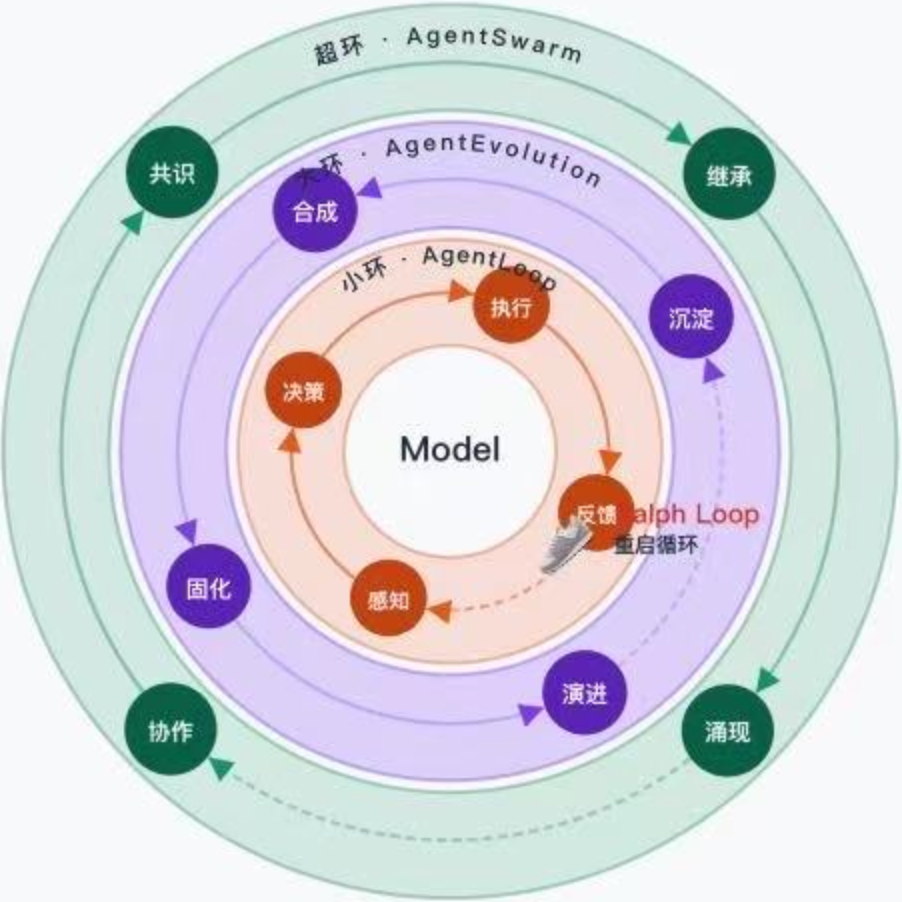
RSI: Evolution Goes Beyond Models

AI has already entered code writing, algorithm optimization, and model development. But after a task is completed, what remains may be reusable capability—or merely an answer and scattered logs. The difference becomes apparent only when a similar problem comes up again: can the system reuse what it learned, or must it pay the cost of exploration all over again? Recursive Self-Improvement (RSI) co…

RSISwarmEvoMapLoopEvolution

evomap.aihttps://evomap.ai