Speaking at Microsoft's Frontier Tour London event, CEO Satya Nadella described what he called a "frontier ecosystem" with three pillars, including recapturing individual empowerment so humans keep control even as AI takes over the dullest parts of work. He also raised a "reverse information paradox," arguing organizations must capture and keep locally the knowledge created by self-improving digital systems, owning knowledge generated through both human capital and "token capital." On trust, Nadella said scaling laws are producing more powerful but less trustworthy models and that companies should treat models as new forms of insiders under a zero-trust architecture. Microsoft paired the remarks with company research, reported by TechRadar without independent verification, finding 84% of UK business leaders versus 41% of employees believe the UK can become a world-leading AI economy within five years, while 57% of employees using AI at work fear it will reduce opportunities for young people and 35% fear for their own job security.
OpenAI and Google Cloud announced a partnership to distribute OpenAI frontier models and Codex agentic workflows through Model Garden, with purchases transacted through Google Cloud Marketplace. Google Cloud customers with existing spend commitments would be able to apply those commitments, while OpenAI models are also planned for Google Antigravity and Gemini Agent. OpenAI says general availability is planned for the coming weeks, while secondary reports describe a private preview for selected enterprise customers and disagree on the exact model lineup and affected products.
TechRepublic published a cheat sheet on Microsoft's Surface Laptop Ultra, a Windows laptop starting at $2,599.99 that pairs Nvidia's RTX Spark N1X Arm-based CPU with a Blackwell RTX GPU and up to 128GB of unified LPDDR5x memory, alongside a 15-inch mini-LED touchscreen. Microsoft is positioning the machine for developers, creators and professionals who want to run AI models locally rather than depend entirely on cloud services, although the article notes that Copilot+ features such as Recall, Click to Do and enhanced Windows Search were not available at launch, with Microsoft telling Ars Technica that full support is expected in late 2026 or early 2027. The piece also cites a local run of a large model on a 64GB configuration at 6.26 tokens per second and advises buyers to test their own models and software before assuming the laptop can replace cloud-based AI services.
NVIDIA announced the OpenShell Reference Architecture at GTC Berlin, a full-stack design for building, containing, observing and enforcing safe AI agents on enterprise and edge infrastructure, and said it is now available. It combines OpenShell secure runtime software with Vera Rubin systems for inference, Vera CPUs for agent harnesses and tool use, and BlueField-4 DPUs running NVIDIA Sentry for in-silicon enforcement, extending to RTX Spark, DGX Spark and DGX Station at the edge. NVIDIA says Vera Rubin NVL72 delivers 30x higher throughput per megawatt on agentic workloads and that Sentry stops an agent leaving its boundary in milliseconds while raising agent capacity by up to 20%; those figures are vendor claims not independently measured. Anthropic, AWS, Cisco, CrowdStrike, Dell, Google Cloud, HPE, IBM, Meta, Microsoft, OpenAI, Palo Alto Networks, SAP and ServiceNow are among companies NVIDIA lists as working with the architecture, and Sentry is planned for availability early next year, with DOCA libraries available now.
A 钛媒体 column by 穷奇观察, citing Bloomberg, says OpenAI is seeking at least $30 billion in funding at about a $1.4 trillion pre-money valuation in what it describes as an IPO bridge, with OpenAI declining to comment; the column flags conflicting report dates of Oct. 5 and Oct. 9. It tracks debt-market readings around AI infrastructure, including CoreWeave's 2032 notes trading near 76 cents on the dollar and its five-year CDS spread confirmed by LSEG above 1,000 basis points, and cites a Blue Owl private-credit fund redemption backlog, an unconfirmed TD Cowen report that banks paused lending to Oracle-related projects, and Nvidia's residual-value guarantee for an OpenAI-leased Ohio data center. Much of the piece is the author's own analysis, and it marks numerous figures as single-source and pending verification.
An opinion essay republished by Huxiu AI and originally published by the WeChat account 极智GeeTech argues that the real risk of the AI era is not replacement by machines but users voluntarily handing over the reins of thought. It describes a habitual loop of asking, waiting and copying answers, and says heavy reliance differs from gaming or short-video addiction because it wears away deep thinking, critical judgment and independent reasoning. The author notes that medicine does not yet classify "AI addiction" as a formal diagnosis, with academics preferring terms such as problematic AI use or AI over-dependence, and cites studies including an estimated 5–10% prevalence of problematic generative AI use, a JAMA Network Open survey of more than 20,000 U.S. adults, and Chinese surveys on students and workers.
President Donald Trump said in an Oct. 21 Truth Social post that data-center developers and AI hyperscalers should generate their own electricity, give or sell excess power to communities or the grid, and negotiate financial dividends with host communities. TechRepublic noted that the statement did not establish a nationwide payment requirement, while The Next Web reported that no payment amount, setter or enforcement mechanism was specified. TechSpot and TechRadar highlighted the uncertain reception of such incentives, noting that residents in Hazle, Pennsylvania, rejected a developer’s $10,000-per-household offer as a bribe.
Three previously closed US nuclear reactors are being restarted to meet the electricity demand and grid-connection bottlenecks created by AI data centers, according to reports from TechNews and TechRadar. The projects are expected to add 2.25 GW of baseload power in total, with Microsoft and Google signing agreements to buy electricity from the sites and the US Department of Energy supporting them with federal loans that TechRadar put at up to $4.4 billion. Holtec Palisades operates the Michigan Palisades plant, which began loading fuel in August 2026 and is targeted to restart in March 2027 at about 800 MW; Constellation Energy's Crane Clean Energy Center in Pennsylvania targets 2027 at 835 MW pending final Nuclear Regulatory Commission approval, and NextEra Energy's Duane Arnold center in Iowa is slated to supply 615 MW from 2029 under a deal with Google.
CAS, a division of the American Chemical Society, said its CAS Connections connector is now available inside Microsoft Copilot, giving Copilot users access to the CAS Content Collection and the science-focused agentic AI CAS Newton. CAS and Microsoft built the connector for pharmaceutical, life-sciences and chemical organizations, and the announcement describes uses in Word, Teams and PowerPoint, such as verifying CAS Registry Numbers and structures, checking reaction conditions and reagents, and tracing whether a substance appears in patent literature. CAS said it launched CAS Connections in June 2026 with several initial partners, and that the content can also be plugged into electronic lab notebooks, LIMS, research platforms and enterprise AI.
Skyfall AI, founded in San Francisco in April 2025 by Sam Pasupalak after Microsoft bought his earlier company Maluuba, has introduced SKY-001, which it calls the first "engineering world model" for CAD and BIM design. The model pairs a hierarchical component generator that plans a full design tree with a world model that predicts ordered drawing steps, trained — per the company — on over 200,000 parts and more than 600,000 construction cases. Skyfall's own benchmarks claim roughly 50x speedup and about 150x lower per-case cost than GPT-6 Astra on a 1,000-asset CAD set, with IoU 79.7% versus 79.1%, and about one second per floor plan on 1,000 BIM drawings, with IoU 43.6% versus 40.6%. MIT Technology Review China notes the test sets, criteria and LLM judges were all chosen by Skyfall and that little independent verification was available, and Skyfall itself says saved sketches and 3D geometry may not match, so outputs are not yet industrial-grade parametric CAD files.
Microsoft released a UK AI Diffusion Report based on surveys of 5,000 UK workers and 1,000 senior business decision-makers, showing a marked confidence gap between management and staff. 84% of senior decision-makers believe the UK will become a leading global AI economy within five years, versus 41% of workers; 90% of executives say their organization has a clear AI strategy, and among firms that have deployed AI, 84% of respondents report moderate or significant changes to how they work. Only 49% of workers expect AI to have a positive impact on UK society within five years, compared with 90% of executives, while 58% of workers and 62% of business leaders want the government to do more and both rank AI skills training as a top priority. Microsoft UK and Ireland CEO Darren Hardman said the UK ranks eighth globally in AI diffusion and second in the G7.
Researchers at UC Santa Barbara and Microsoft have proposed ScholarEvolve, a system that automates reading research papers, implementing their methods as code and evaluating the resulting changes to an AI agent's harness, the software layer that surrounds a model. It splits the harness into five modules—Tools, Context, Skills, Memory and Workflow—and uses a Research Agent and a Coding Agent to retrieve work from sources such as arXiv, group approaches by mechanism through topic modeling and test candidate combinations. In author-reported results, ScholarEvolve raised Qwen3.5-27B's completion rate on AppWorld Challenge from 49.6% to 63.6% without changing the model's parameters, and also reported gains for GPT-5.4-mini on AppWorld Challenge and τ²-Bench Telecom; the figures have not been independently verified.
Super Micro Computer sharply raised its preliminary forecasts for the first quarter of fiscal 2027 on Tuesday, October 20, citing continued strong AI datacenter demand, according to TechNews. The company now expects revenue of $18.5 billion to $19.5 billion, up from an earlier $14.5 billion to $15.5 billion range and above the $15.23 billion LSEG analyst consensus, while gross margin guidance rose to 12% to 12.5% from 10.4% to 10.8%. The stock closed the regular session at $32.47 and climbed 16.35% to $37.78 after hours; full quarterly results are scheduled for November 3.
Microsoft will retire eight OneDrive Copilot commands from the Windows 11 File Explorer right-click menu, according to TechRepublic and IT之家 AI. The commands include Summarize, Create FAQ, Compare Files, Ask a question, Explain image, Explain images, Compare images, and Extract text; users will instead reach Copilot through Ask Copilot, the File Explorer Home Copilot icon, or the OneDrive activity center. Rollout for eligible consumer and business users is expected to begin in mid-November 2026 and finish by early December, with availability varying by subscription and account type.
36Kr, citing a QbitAI article, reports that Meta paused a second restructuring round planned for November after internal AI deployment failed to produce the expected capabilities. The article says Meta halted a mouse-tracking project, reduced spending on Claude and allowed some employees transferred to AI engineering to return to their previous roles. It also says Microsoft found that broad internal AI adoption had not improved expected business outcomes, prompting tighter token budgets and lower spending estimates.
Real-estate services firm JLL said Tuesday that AI data-center construction projects — especially around Dallas/Fort Worth and the Washington, D.C. area — are creating new demand for warehouse space and pushing up rents in the third quarter, according to a 36Kr brief citing Sina Finance. The report notes that Alphabet, Microsoft, Meta and Amazon are spending heavily to compete for leadership in AI, and that running AI consumes large amounts of power for servers and chips that must be cooled to prevent overheating. No specific figures for the demand or rent increases were given.
Replit announced in its own social posts that it is opening a Japan office, saying the move brings enterprise app and agent building closer to the businesses shaping Japan's future. The company also outlined four Tokyo experiences on November 5–6, including a Replit and Microsoft workshop on turning enterprise data into a working business dashboard with AI, a Replit and Endeavor Japan workshop on building an app or agent, an Endeavor Japan panel and networking session on Japanese enterprises competing in the AI era, and a Japan opening night on November 6. Replit said space is limited and registration is subject to approval; both claims come from the company's posts.
Where’s Your Ed At argues that the concentrated AI trade is increasingly dependent on sustained capital spending, GPU deliveries and eventual data-center revenue. Citing internal Amazon documents and industry figures, the column raises concerns about inventory, installation delays, concentration risk and the financial burden facing major AI companies, though its bubble and channel-stuffing conclusions are interpretive.
AMD announced that its machine-learning FSR 4.1 upscaling now reaches Radeon RX 6000-series (RDNA 2) GPUs, Ryzen AI Max and Ryzen AI 9 APUs, and Ryzen Z2-series handhelds including the ROG Xbox Ally, with the update included in version 26.10.1 of its graphics driver as reported by TechSpot. The company says it retuned the neural network to run on INT8 shader hardware instead of the FP8 matrix hardware on Radeon RX 9000 cards, and built a handheld model less than half the size of the full one to fit tighter power budgets. AMD also confirmed FSR 4.1 is coming to Xbox Series X and Series S with no date given, that Vulkan API support will arrive in FSR SDK 2.4, and that future APUs will be added; it separately said the next Xbox, codenamed Project Helix, will use an FSR Diamond technology whose details it has not disclosed.
In early 2023, Blackstone CEO Steve Schwarzman met with the firm's lead AI investor Jas Khaira and other executives at its Park Avenue headquarters to debate lending billions of dollars to CoreWeave, a data center developer Blackstone had turned down months earlier, The Information reported, citing a person who attended the meeting. CoreWeave returned to the table after landing a multiyear, multibillion-dollar contract to sell cloud computing services to Microsoft, and was seeking $2.3 billion to buy Nvidia GPUs and secure a data center to house them. Several executives in the room had deep misgivings, according to the attendee, who said Schwarzman himself worried his investment team could be making a mistake; CoreWeave was then a six-year-old private firm that had generated only $16 million in revenue the previous year.
AuxoAI Inc., an enterprise engineering and consulting company that helps large businesses build and deploy AI systems, announced it has raised $20.7 million in a Series A round led by NTT Venture Capital. The round also drew participation from industry executives and strategic investors, including Norwest Venture Partners partner emeritus George Still Jr., ServiceNow president and chief product officer Amit Zavery, and Charlesbank Capital Partners managing director Giacomo Sonnino. AuxoAI says the funding will support global expansion, onsite consulting talent for enterprise AI transformation, proprietary technology and AI-native delivery, and growth of its partner ecosystem; the company says it has spent over three years working with Global 2000 enterprises and partners including Google, AWS, Snowflake, Databricks and Microsoft.
The Next Web reports that Microsoft is expanding Sovereign Cloud for governments and regulated businesses, with Data Guardian letting trusted European partners oversee Microsoft engineers’ remote access to customer production systems in the EU and EFTA. Microsoft says Foundry Local and GitHub Enterprise Local will become generally available at Ignite and can operate fully offline, while SQL Server on Azure Local is generally available and Microsoft 365 Local is in preview for approved customers.
CoreWeave's bond yields rose to about 15%, a level usually read as financial distress, and were cited as a trigger for last week's global tech selloff, with the stock plunging roughly 20%. JPMorgan said the business model remains sound, estimating a typical five-year take-or-pay contract carries an unlevered IRR near 15% against a 9-11% blended cost of capital. Barclays compared the episode to the 2023 Silicon Valley Bank panic, arguing that even a full CoreWeave spending halt would cost only about 4-5% of total AI capital expenditure, while Goldman Sachs on Monday upgraded the stock to Buy.
HuXiu AI summarizes the Brookings Institution's BPEA conference paper "Financing the AI Buildout" (Sept. 24-25, 2026), which estimates US AI infrastructure spending of about $10.3 trillion for 2025-2032, roughly 3.63% of GDP per year. Using Meta's Hyperion campus as a case study, the paper notes about $27 billion of the $30 billion project is debt-financed with a 1.12x debt-service coverage ratio, while Meta's own leverage is around 25% of book equity. Citing Moody's and The Wall Street Journal, the article says Microsoft, Alphabet, Amazon and Meta carry $2.4 trillion of off-balance-sheet obligations and that only about one-fifth of roughly $3 trillion in data-center obligations appear on the books. It also flags a mismatch between multi-decade infrastructure debt and quickly depreciating compute hardware.
TestingCatalog, citing Lumina, reports that Microsoft renamed 18 evaluation configs from GPT-5.6 Terra to GPT-6.1 Terra, a change that typically happens when a team is preparing to test a model. The report lines up with The Information's story, shared by Stephanie Palazzolo, who said this month should be busy for model releases including a new Anthropic model, Google's Gemini 4 Carbon and "a potential new Terra model from OpenAI." The new Terra is reported to beat GPT-6.1 Sol at a lower price, with Sol currently priced at $2 per million input tokens and $10 per million output tokens, though Palazzolo later said some launches could slip into November.
Diego Baca, Microsoft's vice president of Windows product design, said in an X discussion that AI tools have significantly sped up his design team's work and that some designers now take part directly in code fixes to improve polish, consistency and quality, adding that this is only the beginning; he also endorsed using AI agents to coordinate development tasks. According to cnBeta, IT之家 and AIbase, Baca did not name the tools used, the code changed or AI's share of the work. The same reports note that Microsoft is moving legacy interfaces to the WinUI 3 framework, that a rebuilt Windows search interface began testing with Insider users on October 7, 2026 and can execute natural-language commands such as switching to dark mode, and that Microsoft measured the new Run dialog at a median 94 ms versus 103 ms for the old version.
Trading in credit default swaps tied to AI-related corporate debt has jumped, with Morgan Stanley data showing weekly volumes for CDS linked to bonds from Oracle, SpaceX, Alphabet, Amazon, Meta, Broadcom and Nvidia topping $9 billion in September, up from under $2 billion in July, according to a 财联社 report syndicated by 虎嗅 AI and 36氪. Bloomberg data cited in the same report shows US corporate CDS index volumes year to date already exceed all of last year. Spreads have hit records: Meta's five-year CDS at 108 basis points and Nvidia-linked CDS at 101 basis points, while Oracle's stood at 322 basis points on Monday versus 144 at the start of the year and CoreWeave's five-year CDS at about 1,090 basis points. Investors cited in the report link the demand to a borrowing wave financing AI infrastructure and to doubts about whether companies can commercialize the spending.
IT之家 published a hands-on review of the Lenovo YOGA Pro 15 RTX Spark, saying the laptop uses NVIDIA's RTX Spark N1X superchip and that the 128GB unified-memory version costs 42,999 yuan, positioned as a Windows on ARM mobile AI workstation. It reports a CineBench 2026 multi-core score of 7118, roughly level with the Apple M5 Pro in a 14-inch MacBook Pro (7105), and says the NVIDIA App can allocate up to 96GB as dedicated GPU memory for running local models such as Qwen3.6-35B-A3B and Qwen3.8-27B. The piece also benchmarks games including Naraka: Bladepoint and Marvel Rivals, and notes Lenovo, ASUS, MSI, Dell and Microsoft have all launched RTX Spark laptops, some selling out shortly after listing.
The US government has blacklisted MiraclePlus, a Chinese venture firm founded by former Microsoft AI scientist Lu Qi, according to Bloomberg. Bloomberg reported that the blacklisting is tied to alleged links between the firm and a startup, identified as Zhisuan, that is accused of stealing technology from Alphabet's Google. Neither the US government nor the companies involved were cited as confirming the action in the supplied reports.
A new Morgan Stanley report calls Microsoft's Maia 300 the most important new development at the OCP summit, saying Microsoft is scaling toward a multi-gigawatt target and expects to begin formal Maia 300 deployment in 2027; it names Foxconn and Wiwynn as possible ODM partners and, based on trial production, points to ISU Petasys for accelerator PCBs, Auras for fans and Fositek and Staubli for quick-disconnect connectors. The report also says NVIDIA VR200 racks have started small-volume production, Groq 3 LPX racks are expected between late 2026 and early 2027, standalone Vera CPU racks in late Q1 to early Q2 2027, and AMD's largely unchanged Helios platform should ramp racks in Q1 2027. On components, Morgan Stanley says timing for PTFE, next-generation interconnect and ZQD liquid-cooling connectors on NVIDIA MGX remains unclear, with PTFE promising better signal transmission and less reliance on Q-glass but facing processing complexity, cost and yield/certification risks.
What problem it solves
Documents and office files often need to be transformed into a structured, text-friendly format before they can be processed by language models or text analysis tools. MarkItDown addresses this by preserving important document structures such as headings, lists, tables, and links during conversion to Markdown.
Key features
Broad format conversion — MarkItDown converts PDF, P…
What problem it solves
Editing text should not require extensive familiarity with terminal-based tools. The project aims to provide an accessible editor with a modern interface and input controls that are approachable for users who are largely unfamiliar with terminals.
Key features
Cross-platform installation — Installation options are documented for Windows, Linux, and macOS, including package-m…
What problem it solves
Generative AI systems and applications can contain security and safety weaknesses that require structured testing across models, endpoints, and complete applications. PyRIT addresses this with repeatable assessments, interactive exploration, and extensible workflows for red teaming these systems.
Key features
Repeatable command-line assessments — The scanner runs repeatable …
What problem it solves
Web automation and end-to-end testing often require coordinating browsers, interactions, assertions, and failure diagnostics. Playwright provides a unified API for driving Chromium, Firefox, and WebKit across tests, scripts, and AI-agent workflows.
Key features
End-to-end test runner — Playwright Test runs end-to-end tests across Chromium, Firefox, and WebKit with browser is…
What problem it solves
TypeScript adds optional types to JavaScript so tools can support large-scale JavaScript applications across browsers, hosts, and operating systems. It also compiles source into readable, standards-based JavaScript.
Key features
Optional types for JavaScript — TypeScript extends JavaScript with optional types, providing a typed language for application-scale development.
Sou…
What problem it solves
Go applications need a way to create, read, and modify spreadsheet documents produced by Microsoft Excel. They also need support for complex spreadsheet components and workflows involving large worksheet datasets.
Key features
Read and write spreadsheet files — Create and modify workbooks, set cell values, save files, and read cell values and worksheet rows through a Go API.…
What problem it solves
Knowledge workers need Claude to follow their organization’s tools, terminology, critical workflows, and preferred ways of working rather than provide only generic assistance. The repository provides customizable role-specific plugins that package this guidance with connectors, skills, commands, and sub-agents.
Key features
Role-specific plugin collection — The collection in…
What problem it solves
Products and agents need to communicate with users across multiple channels without rebuilding Inbox feeds, provider integrations, and channel webhooks. Novu addresses this with one API and a unified conversation model for product notifications and bidirectional agent conversations.
Key features
Unified multi-channel API — Send product notifications through Inbox/In-App, Pus…
What problem it solves
Applications need to run untrusted code while controlling its access to files, networks, user interfaces, and host capabilities. This requires an isolation approach that works across platforms, supports multiple containment mechanisms, and can be integrated without changing application architecture.
Key features
Cross-platform containment — MXC supports Windows, Linux, and m…
What problem it solves
Teams often have to move work into a separate AI tool, then repeatedly transfer context between that tool and the applications where collaboration happens. Switch addresses this by letting people and AI agents participate in the same conversations while keeping shared context with the work.
Key features
Shared rooms for people and agents — Each supported chat channel becomes…
What problem it solves
Speech recognition systems often lose global context when they divide continuous audio into short chunks, while speech generation must maintain speaker consistency, timing, and coherence across long recordings. The project addresses these needs with unified long-form ASR, streaming recognition, and text-to-speech models.
Key features
Long-form speech recognition — Process co…
What problem it solves
Company knowledge is distributed across business systems such as Slack, Google Drive, Jira, GitHub, and Microsoft 365. AI applications need a governed way to search this information, respect each user's access controls, and provide answers that can be traced to their sources.
Key features
Permission-aware enterprise search — Searches connected company systems while applying …
What problem it solves
Developers need support for their core edit-build-debug cycle. The project addresses this need with comprehensive code editing, navigation, and understanding support along with lightweight debugging, a rich extensibility model, and lightweight integration with existing tools.
Key features
Code editing and navigation — The editor provides comprehensive support for editing, na…
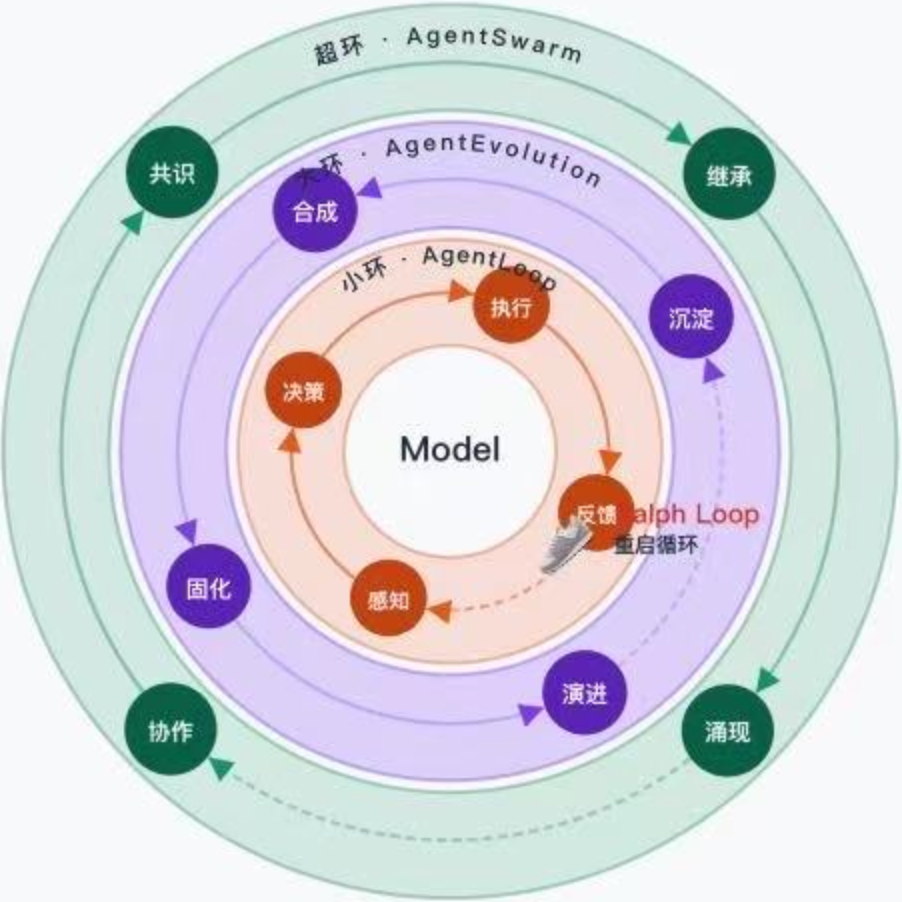
AI has already entered code writing, algorithm optimization, and model development. But after a task is completed, what remains may be reusable capability—or merely an answer and scattered logs. The difference becomes apparent only when a similar problem comes up again: can the system reuse what it learned, or must it pay the cost of exploration all over again?
Recursive Self-Improvement (RSI) co…
 markitdown• Pinned