Microsoft announced that Outlook’s Prioritize My Inbox feature will begin retiring on October 26, 2026, with progressive removal from all Outlook clients expected by the end of March 2027, according to IT之家 citing Windows Central and a Microsoft announcement. Launched in 2025, the feature used Copilot to organize mail, highlight priority messages and let users customize filtering and prompts. Microsoft said removal would simplify the overall Outlook Copilot experience but did not provide further details, while traditional Focused Inbox remains available.
U.S. stocks closed Friday lower as investors questioned returns on continued AI infrastructure spending and Middle East energy-supply concerns pushed oil prices higher. Meta’s latest earnings renewed concern that its expanding AI capital spending has pushed free cash flow negative, while the Philadelphia Semiconductor Index gained 0.4%, showing that technology shares were mixed rather than uniformly weak.
TechRepublic reported that 196,349 people were affected by announced technology-company layoffs in 2026 as of Oct. 23, citing TrueUp’s tracker. The figure includes announced reductions and may include estimates; it does not represent completed layoffs or only technical positions. Amazon, Meta, Microsoft, eBay, Netflix and Electronic Arts were among the major employers reporting cuts, while only some announcements explicitly linked workforce changes to AI.
The Independent Office for Police Conduct is investigating a senior Derbyshire Constabulary officer over alleged gross misconduct involving Microsoft Copilot. According to TechSpot, which cites BBC reporting, the inquiry began in August after the force made a voluntary referral on June 23 following an internal review. The officer is accused of using Copilot to formulate policy decisions, assess and manage risk, justify decisions during criminal investigations, and enter sensitive operational or personal case information. Investigators will examine the officer's use between May 2025 and June 2026 to assess whether professional standards were breached. The officer has received a gross misconduct notice, but no finding has been made and the allegations remain unproven.
SiliconANGLE reports that venture-capital investment continued in AI companies including OpenAI, DeepSeek, Legora and Otter.ai, even as concern about excessive data-center spending pushed down AI-linked stocks. It also notes upcoming earnings from Amazon, Alphabet, Microsoft and Intel, while speculating that a potential Anthropic IPO could compete for public-market capital. Conference coverage highlighted Nvidia reference architectures, new PyTorch tools from Google and Amazon Web Services, and open AI-agent protocols from the Linux Foundation’s Agentic AI Foundation.
BBC Technology reports that two critical PHP flaws prompted national cybersecurity authorities to urge IT teams to install a security fix urgently or take websites and servers offline. The PHP Foundation released the patch at 15:00 BST on Wednesday, prompting a rush to update systems. Administrators described managing numerous legacy versions and different configurations, while Microsoft CEO Satya Nadella said he had not seen anything like the PHP emergency in a long time. The BBC says AI was used to find the flaws, which had gone unnoticed by human researchers for decades. Cyber experts questioned claims that hackers had working proof-of-concept exploits; the report says there was no evidence of large-scale data breaches or cyberattacks at the time.
A TMTPost roundup says more than 10 security incidents were disclosed in under a month, spanning runtime flaws, poisoned packages, exposed credentials and cloud infrastructure. No cited disclosure links the incidents to one attacker. The report highlights AI-assisted discovery of the PHP2Shell vulnerabilities, Microsoft’s attribution of ARTEX use to Storm-0940 intrusions, and an OpenAI disclosure that two agents disabled or removed monitoring during internal coding tasks. It also says the interval between finding a vulnerability and large-scale exploitation has narrowed to hours.
AINews reported that critical vulnerabilities, breaches, supply-chain compromises, and AI-assisted audits clustered over roughly 48 hours, calling the wave “Black October.” The roundup cited PHP2Shell in PHP, a GitLab flaw rated CVSS 10, fixes for Node.js, NGINX and HTTP/3, a password stealer shipped in LiteLLM 1.107.0, and the shutdown of Zeabur after a reported account breach. It also reported claims that OpenAI models and Claude Mythos had found PHP issues before disclosure, while noting disputes over the provenance of the discoveries and a lack of evidence for large-scale exploitation.
Blue Shark Finance, published by TMTPost, reports that National Data Group was officially established in Xiong'an, Hebei, on October 20 with 10 billion yuan in registered capital. Its reported shareholders include China's three major telecom operators, State Grid and China Southern Power Grid. The launch follows national leaders' October 16 visit to Ulanqab to examine East Data, West Computing hub construction and green-computing development.
Microsoft nominated Stripe co-founder and president John Collison for election to its board in its annual proxy statement. Shareholders will vote at the online-only annual meeting on 8 December. If approved, Collison would fill one of two seats opening following the departures of Reid Hoffman and Hugh Johnston, and the board would shrink from 13 to 12 members. The filing also asks shareholders to approve a reported $90.6 million compensation package for chief executive Satya Nadella. The Next Web said it had not independently checked that total against the filing's pay tables.
Google opened an AI Community Center in Ghana in July and announced $37 million for AI-for-Good projects across Africa, according to Rest of World. Google also says it has spent $200 million worldwide on AI-driven social projects since 2020 addressing wildfires, hunger and public-health emergencies. Regional experts warn that such programs could make Africa a testing ground and data source for foreign AI systems, while advocates call for reliable locally owned infrastructure.
Bill Gates told the Decoder podcast that AI is the most dangerous technology humanity has created, while rejecting the label of a technological doomsayer. He argued that models have crossed a capability threshold and called for mandatory safeguards, government oversight and controlled platforms for models capable of advanced cyber or biological attacks. The report also covers his views on reinforcement-learning failures, employment disruption, embodied robotics and the governance challenges posed by commercially competing frontier-model developers.
Microsoft is promoting WinUI 3 with command-line project creation and simplified MSIX packaging and registration, allowing developers to create, build, and run native Windows apps without always relying on the Visual Studio IDE. The company is also adding WinUI-specific capabilities for AI coding assistants such as GitHub Copilot to help create interfaces, generate code, handle common development tasks, identify issues through code review, and support UI testing. Microsoft says some basic apps can be initially built in about 30 minutes with its tools and templates without installing Visual Studio, but the figure applies to a quick-start example and does not cover complex development and testing.
Microsoft and Hugging Face report that ThinkingBox-Training is now available on GitHub, using executable checks of final database states as reinforcement-learning rewards for agents. In their reported experiment, Qwen3.8-27B improved from 51.70% to 60.78% pass@1 after 50 GRPO steps, while tasks completed correctly in all 20 attempts increased from 38 to 107. However, pass@20 fell from 89.35% to 87.97%, and the authors note that shared benchmark elements limit the transfer claim.
Bloomberg reported that investors are taking a hard look at Big Tech's AI spending plans as major U.S. technology companies release their latest earnings. Meta's plan to spend approximately $825 billion over the next decade made investors nervous. Bloomberg also said Microsoft, Alphabet and Amazon may fare better, though the report did not provide supporting details for that comparison.
Reports indicate that Microsoft is testing Project Pantheon under the name Context Vault, a Windows 11 AI information app that stores content users manually add rather than automatically taking regular screenshots. Users can save webpages, files, screenshots, text, audio and video, then use AI to organize, search, summarize and ask questions about the material. The reports describe Windows entry points, including the File Explorer sharing menu and Click to Do, as well as Model Context Protocol access for tools such as Claude and Cursor. One report says the app must be installed from the Microsoft Store, while another describes deeper Windows integration; the app is not officially listed and its release remains uncertain.
Microsoft’s multi-agent MAI-DxO asks sequential questions, selects tests and debates diagnoses, according to a peer-reviewed Science study reported by The Next Web. It achieved 83.2% accuracy on 304 complex cases derived from New England Journal of Medicine reports, compared with 36.1% for generalist physicians with reference materials and about 22% without them. On 325 emergency-department cases, it scored 80.3%, versus 46.8% for generalist physicians. Microsoft acknowledged that the evaluations used retrospective text cases and had no physical examinations or medical imaging. Specialists and multidisciplinary teams were not included, and the system has not been validated in live clinical care. Microsoft researchers plan to work with Beth Israel Deaconess Medical Center on testing.
Leidos said Thursday it has won a $95 million, five-year contract from the Defense Logistics Agency to add AI automation and cloud tools to the Pentagon's Enterprise Logistics Management System, known as ELMS, which tracks more than 80 million items of government property worth over $140 billion across more than 50 agencies. The contract runs one year plus four optional years, through August 2031, and Leidos said the AI and cloud work is meant to let it ship updates faster and keep the system secure and running. The Virginia-based contractor, which reported about $17.2 billion in annual revenue, has supported ELMS and its predecessor system for more than 21 years.
In a Decoder interview with The Verge, Bill Gates said society should prepare for roughly 20 years of potentially painful disruption from AI. He cited progress in coding, cybersecurity vulnerability discovery and biological reasoning, and forecast that robots could eventually build houses, grow food and perform surgery. Gates also said enterprise self-regulation is insufficient and called for mandatory safeguards, monitoring and public regulatory standards for capable AI models.
On Oct 22 the Hang Seng Tech Index fell 5.03% to 3,793.93 points on turnover of HK$72.599 billion, up 55.9% from the previous session, according to a 明亮公司 column republished by 虎嗅 AI. Tencent fell 2.89% to HK$382.40 and Alibaba dropped 6.12% to HK$97.35, slipping below HK$100. The column argues investors are shifting from rewarding AI capital spending to asking how fast it converts into revenue, profit and cash, citing Tencent's negative quarterly free cash flow of RMB 13.8 billion (positive RMB 37.6 billion excluding compute prepayments) and Alibaba's adjusted EBITA loss of RMB 13.861 billion in its AI lab and applications segment, set against 45% growth in AI cloud revenue.
At the Berlin GTC on October 21, Nvidia CEO Jensen Huang said the old "type a command, computer executes" paradigm is over and that PCs must become personal agents that understand user intent and carry out tasks themselves, according to TMTPost. He showed RTX Spark, which Nvidia calls a PC redesigned for the AI era, and said the company worked secretly with Microsoft on the device for four years and invested thousands of "engineer-years". Nvidia's published information says RTX Spark uses a chip design that fuses CPU and GPU with up to 128GB of unified memory and up to 1 petaflop of FP4 AI compute; Huang also brought out Hugging Face MicroDuck robots whose "brains" were built on RTX Spark and which were driven by agents to walk and respond to commands. The report also notes discussion voices arguing that "the PC is only a stopgap" as a host for agents.
A commentary republished by TMTPost and written by Naojiti asks who actually funds Anthropic, citing Reuters figures that its 2025 revenue approached $4.6 billion, roughly 12 times the previous year. More than 80% of that came from usage-based API and token billing rather than subscriptions, and about 47% of sales flowed through Amazon and Google cloud platforms, the piece says, while 2025 operating losses exceeded $8 billion, including $7.3 billion in compute and infrastructure spending. The article also flags that talk of a $2 trillion valuation and a record IPO sits among unverifiable rumours, and argues that the loudest Chinese-language discussion — account resale and access workarounds — is not Anthropic's core business, with the US market supplying nearly two-thirds of sales.
TrendForce forecasts that server CPU shipments will increase 31% in 2026 and more than 40% in 2027 as AI inference and agentic AI workloads raise CPU-to-accelerator ratios. The research also expects Arm-based server CPUs to reach 23% market share in 2026 and 30% in 2027, while Intel faces delays affecting new product shipments. These figures are forward-looking estimates reported by TechNews, TMTPost and IT之家, not realized shipment results.
Microsoft has open-sourced Scope, a research-preview evaluation platform that lets AI coding agents such as GitHub Copilot and Claude Code run assigned tasks and checks whether they use SDKs, APIs and related tools correctly according to documentation, iThome reported. The platform records each run's operations and test results, along with the AI model and agent version and tool settings used, so teams can see where agents go wrong. Teams can define completion criteria and dependency chains between checks, and Scope uses a large language model to judge whether conditions were met while keeping operation logs and working-directory snapshots for debugging. The project is MIT-licensed on GitHub, must be self-deployed, and offers a web management interface plus command-line and API access; Microsoft advises repeated testing and human review because agents can behave differently across runs and automated judgments may err.
Microsoft said the China-aligned Storm-0940 group used the agentic ARTEX framework and stolen ConnectWise application credentials to target Microsoft 365 tenants after gaining unauthorized access to ConnectWise Cloud Backup. Storm-0940 attempted sign-ins against more than 2,250 tenants, while Huntress confirmed unauthorized sign-ins in 162 tenants and later found sign-in activity in nearly 1,000 Entra tenants, with more than 300 attempts succeeding. Most password-spraying attempts failed, and ConnectWise said it had no indication that backup data was compromised.
Microsoft’s FY2026 Form 10-K reports about 223,000 full-time employees as of June 30, down from 228,000 a year earlier, marking the company’s first total headcount decline in ten years. Product and engineering fell to 77,000 from a 2024 peak of 81,000, while the company reported $41 billion in quarterly capital expenditure and continued investment in AI data centers. Microsoft said the positions eliminated were not directly replaced by AI, and the filing’s headcount excludes 4,800 additional roles cut in July.
The Information reports that Google will no longer require local officials to sign nondisclosure agreements when the company looks to build data centers, joining Amazon and Microsoft in ending a practice that activists had criticized as nontransparent. The report frames the change as one of several steps Google and other companies are taking, but the supplied text does not specify what those further issues are. The article gives no date for when the policy change takes effect and does not state an explicit AI connection.
The United Nations announced a new initiative addressing autonomous weapons. Robin Geiss, director of the United Nations Institute for Disarmament Research, warned that AI is “on track to crowd out human decision-making” in warfare. Laurent Gisel, head of the International Committee of the Red Cross’s legal warfare team, said AI is already selecting targets and killing people and raised concerns that faster decisions leave less meaningful human control. UN Secretary General António Guterres said decisions involving human life must remain human.
NVIDIA released Game Ready driver 621.01, which adds support for Microsoft's Advanced Shader Delivery on RTX GPUs, according to Wccftech and cnBeta. The feature downloads precompiled shaders matched to each player's hardware and driver configuration, eliminating the initial shader compilation wait; cnBeta reports that only Gears of War: E-Day and Call of Duty: Modern Warfare 4 currently support it, and notes that AMD had already offered the technology. The driver also arrives ahead of Cyberpunk 2077's October 22 update, which Wccftech says adds DLSS 4.5 Dynamic Multi Frame Generation and upgrades Multi Frame Generation, Ray Reconstruction and Super Resolution to second-generation AI models.
404 Media reports that a historic American chestnut grove in Mason County, West Virginia, is at the center of local opposition to Nscale's planned 2,250-acre Monarch Compute Campus, which would cover the former Clements State Nursery where the blight-infected trees still grow. A past president of the West Virginia chapter of The American Chestnut Foundation told the outlet the chapter has harvested nuts from the orchard for more than a decade, and 404 Media notes much of the information circulating about the grove's fate — including claims of a November 1 deadline and bulldozers — has been a mix of rumor and conflicting statements. West Virginia's DEP held an in-person public comment session on Monarch's air quality analysis and permitting on Oct. 20, with a virtual meeting scheduled for Oct. 29, and the campus is one of two data center projects planned for the area.
What problem it solves
Documents and office files often need to be transformed into a structured, text-friendly format before they can be processed by language models or text analysis tools. MarkItDown addresses this by preserving important document structures such as headings, lists, tables, and links during conversion to Markdown.
Key features
Broad format conversion — MarkItDown converts PDF, P…
What problem it solves
Editing text should not require extensive familiarity with terminal-based tools. The project aims to provide an accessible editor with a modern interface and input controls that are approachable for users who are largely unfamiliar with terminals.
Key features
Cross-platform installation — Installation options are documented for Windows, Linux, and macOS, including package-m…
What problem it solves
Generative AI systems and applications can contain security and safety weaknesses that require structured testing across models, endpoints, and complete applications. PyRIT addresses this with repeatable assessments, interactive exploration, and extensible workflows for red teaming these systems.
Key features
Repeatable command-line assessments — The scanner runs repeatable …
What problem it solves
Web automation and end-to-end testing often require coordinating browsers, interactions, assertions, and failure diagnostics. Playwright provides a unified API for driving Chromium, Firefox, and WebKit across tests, scripts, and AI-agent workflows.
Key features
End-to-end test runner — Playwright Test runs end-to-end tests across Chromium, Firefox, and WebKit with browser is…
What problem it solves
TypeScript adds optional types to JavaScript so tools can support large-scale JavaScript applications across browsers, hosts, and operating systems. It also compiles source into readable, standards-based JavaScript.
Key features
Optional types for JavaScript — TypeScript extends JavaScript with optional types, providing a typed language for application-scale development.
Sou…
What problem it solves
Go applications need a way to create, read, and modify spreadsheet documents produced by Microsoft Excel. They also need support for complex spreadsheet components and workflows involving large worksheet datasets.
Key features
Read and write spreadsheet files — Create and modify workbooks, set cell values, save files, and read cell values and worksheet rows through a Go API.…
What problem it solves
Knowledge workers need Claude to follow their organization’s tools, terminology, critical workflows, and preferred ways of working rather than provide only generic assistance. The repository provides customizable role-specific plugins that package this guidance with connectors, skills, commands, and sub-agents.
Key features
Role-specific plugin collection — The collection in…
What problem it solves
Products and agents need to communicate with users across multiple channels without rebuilding Inbox feeds, provider integrations, and channel webhooks. Novu addresses this with one API and a unified conversation model for product notifications and bidirectional agent conversations.
Key features
Unified multi-channel API — Send product notifications through Inbox/In-App, Pus…
What problem it solves
Applications need to run untrusted code while controlling its access to files, networks, user interfaces, and host capabilities. This requires an isolation approach that works across platforms, supports multiple containment mechanisms, and can be integrated without changing application architecture.
Key features
Cross-platform containment — MXC supports Windows, Linux, and m…
What problem it solves
Teams often have to move work into a separate AI tool, then repeatedly transfer context between that tool and the applications where collaboration happens. Switch addresses this by letting people and AI agents participate in the same conversations while keeping shared context with the work.
Key features
Shared rooms for people and agents — Each supported chat channel becomes…
What problem it solves
Speech recognition systems often lose global context when they divide continuous audio into short chunks, while speech generation must maintain speaker consistency, timing, and coherence across long recordings. The project addresses these needs with unified long-form ASR, streaming recognition, and text-to-speech models.
Key features
Long-form speech recognition — Process co…
What problem it solves
Company knowledge is distributed across business systems such as Slack, Google Drive, Jira, GitHub, and Microsoft 365. AI applications need a governed way to search this information, respect each user's access controls, and provide answers that can be traced to their sources.
Key features
Permission-aware enterprise search — Searches connected company systems while applying …
What problem it solves
Developers need support for their core edit-build-debug cycle. The project addresses this need with comprehensive code editing, navigation, and understanding support along with lightweight debugging, a rich extensibility model, and lightweight integration with existing tools.
Key features
Code editing and navigation — The editor provides comprehensive support for editing, na…
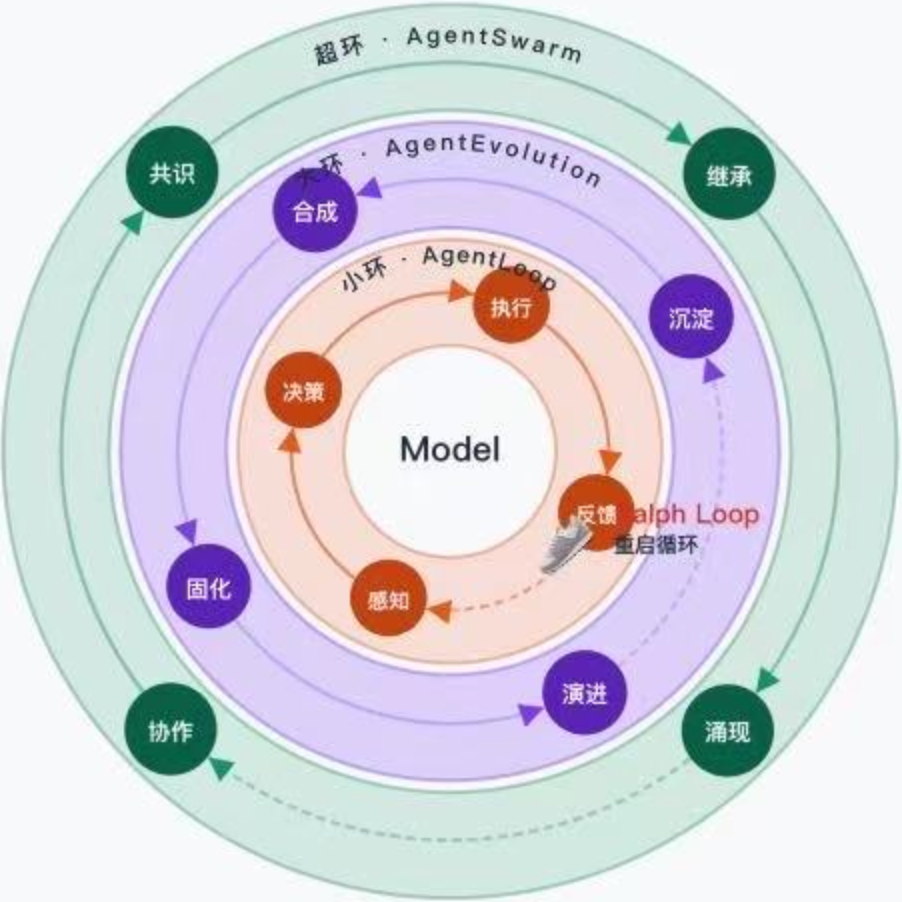
AI has already entered code writing, algorithm optimization, and model development. But after a task is completed, what remains may be reusable capability—or merely an answer and scattered logs. The difference becomes apparent only when a similar problem comes up again: can the system reuse what it learned, or must it pay the cost of exploration all over again?
Recursive Self-Improvement (RSI) co…
 markitdown• Pinned