Anthropic has filed a registration statement for an IPO ahead of a planned November stock-market debut, according to a commentary examining the company’s disclosures. The report says footnotes in its most recent financial disclosures revealed nearly $895 billion in spending commitments, including at least $582 billion in non-cancelable commitments with Amazon, AMD, Broadcom, Google, and Microsoft. Anthropic’s 2026 financial results have not been formally audited. The commentary argues that the SEC should block the offering until Anthropic provides two consecutive quarters of audited financial statements and fuller disclosure of its material spending commitments.
Microsoft and Lumen Technologies said they will jointly sell networking services to enterprises deploying AI workloads on Azure, with Lumen planning to bring its full cloud-networking portfolio to the platform. Their sales teams will collaborate on deals combining networking, cloud migration and AI, while the companies also plan joint customer planning and exploration of integrations with Microsoft’s AI-agent tools. Lumen’s Alkira service is already available through Microsoft Marketplace, but neither company disclosed financial terms or a rollout timetable.
Bloomberg reported, citing October internal guidance, that Goldman Sachs has limited access to Anthropic's Claude Code and Microsoft's GitHub primarily to engineers, restricting tools previously used by traders and bankers. Those employees had used the tools for tasks such as monitoring client trading flows, modeling volatility and positions, and producing text and charts. Goldman Sachs said it weighed productivity and risk management before limiting the tools to people best suited to use them long term.
American Sentiment, operated by San Francisco-based AI startup Prophecy Gov, analyzed 10,202 public comments submitted at 417 local government meetings across 48 states, with 906 public meetings tracked in 2026. It found that 90.5% of comments were negative toward proposed data centers. Water use, local quality-of-life effects and limited project transparency were the leading concerns. The analysis cautions that public comments may not represent the country’s overall sentiment.
a16z News argues that falling inference costs can improve application-company margins, but stronger general-purpose models and easier development tools can also make products easier to replace. It recommends building pricing power around domain expertise, deep integrations, reliable execution, hard-to-access context, and measurable customer value, using Repsol’s legal AI pilot as an example. The reported pilot and productivity figures come from Harvey and were not independently verified.
Microsoft is testing a native internet speed test in Windows 11 preview builds, including Build 26340.9767. Unlike earlier versions that opened a Bing page in the browser, the tool appears in a Windows pop-up and can be launched from the Quick Settings speed-test tile, the Wi-Fi or cellular network panels, or the taskbar network menu. Microsoft executive Marcus Ash said the design and build used a human-guided agentic AI workflow and WinUI 3. He also said that Windows design executive Diego Baca had a working prototype within a day.
A 36Kr excerpt from Du Ning’s book argues that AI demand should be measured not only by tokens consumed or attention captured, but also by cognitive tasks completed, usable results produced, and professional labor saved. It presents token consumption as an enterprise cost category requiring attribution by department, project, and task, alongside controls for hallucinations, data leakage, overreliance, unclear accountability, and runaway costs. The opening market-analysis scenario, including its 500,000-token figure, is explicitly illustrative rather than a documented customer deployment.
A 36Kr analysis argues that enterprise AI agents can generate substantial returns once deployed—IDC and Microsoft research cited by the report puts average global return at 171%—but Forrester and Anaconda data show that 86%–88% of pilots never reach production. McKinsey’s 2026 Global Survey, as cited, finds that 80% of respondents report personal productivity gains, while only 37% of organizations attribute any EBIT impact to AI. The report identifies workflow redesign, identity, permissions, auditability and runtime governance as central barriers to scaling service agents.
HarnessSQL is an open-source framework from researchers at HKUST, Microsoft and other institutions that trains SQL agents with full-trajectory supervised fine-tuning and execution-reward reinforcement learning in database sandboxes. The team reports that HarnessSQL-8B reached 45.2% execution accuracy on Spider 2.0-SQLite, while the 14B version reached 54.8%. These figures come from the authors’ evaluations and have not been independently replicated in the supplied reports.
A 36Kr article authorized from New Zhiyuan describes AI researchers Jinyan Su and Jack Weis struggling to find stable full-time work despite advanced academic credentials and internships. The report says AI agents are taking on coding and internal business tasks, but presents the claim that agents caused hiring contraction and reduced headcount as commentary rather than evidence established by independent hiring or adoption data.
Anthropic’s amended S-1 reported third-quarter revenue of about $17 billion, up from $11.6 billion in the second quarter, but the company returned to a $567 million operating loss from $974 million in operating profit. Compute and infrastructure costs rose to $9.9 billion, or 58% of revenue. The filing disclosed $895.4 billion in purchase commitments and lease agreements, substantially all related to compute and infrastructure, although the supplied reports do not provide a complete breakdown of their terms. Anthropic said the quarterly result was affected by $5 billion in short-term compute purchases, which it said cost more than comparable capacity under multiyear commitments, and an approximately $2 billion noncash employee charitable-matching expense.
Anthropic’s 335-page S-1 prospectus, submitted on October 25, 2026, reportedly disclosed about $637 billion in compute commitments to seven named suppliers over the next decade, according to TMTPost. TechNews reported a broader total of about $895.4 billion for computing and infrastructure commitments, including about $447.5 billion due by the end of 2030. The filings include take-or-pay obligations and a reported $161.2 billion Broadcom lease covering primarily Google-designed TPU chips.
TMTPost commentary argues that companies often use AI and increased compute as a rationale for reducing headcount, while presenting the move as operational efficiency. It cites Dazzle AI, Duckbill and Wajo AI as using contractors for real-world steps agents cannot reliably handle, and reports that human call-center staff assisted Meta's Muse during early testing. The article distinguishes human-AI collaboration from replacing employees before agents can handle exceptions, but many vendor and market claims are not independently verified in the supplied report.
Global equity funds attracted $10.19 billion in the week through October 28, extending inflows to a sixth consecutive week, according to LSEG Lipper figures cited by TechNews and Reuters. Asian equity funds led regional inflows with $9.9 billion, helped by record profits at SK Hynix, while European funds received $4.54 billion. US equity funds recorded a $6.65 billion outflow as investors waited for Alphabet, Microsoft, and Amazon earnings amid concern that heavy AI spending could weigh on profits and cash flow.
36Kr 人工智能 argues that AI can improve efficiency but cannot replace human judgment, organizational coordination, or responsibility for complex and exceptional cases. It cites current AI agents that hand off real-world tasks to contractors, along with market concerns about heavy AI spending and weaker investor enthusiasm. The commentary also argues that layoffs marketed as AI-driven cost savings often shift labor costs to less stable outsourced work.
A report from the WeChat account Zimu Pai, citing external media, said S&P Global Ratings moved Meta’s credit outlook from stable to negative while keeping its AA- rating. S&P warned that Meta’s expanding AI investment could leave free operating cash flow negative for multiple years, though Meta said AI had improved its advertising business and could create new revenue opportunities. The report said Microsoft, Alphabet, Amazon, Meta and Oracle generated a combined $542.9 billion in operating cash flow during the first three quarters while spending $556.9 billion on capital expenditure, resulting in combined free cash flow of negative $14 billion. It also said Blackstone lowered its expectation for Anthropic’s future credit rating, even as it participated in a $63 billion AI-compute financing structure that allocated risk among lenders, chip suppliers and Anthropic.
OpenAI, Google, Microsoft and Anthropic reportedly announced plans to adopt a standard that allows publishers to reject AI crawlers and state their preferences for model-training content across multiple AI companies at once. Anthropic technical lead Kevin Kelley proposed the standard to the Internet Engineering Task Force, and it is expected to be integrated into robots.txt files. The report, attributed to Sina Finance, did not provide the standard’s official name, technical specification, implementation timetable or details.
The supplied article surveys large-model pretraining, covering data, tokenization, optimizers, memory, distributed parallelism, checkpoints, and model evaluation. It compares Megatron-LM, DeepSpeed, and torchtitan; explains the different configuration guidance in Kaplan’s and Chinchilla’s scaling laws; and discusses cost estimation, loss spikes, checkpoint recovery, and resuming distributed training. Framework and performance characterizations are the article’s assessments, while its cost calculation is presented without accompanying source calculations.
A lecture excerpt republished by the WeChat account “老孙荐读” presents AI as a general-purpose technology with the potential to raise productivity and broaden access to expertise. It organizes its analysis into four faces that may coexist: AI’s potential, the large infrastructure investment required, uncertain or delayed commercial returns, and social and labor-market impacts. The lecture argues that these competing considerations help explain investor swings, as capital spending can be read as fuel for growth or as evidence of poor returns. It cites figures and research attributed to companies and institutions, but the supplied excerpt does not independently verify those claims.
Microsoft AI chief Mustafa Suleyman said in an X essay titled “Don't build conscious superintelligence” that current AI models are not conscious and should remain that way. He called creating conscious AI reckless, proposed pausing development if signs of consciousness appear during training, and said evidence of consciousness should be disclosed publicly so society can decide how to proceed. He said developers should build AI systems that serve human welfare without rights or independent motives.
The Wall Street Journal reports that the cost of insuring against debt defaults at Amazon, Alphabet, Microsoft, Meta and Oracle has reached its highest level since 2021. With trillions tied to the artificial-intelligence trade, the report says investors, traders and technology executives are seeking high-stakes protection.
An analysis syndicated by 36Kr and 创业邦 argues that AI expansion depends on more than electricity, linking it to power generation, grids, transformers, cooling, memory, packaging, capital and local permitting. It cites the International Energy Agency’s April 2026 report for rising infrastructure spending and data-center electricity demand, while noting that fast-evolving chips and data centers face slower grid and equipment timelines. The analysis also describes constraints shifting from GPUs to HBM and advanced packaging, then to transformers, gas turbines and grid connections.
Neocloud operators such as CoreWeave and Nebius lease AI compute from large data centres to developers including Anthropic, OpenAI and Meta, and are now at the centre of debate over the AI economy's financial health. BBC reports CoreWeave has accumulated $35.1bn in debt, its stock has lost about a quarter of its value in a month, and Nebius, IREN and Applied Digital have fallen at least as much, while debt investors demand higher returns. Microsoft cancelled a deal with Nscale over power-supply issues, and Australia's Firmus shelved its IPO plans.
Titan Media and 36Kr report that S&P moved Meta's AA- outlook to negative, citing heavy AI infrastructure spending and uncertainty over monetization. They also say Microsoft, Alphabet, Amazon, Meta and Oracle generated $542.9 billion in operating cash flow but spent $556.9 billion on capital expenditures, turning combined free cash flow negative and cutting share repurchases by 83%. For Anthropic, 36Kr cites KBRA's BB+ issuer rating and a revised Blackstone expectation that the company may remain speculative grade even after an IPO, despite a reported $63 billion compute-financing arrangement.
AI investment and data-center demand reportedly pushed Kioxia, Samsung, SK Hynix, Micron and SanDisk’s combined quarterly operating profit to 32 trillion yen, exceeding the roughly 25 trillion yen reported for Alphabet, Microsoft, Amazon, Meta and Apple. The comparison uses QUICK FactSet data cited by IT之家, with Micron covering June through August and Apple represented by a market forecast. Kioxia separately reported record July–September earnings, forecast another record quarter, and said its 2027 production capacity was already sold out.
Microsoft's Mage-VL-Cowork is a 4B vision-language model designed for hybrid computer use, combining teacher-harness evolution, Mage-CUA-Forge environment synthesis, and a five-stage specialize-then-unify curriculum. The project description reports a 66.0% score on OSWorld-Verified at the 4B scale, along with 13.0% fewer model calls and 25.4% fewer output tokens after online reinforcement learning.
A Washington Post test found that ChatGPT cited Ballot Brief in 22% of election-related answers and Microsoft Copilot in 75%, but the rates applied only to the test’s specific prompt and environment. The investigation documented multiple errors on Ballot Brief, including a false claim about Ohio Republican Sen. Jon Husted that Copilot repeated to a user. After being notified, OpenAI said it would act on reported problems and improve model responses; Microsoft said it would prioritize authoritative and official election sources and continue testing. Anthropic did not explain why Claude began linking to Ballot Brief more frequently in the second test round.
Microsoft introduced a broad voluntary employee separation compensation plan that triggered internal concern about 60,000 job cuts and AI-driven job replacement, according to IT之家 citing Business Insider. CFO Amy Hood said the offer lets departing employees choose how to leave, while Microsoft expects no more than 3,000 employees, or 5% or fewer of eligible staff, to accept it. Executives denied that the plan was intended to cut 60,000 positions or replace everyone with AI, noting that some departing employees will be replaced.
IT之家, citing Reuters, reported that the Nasdaq 100 lost more than 5.8% in October as investors questioned when heavy AI infrastructure spending would pay off, with projected market-cap losses of over $2 trillion. Meta, Alphabet and Amazon raised spending plans, while Meta reportedly sought a record $97.5 billion in financing and Microsoft planned about $25 billion in investment-grade bonds. Strong revenue and cloud growth at Amazon, Meta and Microsoft showed that returns were uneven rather than universally deteriorating.
India’s government announced a 20-year tax holiday for foreign cloud companies using Indian data centers to serve global customers, aiming to attract Google, Microsoft and Amazon as AI infrastructure hubs. However, Rest of World reports that farmers and local activists are resisting projects over land acquisition and environmental concerns; Microsoft denies allegations that its Telangana site encroached on a lake or improperly disposed of waste and says it is cooperating with authorities.
What problem it solves
Documents and office files often need to be transformed into a structured, text-friendly format before they can be processed by language models or text analysis tools. MarkItDown addresses this by preserving important document structures such as headings, lists, tables, and links during conversion to Markdown.
Key features
Broad format conversion — MarkItDown converts PDF, P…
What problem it solves
Editing text should not require extensive familiarity with terminal-based tools. The project aims to provide an accessible editor with a modern interface and input controls that are approachable for users who are largely unfamiliar with terminals.
Key features
Cross-platform installation — Installation options are documented for Windows, Linux, and macOS, including package-m…
What problem it solves
Generative AI systems and applications can contain security and safety weaknesses that require structured testing across models, endpoints, and complete applications. PyRIT addresses this with repeatable assessments, interactive exploration, and extensible workflows for red teaming these systems.
Key features
Repeatable command-line assessments — The scanner runs repeatable …
What problem it solves
Web automation and end-to-end testing often require coordinating browsers, interactions, assertions, and failure diagnostics. Playwright provides a unified API for driving Chromium, Firefox, and WebKit across tests, scripts, and AI-agent workflows.
Key features
End-to-end test runner — Playwright Test runs end-to-end tests across Chromium, Firefox, and WebKit with browser is…
What problem it solves
TypeScript adds optional types to JavaScript so tools can support large-scale JavaScript applications across browsers, hosts, and operating systems. It also compiles source into readable, standards-based JavaScript.
Key features
Optional types for JavaScript — TypeScript extends JavaScript with optional types, providing a typed language for application-scale development.
Sou…
What problem it solves
Go applications need a way to create, read, and modify spreadsheet documents produced by Microsoft Excel. They also need support for complex spreadsheet components and workflows involving large worksheet datasets.
Key features
Read and write spreadsheet files — Create and modify workbooks, set cell values, save files, and read cell values and worksheet rows through a Go API.…
What problem it solves
Knowledge workers need Claude to follow their organization’s tools, terminology, critical workflows, and preferred ways of working rather than provide only generic assistance. The repository provides customizable role-specific plugins that package this guidance with connectors, skills, commands, and sub-agents.
Key features
Role-specific plugin collection — The collection in…
What problem it solves
Products and agents need to communicate with users across multiple channels without rebuilding Inbox feeds, provider integrations, and channel webhooks. Novu addresses this with one API and a unified conversation model for product notifications and bidirectional agent conversations.
Key features
Unified multi-channel API — Send product notifications through Inbox/In-App, Pus…
What problem it solves
Applications need to run untrusted code while controlling its access to files, networks, user interfaces, and host capabilities. This requires an isolation approach that works across platforms, supports multiple containment mechanisms, and can be integrated without changing application architecture.
Key features
Cross-platform containment — MXC supports Windows, Linux, and m…
What problem it solves
Teams often have to move work into a separate AI tool, then repeatedly transfer context between that tool and the applications where collaboration happens. Switch addresses this by letting people and AI agents participate in the same conversations while keeping shared context with the work.
Key features
Shared rooms for people and agents — Each supported chat channel becomes…
What problem it solves
Speech recognition systems often lose global context when they divide continuous audio into short chunks, while speech generation must maintain speaker consistency, timing, and coherence across long recordings. The project addresses these needs with unified long-form ASR, streaming recognition, and text-to-speech models.
Key features
Long-form speech recognition — Process co…
What problem it solves
Company knowledge is distributed across business systems such as Slack, Google Drive, Jira, GitHub, and Microsoft 365. AI applications need a governed way to search this information, respect each user's access controls, and provide answers that can be traced to their sources.
Key features
Permission-aware enterprise search — Searches connected company systems while applying …
What problem it solves
Developers need support for their core edit-build-debug cycle. The project addresses this need with comprehensive code editing, navigation, and understanding support along with lightweight debugging, a rich extensibility model, and lightweight integration with existing tools.
Key features
Code editing and navigation — The editor provides comprehensive support for editing, na…
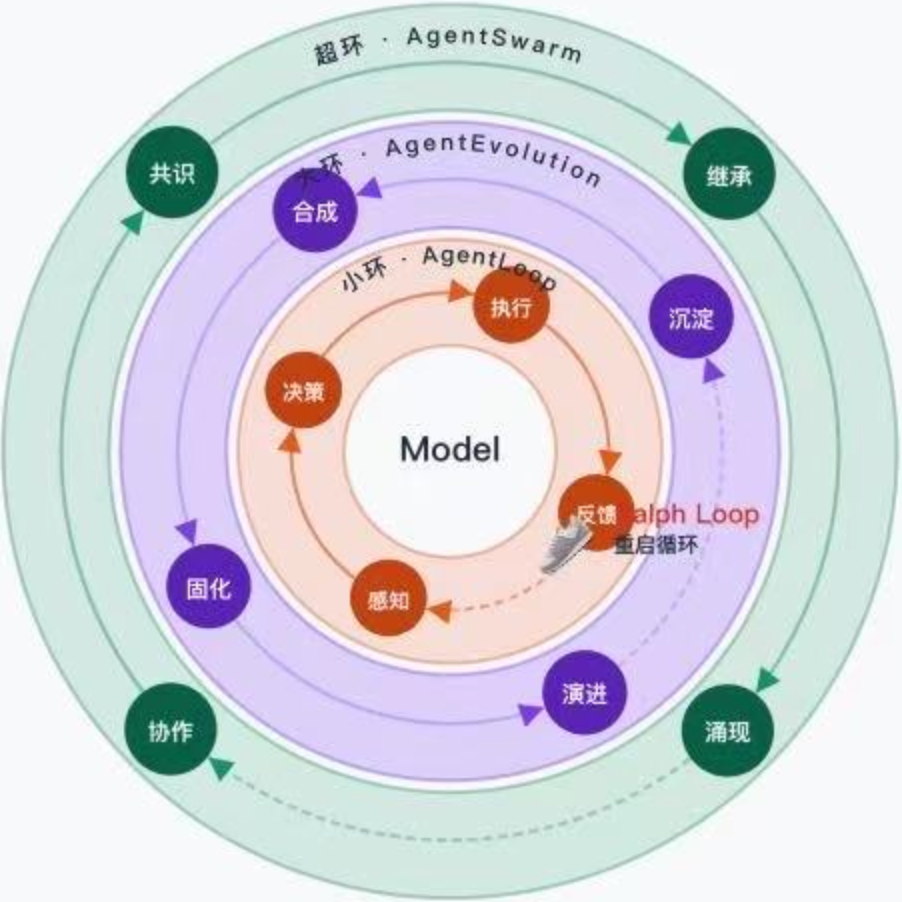
AI has already entered code writing, algorithm optimization, and model development. But after a task is completed, what remains may be reusable capability—or merely an answer and scattered logs. The difference becomes apparent only when a similar problem comes up again: can the system reuse what it learned, or must it pay the cost of exploration all over again?
Recursive Self-Improvement (RSI) co…
 markitdown• Pinned