According to a TMTPost commentary, Microsoft issued $25 billion in corporate bonds on October 29, returning to the bond market after nine years. The offering comprised ten tranches with maturities ranging from two to 40 years, with the longest due in 2066, and reportedly attracted orders of up to $115 billion. The commentary said Amazon, Alphabet, Microsoft, Meta and Oracle had combined capital spending that exceeded operating cash flow in the first nine months of the year and increasingly used debt or equity financing. These broader financial figures were not independently verified in the supplied material.
In an analysis by 万点研究, authorized for publication by 36氪, TD Cowen estimated that Oracle could cut 20,000–30,000 positions and generate $8–10 billion in annual free cash flow. Columbia Business School scholars estimated that Microsoft, Amazon, Meta, Oracle and Alphabet would spend a combined $800 billion on capital expenditure in 2026, exceeding their roughly $707 billion in operating cash flow. The analysis argues that potential workforce reductions are too small to fund that spending directly; instead, they could help preserve margins and credit metrics as external financing becomes more important. These figures are estimates, and the causal interpretation is the analysis’s judgment rather than an independently established fact.
Microsoft released the official MCP C# SDK 2.0, implementing the MCP specification’s 2026-07-28 revision. The release enables stateless Streamable HTTP servers by default, standardizes routing headers and introduces multi-round-trip requests for interactive tools. InfoQ also reported that minor versions 2.1, 2.2 and 2.3 followed between August and October.
Malaysia’s data-center expansion is accelerating as Johor attracts about 50 projects in three years, including projects from ByteDance and Microsoft, while Google, Amazon, Nvidia, and Alibaba have committed investments linked to AI and cloud demand. DC Byte says planned and under-construction capacity in Johor grew 100 times over five years, but local officials and residents report concerns over electricity and water shortages; Malaysia’s national electricity company estimates data-center demand could exceed 5,000 MW by 2035.
Microsoft reportedly declined an option to more than double its Texas compute-capacity contract with Nscale, forgoing additional capacity that the Financial Times said could have been worth tens of billions of dollars. Nscale clarified that the option covered about 500 MW at its own Texas site, while the existing contract remains in place and the company reportedly seeks a valuation of up to $35 billion for its IPO.
Microsoft said delayed third-party cloud providers constrained AI infrastructure spending, contributing to a $5 billion reduction in its annual capital-expenditure forecast. Aterio satellite analysis found that some Microsoft-linked projects lacked generators or cooling equipment, while it estimated that about 140 MW of planned capacity at Nebius's DataOne project could slip to 2027. Currence estimated that 30% to 50% of capacity originally scheduled to come online this year could be delayed to 2027 or later because of power shortages and construction problems.
Microsoft reportedly plans to update search in Outlook Classic for Windows 10 and Windows 11, falling back to the Windows local index when cloud search is slow, unstable or unavailable. The update will improve relevance ranking with a lightweight small language model, surface up to seven relevant messages in “Top results,” and add thumbs-up or thumbs-down feedback. Microsoft says search latency has fallen and overall speed is about 5% better; that performance claim has not been independently verified. Windows Latest, as relayed by IT之家, says the capability is currently limited to Outlook Classic, while the web-based new Outlook does not yet have it.
Microsoft said last week that it spent about $5 billion less on capital expenditures in the third quarter than previously projected because data-center capacity it planned to rent was not ready on time. Microsoft did not publicly name the third parties behind the delays. The report identified cloud firm Iren as one of the parties associated with them.
CNET, citing a Microsoft security report, said attackers used Teams messages and calls to impersonate IT or help-desk staff and persuade users to grant remote access through Quick Assist. The resulting sessions provided hands-on-keyboard workstation access and did not exploit a vulnerability in Teams. Separately, Microsoft introduced AI-powered phishing detection that uses conversation context to flag phishing and social engineering in higher-risk external chats.
Christian & Timbers estimates that elite forward deployment engineers earn $586,000 to $1.45 million in annual total compensation, while senior leaders in the field can receive up to $2.25 million. The executive search firm's report draws on more than 550 interviews with engineers, deployment leaders, and executives, plus closed and current job offers, but says the compensation bands are estimated ranges rather than statistical averages. It also cites a prior estimate that only about 2,000 experienced senior AI deployment leaders are available in the US market.
36Kr reports that TypeSafeAI launched Jev in mid-September, a model designed to classify inputs into preset options and return boolean values, scores, or probabilities rather than conversational text. The report says Jev attracted more than one million users within weeks and helped popularize “decision models,” followed by OpenAI’s Decisions API and similar products from AWS, Microsoft, and Cloudflare; these adoption, valuation, and competitor claims come from a single source and remain unverified. It also argues that AI evaluation is expanding beyond generated-content quality toward decision accuracy, latency, and execution cost.
Huxiu AI reports that the widely circulated claim that 55% of China’s AI tokens go to short drama and video while 58% of US tokens go to programming and R&D lacks authoritative statistical support. China’s figure came from a company investor-relations record without published sample coverage or conversion methods, while the US figure may have been derived from an OpenRouter-a16z sample that excludes video generation and does not represent total US usage. The report also cautions that tokens measure model throughput rather than GPU compute, making direct comparisons between video generation and coding unreliable.
Arista Networks reported third-quarter revenue of $3.66 billion, up 58.5% year over year and above the $3.33 billion market estimate. Adjusted EPS was $1.20, compared with the $1.08 estimate, while product revenue rose about 67% to $3.19 billion. The company forecast fourth-quarter revenue of $3.9 billion to $4.0 billion, above the $3.6 billion consensus, and adjusted EPS of $1.26 to $1.30, above the $1.15 estimate. Its shares gained more than 5% after hours. Arista also announced an open-standard Ethernet architecture with AMD, Arm, Broadcom and Qualcomm, and a liquid-cooling portfolio for interconnecting up to 144 AI accelerators within a rack.
Microsoft is internally testing a small language model designed to rerank Outlook search results and improve the relevance of email retrieval. The model uses a streamlined reranker architecture, supervised by a larger model, and is not intended to understand natural-language instructions. Microsoft said early offline tests were encouraging, while its demonstrations showed improved relevance and fewer irrelevant emails.
Dingjiao One’s analysis of six Magnificent Seven companies, excluding Nvidia, found that revenue growth did not produce uniform stock reactions. Alphabet’s Google Cloud revenue rose 103% to $30.7 billion, yet the shares fell 12.64% the next day; Amazon dropped more than 7% after hours following 39.3% AWS growth, while Meta fell 7% despite 26% revenue growth. The report links steadier reactions at Microsoft, Tesla and Apple to clearer spending payback paths, positive free cash flow or reduced capital spending, but presents this as editorial analysis rather than an independently established cause.
Anthropic’s revised S-1 reportedly quantifies about $895.4 billion in long-term compute and infrastructure commitments, with roughly $70 billion due within a year and more than $448 billion due by the end of 2030. The filing also says automated AI-assisted research could approach thresholds in Anthropic’s Responsible Scaling Policy associated with recursively self-improving development. TMTPost reported that the figures and warnings came from Anthropic’s filing, which has not independently been verified in the supplied source.
Goldman Sachs' Rich Privorotsky says investors are using two competing bearish cases to sell AI infrastructure: insufficient power and data-center capacity to support planned spending, or excess compute that undermines leasing economics. Demand remains strong, with Azure, AWS and Google Cloud reporting quarterly growth of 48%, 39% and 103%, respectively. But Goldman colleague Lee Coppersmith estimates hyperscaler capital spending will reach $1.2 trillion in 2027, while aggregate Q3 free cash flow has turned negative. Intel's 29% single-day plunge followed unexpectedly severe PC-demand guidance, which Privorotsky said was more related to consumer PCs, margins and manufacturing than to AI demand itself.
The Verge AI commentary says the timing of an AI market downturn remains unclear even as institutional investors express caution. PIMCO CEO Emmanuel Roman warned of a possible AI-market downturn and estimated the buildout could require $2 trillion in financing over five years, while Meta, Oracle, Alphabet, and Microsoft continued to raise substantial debt. The commentary also notes Apollo president Jim Zelter's view that AI is improving rapidly but its pricing and economics remain uncertain.
LinkedIn says its AI-powered Hiring Assistant has maintained flat server costs even as usage increased steadily over the past year, according to The Information. The report’s headline attributes the result partly to replacing some OpenAI models. Hiring Assistant uses large language models to automate candidate search and recruiter outreach.
In a first-person account, the author says they moved from engineering on Microsoft’s Windows AI team to research engineering at Salesforce AI Research, with more time spent supporting scientists and rapid prototyping. They now report managing about five to six Claude Code, OpenCode, Codex, or Pi agents for coding, research, writing, and creative work, while drafting a personal AI policy to guide daily use.
In Where’s Your Ed At, Ed Zitron argues that AI investment is running dry as data-center debt becomes harder to raise and venture-backed startups lose their reliable funding base. Citing other reports, he says OpenAI recently raised $11 billion while Anthropic has approximately $447.5 billion in commitments expected through 2030, with $69.8 billion due within 12 months after September 30, 2026. He presents these figures as fault lines around the economics of AI labs, infrastructure operators, and data-center debt.
U.S. equity market capitalization fell by more than $1.5 trillion in October, while the Nasdaq Composite dropped 5.3%, its worst month since March 2025, according to a report from 华尔街见闻. Bert Dohmen and Dion Dohmen of Dohmen Capital Research said the selloff spread from AI and semiconductor stocks, triggering leveraged liquidations and margin calls. Elliott Investment Management separately warned about circular AI investment, debt-funded capital spending and growing anti-AI sentiment. It said a challenge to AI product pricing or a contraction in expectations for AI infrastructure construction could have a historically severe market impact.
AMD is scheduled to report earnings Tuesday afternoon after sales growth accelerated and operating margins expanded under CEO Lisa Su. Analysts cited by Barron's expect third-quarter revenue of $13 billion, up 42% year over year, and adjusted earnings of $1.95 per share, compared with $1.20 a year earlier. They expect data-center revenue to account for 63% of total revenue, while slower PC and game-console sales could offset some growth.
TechRadar argues that the UK Competition and Markets Authority should publish an interim roadmap for public-sector cloud and AI procurement. The commentary says Microsoft’s entrenched position in software, data, identity and security could constrain competition in AI services, while short-term savings can come at the expense of long-term value and choice. It recommends covering licensing, interoperability, exit plans and independently verifiable outcomes.
A Microsoft slide attributed to X leakers outlines a four-tier Windows AI PC roadmap spanning 8GB entry systems, 16GB–64GB Copilot+ PCs, builder systems for local models, and 128GB+ desktop supercomputers. TechSpot and IT之家 also report memory bands for local AI workloads, while listings mention upcoming AMD, Intel, NVIDIA and Qualcomm hardware. Microsoft has not confirmed the slide, and reports differ over whether @9550pro or HXL posted it.
A 36Kr report said Alphabet's Google Cloud revenue rose 103% in the third quarter, while the company reported quarterly free cash flow of negative $9.1 billion. Amazon's AWS revenue grew 39% to $46 billion, but its trailing-12-month free cash flow shifted from a $14.8 billion inflow to a $42.4 billion outflow as spending on property and equipment increased. Microsoft reported 48% Azure growth and positive free cash flow despite $45.2 billion in quarterly capital expenditure. Alphabet's quarterly figure and Amazon's trailing-12-month figure cover different periods and are not directly comparable.
The Nasdaq-100 fell 1.39% to 27,989.82 on November 2, leaving it 10.4% below its October 6 closing high and in its third correction of 2026. The Philadelphia Semiconductor Index fell 3.4%, dropped below its 200-day moving average, and was led lower by declines in Intel, Microsoft, Micron and Marvell. Investors are questioning returns on debt-funded AI infrastructure and the pace of cloud capital-spending growth, while leveraged ETFs such as TQQQ suffered sharp losses.
Microsoft AI (MAI) has released the first draft of its Humanistic AI Behavior Guidelines and opened a six-week public consultation. The draft says models should refuse requests involving weapons manufacturing or dangerous substances, avoid generating violent or sexual content, follow human objectives, disclose reasoning, and abandon tasks that would violate the guidelines. Mustafa Suleiman said the guidelines have not yet been used to train any existing models, with a revised version planned this year to guide development from 2027 onward.
钛媒体 reported that Anthropic filed a Form S-1 with the SEC on October 26, 2026, planning to list on Nasdaq under the ticker “ANT.” The digest says first-half revenue reached $16.286 billion and adjusted operating profit was $1.618 billion, but also highlights substantial customer concentration and large compute, procurement, and lease commitments whose total was not disclosed in the filing.
Microsoft released Microsoft Corporation System Hardware Update 200.0.7.0 for the RTX Spark-powered Surface Laptop Ultra six days after the device went on sale. Microsoft says the update addresses extended reboot times, screen flickering and unexpected restarts, though reviewers differed on whether they encountered flickering. Windows Central's Zac Bowden reported that his reboot problem was fixed. The update is rolling out gradually, and installed firmware cannot be uninstalled or reverted.
What problem it solves
Documents and office files often need to be transformed into a structured, text-friendly format before they can be processed by language models or text analysis tools. MarkItDown addresses this by preserving important document structures such as headings, lists, tables, and links during conversion to Markdown.
Key features
Broad format conversion — MarkItDown converts PDF, P…
What problem it solves
Editing text should not require extensive familiarity with terminal-based tools. The project aims to provide an accessible editor with a modern interface and input controls that are approachable for users who are largely unfamiliar with terminals.
Key features
Cross-platform installation — Installation options are documented for Windows, Linux, and macOS, including package-m…
What problem it solves
Generative AI systems and applications can contain security and safety weaknesses that require structured testing across models, endpoints, and complete applications. PyRIT addresses this with repeatable assessments, interactive exploration, and extensible workflows for red teaming these systems.
Key features
Repeatable command-line assessments — The scanner runs repeatable …
What problem it solves
Web automation and end-to-end testing often require coordinating browsers, interactions, assertions, and failure diagnostics. Playwright provides a unified API for driving Chromium, Firefox, and WebKit across tests, scripts, and AI-agent workflows.
Key features
End-to-end test runner — Playwright Test runs end-to-end tests across Chromium, Firefox, and WebKit with browser is…
What problem it solves
TypeScript adds optional types to JavaScript so tools can support large-scale JavaScript applications across browsers, hosts, and operating systems. It also compiles source into readable, standards-based JavaScript.
Key features
Optional types for JavaScript — TypeScript extends JavaScript with optional types, providing a typed language for application-scale development.
Sou…
What problem it solves
Go applications need a way to create, read, and modify spreadsheet documents produced by Microsoft Excel. They also need support for complex spreadsheet components and workflows involving large worksheet datasets.
Key features
Read and write spreadsheet files — Create and modify workbooks, set cell values, save files, and read cell values and worksheet rows through a Go API.…
What problem it solves
Knowledge workers need Claude to follow their organization’s tools, terminology, critical workflows, and preferred ways of working rather than provide only generic assistance. The repository provides customizable role-specific plugins that package this guidance with connectors, skills, commands, and sub-agents.
Key features
Role-specific plugin collection — The collection in…
What problem it solves
Products and agents need to communicate with users across multiple channels without rebuilding Inbox feeds, provider integrations, and channel webhooks. Novu addresses this with one API and a unified conversation model for product notifications and bidirectional agent conversations.
Key features
Unified multi-channel API — Send product notifications through Inbox/In-App, Pus…
What problem it solves
Applications need to run untrusted code while controlling its access to files, networks, user interfaces, and host capabilities. This requires an isolation approach that works across platforms, supports multiple containment mechanisms, and can be integrated without changing application architecture.
Key features
Cross-platform containment — MXC supports Windows, Linux, and m…
What problem it solves
Teams often have to move work into a separate AI tool, then repeatedly transfer context between that tool and the applications where collaboration happens. Switch addresses this by letting people and AI agents participate in the same conversations while keeping shared context with the work.
Key features
Shared rooms for people and agents — Each supported chat channel becomes…
What problem it solves
Speech recognition systems often lose global context when they divide continuous audio into short chunks, while speech generation must maintain speaker consistency, timing, and coherence across long recordings. The project addresses these needs with unified long-form ASR, streaming recognition, and text-to-speech models.
Key features
Long-form speech recognition — Process co…
What problem it solves
Company knowledge is distributed across business systems such as Slack, Google Drive, Jira, GitHub, and Microsoft 365. AI applications need a governed way to search this information, respect each user's access controls, and provide answers that can be traced to their sources.
Key features
Permission-aware enterprise search — Searches connected company systems while applying …
What problem it solves
Developers need support for their core edit-build-debug cycle. The project addresses this need with comprehensive code editing, navigation, and understanding support along with lightweight debugging, a rich extensibility model, and lightweight integration with existing tools.
Key features
Code editing and navigation — The editor provides comprehensive support for editing, na…
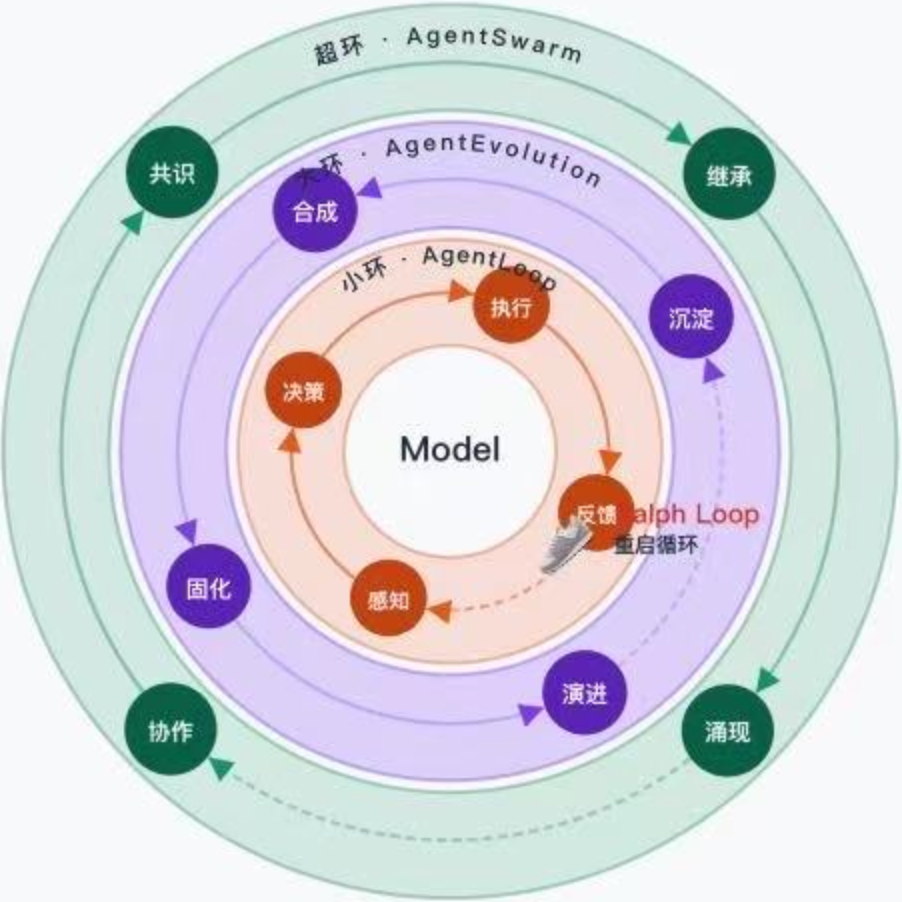
AI has already entered code writing, algorithm optimization, and model development. But after a task is completed, what remains may be reusable capability—or merely an answer and scattered logs. The difference becomes apparent only when a similar problem comes up again: can the system reuse what it learned, or must it pay the cost of exploration all over again?
Recursive Self-Improvement (RSI) co…
 markitdown• Pinned