Speaking at a developer event in London, Nvidia CEO Jensen Huang praised Microsoft's new Surface Laptop Ultra as "so beautiful" and "incredible," calling the project "a work of love" that took four years and several thousand engineering years to build. According to TechRadar, the device is the first Microsoft product powered by an Nvidia chip, using Nvidia's RTX Spark platform with an N1X processor and RTX Blackwell graphics and up to 128GB of unified memory; it was revealed in September 2026 and is set to launch on October 16, 2026. Huang said the chip delivers one petaflop of computing and is Nvidia's first GPU with shared memory, and described a vision of a PC that runs an agent locally so users can message it to render images or update slides; those performance and capability claims are his own.
A commentary republished by Huxiu AI and originally by Piansheng says Microsoft released its in-house Maia 300 chip, which strips out redundant training hardware and targets high-concurrency inference such as long-context chat, low-latency interaction and multi-step agent tasks. It traces the line from Maia 100 in November 2023, described as a combined training/inference design, to Maia 200 in January, which shifted toward inference, and notes Google's TPU 8i and Amazon's Inferentia also focus on inference. The piece cites Microsoft's technical team estimating a 30%–50% drop in per-token inference cost at scale and industry estimates that inference will exceed 70% of compute in 2026, without independent sourcing; the claim that Microsoft has abandoned competing on high-end training chips is the author's interpretation.
A TMTPost analysis describes two ways general-purpose LLMs are entering robotics. On Oct 16, MicroFactory founder Igor Kulakov said a single customer deployment used Claude Opus and GPT-6 Astra to generate control plans and code while dedicated programs executed the work, running 1.5 hours of autonomous electronics assembly with zero errors (a company claim). Two days earlier, Poke & Wiggle let Claude Opus 5.5 handle the full loop of reading papers, writing algorithms, training models and running real-robot evaluations to reproduce 10 robotics papers; an agent integrated and trained Microsoft's ~5B-parameter open-weight dual-arm Rho model the next day, reaching 87% success on a screw-driving task, and once diagnosed and rolled back its own inference-code bug in under 35 minutes. The piece also recounts a DSD reproduction where the agent widened the action-normalization range, flattening DSD's edge (45.3% vs 46.0%); restoring the paper's parameters gave DSD 45.3% against a 32.0% baseline, a 13.3-point lead. The author concludes R&D and integration workflows are shifting, but the evidence does not show general LLMs broadly replacing VLA models.
Since around September, Bilibili creators have posted AI-assisted revivals of discontinued games such as Shuang Sheng Shi Jie, Huan Shu Qi Shi Lu and Yue Qian Lv Ren, with some builds downloadable and playable; overseas projects similarly target Halo, GTA: Vice City and Call of Duty: Black Ops zombies. A Game Grape feature republished by Huxiu AI says many projects reuse existing client assets and AI decompilation, but "runnable" and "playable" are not the same as a finished product. It also notes that on Oct. 14 Microsoft announced a team, referred to in the article as Xbox Labs, to explore game decompilation, cross-platform play and player co-creation, while warning that original art, music and story remain copyrighted after a game shuts down.
Meta reports third-quarter results after the U.S. market close on Oct. 21, becoming the first major U.S. tech company to face scrutiny over whether its AI capital spending is paying off amid mounting "AI is short of money" concerns. Meta's prior guidance was $61–64 billion in revenue, versus a $63.29 billion analyst consensus and $6.85 adjusted EPS, while institutional estimates see free cash flow turning negative at -$9.14 billion with about $40.97 billion of capex. The September launch of its Muse AI agent and this month's Muse Wonder model are cited as evidence that spending turns into product value, but Guggenheim, citing Apptopia data, said Muse reached 1.3 million daily active users five weeks after launch with a 22% 14-day retention rate, slightly below ChatGPT's, and Meta began charging $20 and $100 monthly subscriptions on Oct. 12.
TSMC reported third-quarter 2026 revenue of $46.7 billion, up 41% year over year, with net profit exceeding NT$760 billion (up nearly 69%) and a 66.4% gross margin. The company guided fourth-quarter revenue to $52.3–54.3 billion and raised its full-year growth forecast from an initial 30% to 44%. 3nm accounted for 33% of wafer revenue, 2nm rose from 3% to 8% quarter over quarter, and high-performance computing contributed 68% of revenue. TSMC plans $60–64 billion in 2026 capital spending, expects 2nm-family capacity to more than double in 2027 versus 2026, and said customer interest in the 2028 A14 node exceeds early 2nm interest. The report also noted gross margin slipped from 67.7% the prior quarter and that investors are watching whether customers such as Microsoft, Google, Amazon and Meta can earn enough from AI services to sustain the spending.
A 36Kr piece from the Tech商业 account looks at how quickly discussion of Instinct, the AI startup founded by 23-year-old Noah Shinn under the legal name Spear Street Technology, has faded. It reports that the company raised a Series B at a $2.5 billion valuation in late August and then a $1 billion Series C on Sept. 28 at a $10 billion valuation, with Sequoia, Benchmark and Coatue participating. The product is described as a "personal AI butler" with no standalone app and an invite-only beta, where users text or call an AI agent to handle email, flights and groceries; the team has 14 people, users just topped 100,000, and the founder says it is not charging users yet, while the article cites an annualized GMV of about $1 billion. The author argues the mood has shifted as Anthropic's expected valuation reportedly slid from about $2 trillion toward $1.5 trillion, Microsoft trimmed its 2026 calendar-year capex outlook from roughly $190 billion to about $175 billion, and Meta held guidance at $125–145 billion while cutting about 8,000 jobs.
Citing the WTO's October 8 Global Trade Outlook and Statistics, TMTPost reports that "AI-enabled goods" accounted for roughly 47% of the increase in global merchandise trade by value in the first half of 2026, growing 67% year on year, even though they made up only 14.8% of world goods trade — up from a 7–8% share between 2016 and 2023. The WTO raised its 2026 merchandise trade growth forecast to 3.9% from 1.9%, with 4.1% expected in 2027, moving opposite to UNCTAD's 2.6% global growth estimate for the same year. The report notes that the WTO, UNCTAD and World Bank use different product lists, so figures such as 42%, 67% and 47% are not interchangeable, and that the revised 104 HS-code list is not published, meaning the 47% cannot be reproduced; price effects also inflate the value reading, with the ECB estimated to put AI-related import price growth at 20–30% in the first half. The piece argues the boom is driven by the chip, server and data-center supply chain and depends on capital spending from a handful of cloud providers — Amazon, Microsoft, Alphabet and Meta — plus power, financing and application-layer revenue.
Microsoft said in an October 15 blog post that it is launching PRAISE, an “AI-accelerated software engineering mentorship” program with Carnegie Mellon University, aimed at preserving the pipeline of future senior engineers as AI speeds development. The program borrows a clinical mentoring model from nursing, pairing early-career junior engineers with senior engineers who guide them in understanding systems, testing assumptions, deciding when to use AI and taking responsibility for outcomes. Carnegie Mellon will provide formal courses and small-group seminars; CMU faculty member Michael Hilton said juniors once built expertise through many foundational tasks, and academia and industry now need to design a new growth path together.
TechSpot rounded up the first reviews of Microsoft's Surface Laptop Ultra. Reviewers praised its exceptionally bright mini LED screen, MacBook-like build quality and haptic trackpad, and said the Nvidia RTX Spark chip is powerful for running AI models locally, with good performance on battery. Complaints centered on battery life that can't match the MacBook Pro, noticeable fan noise, some popular games not yet supported, emulation hiccups, a high price, and the absence of all Copilot+ features at review time.
Microsoft announced Copilot for Legal, a version of its Microsoft 365 Copilot assistant for lawyers and in-house legal teams, offering more than 20 law-specific skills delivered as plugins. In Word desktop, it reviews contracts against a company's playbook and proposes edits in tracked-changes mode that users must approve, while the cross-app Cowork workspace handles multi-document work such as obligation tracking, agreement comparison and case timelines. Microsoft said the capabilities, offered in a Frontier stage since April, have been used by more than 1,800 people to generate nearly 100,000 edit suggestions, about 70% of which were adopted — figures from Microsoft's own usage and internal evaluation, not independent testing. Partners including Bloomberg Law, Thomson Reuters HighQ, DocuSign, Harvey, Relativity, iManage and NetDocuments supply plugins, and Microsoft says AI output still needs professional verification.
Andrew E. Freedman of Tom's Hardware reviewed the Microsoft Surface Laptop Ultra, calling it powerful with a useful Magnetic Connect port and a bright screen, but heavy and loud. The review also says Windows does not yet take advantage of RTX Spark, noting the machine is useful for AI models while users wait for more Windows 11 features to exploit it.
The first Windows laptops with Nvidia's RTX Spark superchip are on sale, and ifanr tested the 16-inch ASUS ProArt 16 RTX Spark (RTX Spark N1X), priced at 28,999 yuan for 64GB of unified memory and 37,999 yuan for 128GB. It marks Nvidia's first complete Windows compute platform — its own Arm CPU, a Blackwell RTX GPU and unified memory — rather than just supplying graphics cards; the 64GB unit exposes roughly 46.7GB of usable GPU memory with LPDDR5X bandwidth peaking near a theoretical 300GB/s. In testing, a Qwen 3.8 27B model in LM Studio generated about 14.3 tokens/s with a 2.83s time to first token, and handled long contexts without obvious degradation; under sustained local inference the machine drew about 86.5W and its 99.9Wh battery would theoretically last roughly an hour and 15 minutes at ~80W average. WorkBuddy offers a beta for downloading and managing local models on the device; the model's file header indicates a Tencent-optimized 50B-parameter MoE, 16GB in size and CUDA 13 accelerated, and LM Studio's local API can feed other tools.
Tom’s Hardware’s review of the Microsoft Surface Laptop Ultra finds the Nvidia RTX Spark N1X machine (20 CPU cores, 6,144 CUDA cores, 32GB unified memory) is among the first Windows on Arm laptops without a Qualcomm chip, and one of the best-built Surfaces yet. It praises the 15-inch mini-LED display, three USB4 Type-C ports and the new Magnetic Connect charger, but notes the 4.41-pound body and the $3,699.99 as-configured price. In benchmarks it scored 3,151 single-core and 20,203 multi-core on Geekbench 6, trailing both the M5 Max MacBook Pro and a Snapdragon X2 Elite Extreme laptop, while edging the MacBook Pro by one second in a Handbrake 4K-to-1080p transcode and running smaller local models such as Gemma 4 12B and Qwen 3.6 35B Q2. The reviewer stresses that Windows 11 still ships no system-level AI features for the chip—Nvidia OpenShell, the new Copilot and taskbar natural-language search are not ready—so apart from local model tinkering, the experience feels largely unchanged.
The UK Competition and Markets Authority on October 16 proposed giving Microsoft a Strategic Market Status designation in business software and opened a consultation, with feedback due November 13 and a final decision expected by February 2027. The CMA said Microsoft holds a strong position in all five areas it examined — PC operating systems, productivity software, security software, server operating systems and relational database management — and that switching barriers and bundling practices may limit rivals. It will further examine whether customers can freely choose AI tools and whether competitors can take on Copilot, along with security-software bundling and how licensing affects cloud choice; Microsoft said all its products, including Copilot, are open and interoperable.
In an essay for Peking University Financial Review, Nomura chief China economist Lu Ting argues that this AI cycle is structurally skewed: growth power is concentrated in capital spending on data centers, high-end hardware, enterprise software and frontier model training, while economy-wide productivity gains have yet to materialize. He writes that AI-related capex directly contributed 0.8 percentage points of the 2.1% US real GDP growth in 2025, nearly 40% of the total, and that top global firms invested roughly $400–500 billion in AI in 2025, with about $700 billion expected in 2026. He also describes a bipolar US-China AI landscape in which China's AI momentum is too small and too unevenly distributed to offset the drag from its property downturn.
The Information reports that the third-quarter revenue numbers Anthropic disclosed to investors on Wednesday implied its growth has slowed from the second quarter, which the outlet says is likely to put a ceiling on its IPO valuation. The piece argues Anthropic might have fared better going public in June, when growth was still spectacular, though it notes a June IPO might have been impractical because that is when SpaceX went public. It also says slowing growth revives an old investor question about Anthropic's moat: businesses increasingly don't need expensive frontier models and developers are opting for other models that are good enough, and it recalls its report 10 days earlier that Anthropic's aggressive pricing prompted companies such as Microsoft to cut spending on its models.
Bloomberg reports that UK-based AI infrastructure firm Nscale is seeking to raise up to $3 billion in an initial public offering as soon as this month, with a Techmeme summary of Bloomberg's reporting putting the targeted valuation at up to $35 billion. One flagship AI data center in Norway is about six months behind schedule, and construction has also been hit by regulatory hurdles, a fire and other delays, with workers set to be housed in a floating hotel to get it over the finish line. Sources told Bloomberg that Nscale owes penalties to Microsoft and ByteDance, and the reporting notes investors are growing increasingly wary of the risks of the AI buildout.
Microsoft began rolling out a redesigned Windows 11 Photos experience to Windows Insiders on October 15, 2026, with broader availability planned for later in the year. The update combines a native WinUI 3 editor, a faster viewer, and a gallery that can search local, OneDrive, and iCloud collections, while adding AI object removal and Relight controls. Microsoft says the editor launches 25% faster and the viewer opens 15% faster on average, based on its controlled tests.
KeyBanc analysts, after a research trip to Asia, said Intel Foundry has secured projects to make networking switch chips for Broadcom, server CPUs for Google and Microsoft, gaming GPUs for Nvidia, client compute modules for AMD, and multi-generation M-series and A-series chips for Apple, with most potential orders skewed toward the 14A process. The firm estimated Apple-related work could reach about 600,000 wafers worth $15–20 billion in revenue, a bespoke Anthropic ASIC at 5–10 million units worth $40–80 billion including advanced packaging, and $12–15 billion from packaging Google's Humufish TPU v9 and Icefish TPU v10 via EMIB-T. IT之家 and cnBeta both noted that the customer list, contract details and amounts have not been publicly confirmed by Intel or the named companies, and that these figures are analyst projections rather than disclosed deal values. According to Intel's public materials, 14A uses RibbonFET 2 transistors and PowerDirect backside power delivery, with risk production targeted for the second half of 2027 and a high-volume ramp in 2028; the company has said it is still seeking major external customers for the node.
Nvidia said on Oct. 16 that RTX Spark Windows laptops are available with up to 128GB of unified memory and up to 1 petaflop of FP4 AI performance, sold by Asus, Dell, HP, Lenovo, Microsoft and MSI starting at $2,599. Each laptop runs on a single superchip pairing a Blackwell RTX GPU with a Grace CPU, with native CUDA on Arm; Nvidia says users can install agents such as GitHub Copilot, Hermes, OpenClaw and Perplexity from first start-up without a command line. Microsoft, which says it is optimizing Windows for local AI models and a new Search interface, describes Windows as a platform for hybrid intelligence, and Lenovo has begun selling its YOGA Pro 15 RTX Spark in China from 29,999 yuan.
Tom's Hardware tested Nvidia's RTX Spark platform in Microsoft's Surface Laptop Ultra, a system with the full GB10 Superchip, 20 CPU cores, 6,144 CUDA cores and 128GB of LPDDR5X-9400 memory. Launch embargoes limited this round to platform-wide experience and comparative performance, with battery life, build and display details promised later. For AI, the outlet used Artificial Analysis's AgentPerf-local benchmark, reporting time-to-completion across agentic tasks instead of time-to-first-token and tokens-per-second. In gaming, Gears of War: E-Day averaged 77.7 fps with 39.9 fps 1% lows near 1080p, which the reviewer called not a great experience; Control Resonant averaged 109.2 fps at 2560x1440 but with input latency above what the tester considers acceptable. The tested unit lists at $5,899 with 1TB of storage, with lead times already into late December.
After Microsoft's Windows and Surface event in San Francisco on October 7, ifanr obtained the Surface Laptop Ultra and tested it. The machine runs Nvidia's RTX Spark N1X platform, which Nvidia says offers up to a 20-core Grace CPU, a Blackwell GPU with 6,144 CUDA cores and up to 128GB of unified memory, with a claimed 1 PFLOPS of sparse FP4 AI compute; the Surface Laptop Ultra and the first wave of RTX Spark OEM machines opened for preorder and go on sale October 16. Running Qwen3.5 35B-A3B at Q4 quantization locally via Ollama and Open WebUI, the reviewer measured about 59.65 tokens per second of sustained generation, and about 20.98 tokens per second for the denser Qwen3.8 27B after warm-up; a local version of WorkBuddy can use on-device compute for agent tasks, some of them offline, but it does not yet switch automatically between local and cloud models. The laptop has a 15-inch 3:2 Mini LED touchscreen with 2000-nit peak HDR brightness, is about 18mm thick and 2.0kg, and starts at 21,988 yuan for 24GB of memory and 512GB of storage, rising to 48,388 yuan for the 128GB top configuration; Asus, Lenovo, MSI, Dell and HP also announced RTX Spark models.
Writing for 36Kr, Tencent Research Institute senior expert Liu Jinsong lays out seven issues through which generative AI is reshaping media across production, distribution and value capture. He cites Pew Research Center data showing that when an AI summary appears in search results, the share of users clicking external links falls from 15% to 8%, only 1% click cited links inside the summary, and the share ending the session right after seeing a summary rises from 16% to 26%. The piece also references an October 2026 wave of US local publishers, including Emmerich Newspapers and USA Today, suing OpenAI over unauthorized use of their reporting for model training, and Microsoft's February 2026 publisher content marketplace, which aims to pay publishers based on how much of their content is consumed. The author argues that in the AI era the scarce goods are trustworthy facts, original findings and valuable judgment, with media's core role split into recording the real world, forming professional judgment and sustaining a shared public space.
A 字母榜 feature republished by 虎嗅AI, cnBeta and 36氪 says AI data-center demand for HBM and enterprise DDR5 is crowding out commodity memory capacity and driving hardware prices up: Microsoft's top-end Surface Laptop Ultra lists at 48,388 yuan for the bare unit, while Lenovo, Dell and HP have raised PC prices by as much as about 20% this year. Citing IDC, it says global traditional PC shipments in Q3 2026 were 62.7 million units, down 20.1% year on year; citing Omdia, it says mainland China smartphone shipments were about 59.3 million units, down 12% and the lowest third quarter since 2013. The report also says 16GB DDR4 memory module spot prices rose 340% in a year, and Huawei's Richard Yu said memory costs added more than $200 per phone, with Huawei raising prices twice in September and October.
Llama for Windows, the Windows counterpart to the macOS Llama app, is a free, open-source Windows 11 application built on Microsoft's WinUI 3 that lives in the system notification area and opens its control panel from a taskbar icon. It connects directly to the Hugging Face model hub, shows a curated model list with parameter counts, disk usage and vision support, and downloads GGUF-quantized models driven by the llama.cpp ecosystem, all without admin rights, manual compilation or complex launch parameters. The app offers an Alt+Space floating chat window, a built-in web UI for loading and unloading local models, and can start an OpenAI-compatible local server at localhost:9931 that scripts and AI agents can call, with multiple apps able to share one model file. According to the project, prompts and inference stay on the device and no telemetry, analytics events or installation identifiers are collected, though network access is still needed to fetch models and updates; it supports Windows 11 x64 and ARM64 plus NVIDIA's RTX Spark platform, and does not list Windows 10 as supported.
Investor Dan Bin has flipped his long bullish stance on the memory sector, arguing the AI boom requires steadily falling token costs while rising memory prices push compute costs in the opposite direction. Citing estimates from Goldman Sachs, CICC and RBC, the column says memory inflation is eating into hyperscaler profits — CICC calculates that under a 170% memory price increase, token-generation efficiency per dollar on GB300 deployments is 37% lower than on GB200, and about $25bn of Microsoft's $190bn capex comes from memory price increases that add no new compute. It also says the four big cloud providers' combined free cash flow fell from roughly $60bn in Q4 2025 to about $7bn in Q2 2026, operating cash flow coverage of capex dropped from 1.79x to 1.06x, and tech giants have issued nearly $220bn of bonds in 2026 amid rising financing costs. The conclusion: whether the AI investment cycle can continue depends on costs falling and AI revenue catching up with both spending and financing costs. (Opinion and third-party estimates, not official figures.)
Microsoft said on October 15 that it had completed pretraining of MAI-Base-2, a new base model it says outperforms all open-weight models tested. The mixture-of-experts model has 2.8 trillion total parameters and 80 billion active parameters, and was trained for 38 days on 6,000 Nvidia GB200 GPUs with 21% average floating-point utilization and 89% effective throughput, according to the company. Microsoft claims 4x to 12x the pretraining compute efficiency of DeepSeek-V4-Pro-Base and says it has begun preparing MAI-Base-3; Microsoft AI chief Mustafa Suleyman also told employees the model beats the one powering GPT-5.6 Sol using about a quarter of OpenAI's compute, though Microsoft ran those comparisons privately and OpenAI did not comment.
Gartner's analysis published on 14 October estimates that more than $3.5 trillion of AI infrastructure spending could face impairment by the end of 2030 if providers keep investing at the current pace, with more than $4 trillion of asset value at write-down risk through 2032. The firm expects nearly $1 trillion of AI infrastructure spending in 2026 and about $6 trillion more between 2027 and 2030, while AI data centre owners would need $8.5 trillion in revenue to cover that spending, financing costs and a 12% return on invested capital, against forecast business and consumer AI revenue of no more than $3.6 trillion. Gartner also predicts that more than 80% of neoclouds — companies that rent out AI computing power — will stop operating independently by 2030, citing cost pressure and a lack of business-model differentiation, while hyperscalers with diversified revenue are better placed to sustain AI investment.
The Information reported that Azure president Girish Bablani asked the unit to cut internal costs by 20%; Microsoft denied the report, saying Azure leadership did not direct employees to draw up a formal cost-reduction strategy. The report said the unit has about 11,500 employees and that options still under discussion include ending third-party contracts, without specifying whether jobs would be cut. Azure generated $101.9 billion in revenue in the fiscal year through June, up 40% year over year, with second-quarter growth of 43% and nearly 31% of Microsoft's total revenue.
What problem it solves
Documents and office files often need to be transformed into a structured, text-friendly format before they can be processed by language models or text analysis tools. MarkItDown addresses this by preserving important document structures such as headings, lists, tables, and links during conversion to Markdown.
Key features
Broad format conversion — MarkItDown converts PDF, P…
What problem it solves
Editing text should not require extensive familiarity with terminal-based tools. The project aims to provide an accessible editor with a modern interface and input controls that are approachable for users who are largely unfamiliar with terminals.
Key features
Cross-platform installation — Installation options are documented for Windows, Linux, and macOS, including package-m…
What problem it solves
Generative AI systems and applications can contain security and safety weaknesses that require structured testing across models, endpoints, and complete applications. PyRIT addresses this with repeatable assessments, interactive exploration, and extensible workflows for red teaming these systems.
Key features
Repeatable command-line assessments — The scanner runs repeatable …
What problem it solves
Web automation and end-to-end testing often require coordinating browsers, interactions, assertions, and failure diagnostics. Playwright provides a unified API for driving Chromium, Firefox, and WebKit across tests, scripts, and AI-agent workflows.
Key features
End-to-end test runner — Playwright Test runs end-to-end tests across Chromium, Firefox, and WebKit with browser is…
What problem it solves
TypeScript adds optional types to JavaScript so tools can support large-scale JavaScript applications across browsers, hosts, and operating systems. It also compiles source into readable, standards-based JavaScript.
Key features
Optional types for JavaScript — TypeScript extends JavaScript with optional types, providing a typed language for application-scale development.
Sou…
What problem it solves
Go applications need a way to create, read, and modify spreadsheet documents produced by Microsoft Excel. They also need support for complex spreadsheet components and workflows involving large worksheet datasets.
Key features
Read and write spreadsheet files — Create and modify workbooks, set cell values, save files, and read cell values and worksheet rows through a Go API.…
What problem it solves
Knowledge workers need Claude to follow their organization’s tools, terminology, critical workflows, and preferred ways of working rather than provide only generic assistance. The repository provides customizable role-specific plugins that package this guidance with connectors, skills, commands, and sub-agents.
Key features
Role-specific plugin collection — The collection in…
What problem it solves
Products and agents need to communicate with users across multiple channels without rebuilding Inbox feeds, provider integrations, and channel webhooks. Novu addresses this with one API and a unified conversation model for product notifications and bidirectional agent conversations.
Key features
Unified multi-channel API — Send product notifications through Inbox/In-App, Pus…
What problem it solves
Applications need to run untrusted code while controlling its access to files, networks, user interfaces, and host capabilities. This requires an isolation approach that works across platforms, supports multiple containment mechanisms, and can be integrated without changing application architecture.
Key features
Cross-platform containment — MXC supports Windows, Linux, and m…
What problem it solves
Teams often have to move work into a separate AI tool, then repeatedly transfer context between that tool and the applications where collaboration happens. Switch addresses this by letting people and AI agents participate in the same conversations while keeping shared context with the work.
Key features
Shared rooms for people and agents — Each supported chat channel becomes…
What problem it solves
Speech recognition systems often lose global context when they divide continuous audio into short chunks, while speech generation must maintain speaker consistency, timing, and coherence across long recordings. The project addresses these needs with unified long-form ASR, streaming recognition, and text-to-speech models.
Key features
Long-form speech recognition — Process co…
What problem it solves
Company knowledge is distributed across business systems such as Slack, Google Drive, Jira, GitHub, and Microsoft 365. AI applications need a governed way to search this information, respect each user's access controls, and provide answers that can be traced to their sources.
Key features
Permission-aware enterprise search — Searches connected company systems while applying …
What problem it solves
Developers need support for their core edit-build-debug cycle. The project addresses this need with comprehensive code editing, navigation, and understanding support along with lightweight debugging, a rich extensibility model, and lightweight integration with existing tools.
Key features
Code editing and navigation — The editor provides comprehensive support for editing, na…
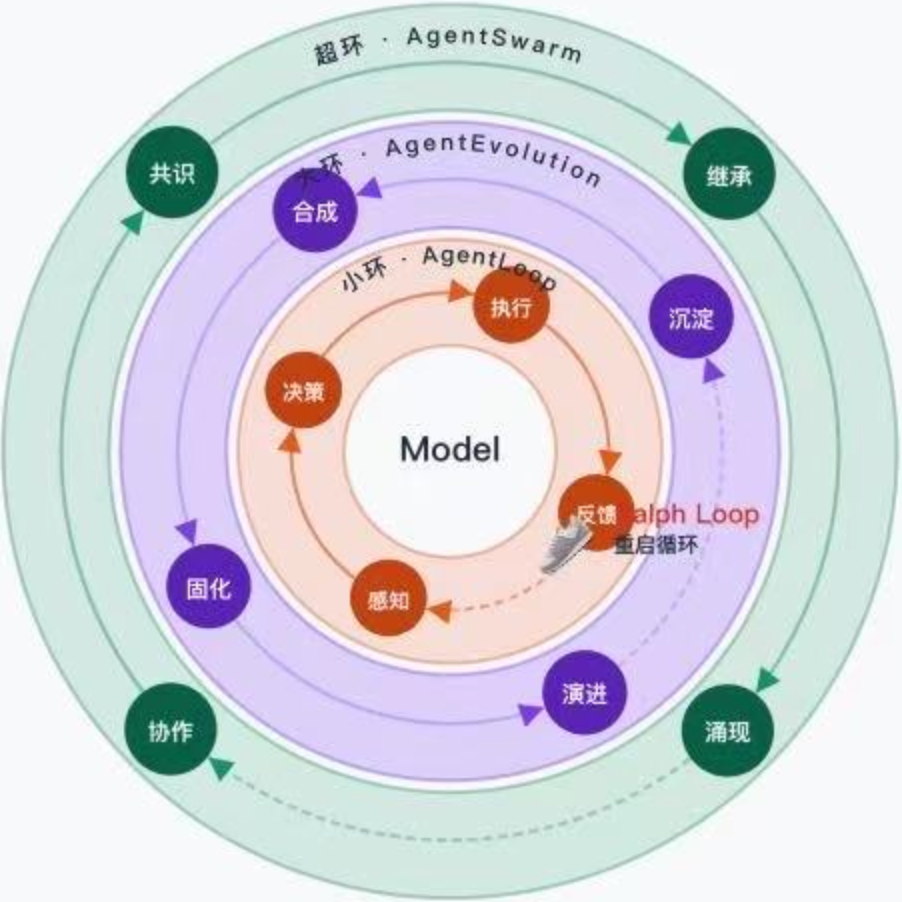
AI has already entered code writing, algorithm optimization, and model development. But after a task is completed, what remains may be reusable capability—or merely an answer and scattered logs. The difference becomes apparent only when a similar problem comes up again: can the system reuse what it learned, or must it pay the cost of exploration all over again?
Recursive Self-Improvement (RSI) co…
 markitdown• Pinned