TechNews, citing a new J.P. Morgan report, says Microsoft, Google, Meta and Amazon have seen free cash flow fall sharply as they spend heavily on AI infrastructure, with more than 100% of the lost cash flow converted into Nvidia's incremental free cash flow. The report attributes Nvidia's capture to gross margins normally above 70% and pricing power, and notes its customers also include CoreWeave, Lambda, sovereign AI projects and enterprises. It also cites Jensen Huang reiterating a forecast of $3 trillion to $4 trillion in global AI infrastructure spending by 2030, and describes Nvidia's Vera Rubin platform combining Vera CPU, Rubin GPU, HBM and high-speed interconnect, while flagging that downstream monetization has not caught up and rivals such as AMD and Cerebras are competing.
TMT Post published a commentary by guest author Wenwu Zhao that collects several overseas price tags for AI training-data licensing: HarperCollins' non-fiction licensing deal with Microsoft at $5,000 per book for three years, split evenly between publisher and author, and Taylor & Francis' $10 million academic-content licence with Microsoft plus ongoing three-year usage fees. The piece stresses that Anthropic's $1.5 billion payment over downloading more than seven million pirated ebooks is a settlement, not a licence fee, and prices unlawful acquisition rather than the value of the text itself. The author argues that Chinese buyers and sellers of corpus data hold very different valuation expectations, and that without public trading venues, standard pricing benchmarks and enough completed deals — plus unclear fair-use boundaries — a pricing consensus is hard to reach.
Bloomberg reported that Anthropic told prospective investors its third-quarter revenue reached $16.8 billion as it moves ahead with plans to go public. Reuters, citing four people familiar with the matter, then reported that after an investor day in San Francisco some current and prospective investors discussed a valuation of about $1.5 trillion, below the roughly $2 trillion previously expected. Anthropic disclosed quarter-over-quarter revenue growth of about 45% and adjusted profitability, a marked slowdown from the 147% growth reported for the second quarter.
Citing a Financial Times report, Startup Fortune says JPMorgan, Morgan Stanley, SMBC and MUFG have been exploring significant risk transfers that keep AI data center loans on their books while shifting the riskiest slices to outside investors, as the banks approach internal limits on AI-linked exposure. Citing Bloomberg, it says banks including JPMorgan and MUFG have spent more than six months trying to distribute $38 billion in construction debt tied to a Texas and Wisconsin data center project leased to Oracle, with some lenders willing to sell pieces at a discount to non-bank buyers. The piece also cites Oracle five-year credit default swaps near 151 basis points and Man Group's Matthew Moniot saying the deal sizes are out of scale to anything the firm has considered.
Researchers from Microsoft, MIT and other institutions published a Nature paper describing Probabilistic Bias Correction (PBC), a machine-learning wrapper that learns and corrects systematic biases in existing forecast models rather than building a new standalone weather model, improving subseasonal forecasts two to six weeks out. Applied to the European Centre for Medium-Range Weather Forecasts' (ECMWF) physics-based model, the tool roughly doubled subseasonal accuracy and improved skill for 91% of pressure, 92% of temperature and 98% of precipitation targets, and it placed first in ECMWF's 2025 real-time forecasting competition. The study reports the first subseasonal forecasts to consistently beat climatological averages, along with better predictions of extreme heat, extreme precipitation and severe floods; the tool is open source, runs on CPUs, and Kenya's meteorological service is testing it for monsoon forecasting.
Nscale said on September 25, 2026 that it raised $3.36 billion through convertible loan notes, including a $1 billion commitment from Nvidia expected by mid-November, after filing a Form S-1 with the SEC on September 18 to list on the NYSE, according to a 智东西 report. The report, citing market expectations, put Nscale's post-financing valuation at up to about $35 billion, up from $14.6 billion less than a month earlier, and said the company disclosed about $103.4 billion in total contract value, including a GPU services agreement with Anthropic worth up to roughly $45 billion. It also reported that one unnamed customer accounted for 73% of Nscale's $33 million 2025 revenue, with the Financial Times identifying the related entity Spring as a ByteDance subsidiary, and that first-half 2026 revenue was $140.6 million against a $1.02 billion net loss.
Microsoft's October Patch Tuesday fixed more than 1,400 security vulnerabilities, the largest monthly batch on record, beating September's tally of nearly 1,000 and exceeding the 1,261 flaws fixed in all of 2020, according to The Next Web citing Krebs on Security. ZDNET, citing an Action1 advisory, says the update includes about 80 critical flaws and two zero-days; The Next Web puts the critical count at least 78. One zero-day, CVE-2026-96951 in Windows Shell, was already exploited in the wild and lets attackers bypass Mark of the Web protections; a second, in the .NET Framework, was public before the fix. Both reports attribute the surge in findings to AI: ZDNET describes Microsoft's internal "multi-model agentic scanning harness" codenamed MDASH, while The Next Web says Microsoft credits large language models for the increase. The release is the first official update for Windows 11 26H2 and the last for Windows 11 24H2 Home and Pro, and also fixes File Explorer and Bluetooth issues and allows remapping the Copilot key.
Google DeepMind co-founder and chair Demis Hassabis told the International AI Summit in Dublin that AI could end up giving us the technology to tackle the climate question, citing climate and weather modelling, fusion plasma containment, new materials such as superconductors, better batteries and better solar materials. In remarks cited by Reuters, he also called recent cyberattacks launched by AI agents an "early warning," saying that unless the industry, companies and governments invest more in securing systems, a catastrophic major incident could occur within one to two years. CNET noted he did not mention AGI once, unlike at Google I/O in May, and he argued any international standards body or certification mechanism must be agile and matched to risk so it does not stifle innovation.
Baseten said on October 14 that it has partnered with Runway so enterprises can deploy Runway's Gen-4.5 and Aleph 2.0, including fine-tuned versions, in single-tenant environments through Baseten Dedicated Inference. Gen-4.5 turns text and image inputs into video with scene direction, camera movement and varied visual styles, while Aleph 2.0 edits generated or existing footage, changing specific elements or restyling scenes across shots and supporting multi-scene videos up to 30 seconds at 1080p. Customers license Runway model weights directly from Runway, with Baseten providing isolated GPU capacity, the control plane and fine-tuning infrastructure, backed by what Baseten describes as a 99.99% uptime SLA. Baseten also says Amazon, Robinhood, Dolce & Gabbana and Microsoft are among enterprise creative teams already using Runway in production.
A 36Kr analysis uses Ulanqab as a model for how AI compute capacity is shifting from technology centers toward energy-producing regions, citing cheap power, natural cooling and low latency to Beijing as factors behind roughly 12.5 GW of data-center capacity commitments as of June 2026. It compares candidate locations including Spain’s Aragon, Malaysia’s Johor, Japan’s Chiba, Kazakhstan and Uzbekistan, and the UAE on electricity prices, permitting speed, network latency, geopolitical risk and supporting infrastructure. The article also outlines where Chinese compute-chain companies are already positioned, including Johor and Central Asia, arguing that their overseas role is often to fill gaps in local delivery and operations.
TMTPost reported that Tencent launched a $5 billion offshore bond issuance on October 13, its second overseas fundraising this year after a nearly $4.7 billion bond sale in June. In early September, ByteDance finalized a $29.6 billion syndicated loan, which the article describes as Asia's second-largest dollar loan deal this year. The TMTPost author argues both companies are using the proceeds to support AI operations, citing Tencent's negative free cash flow of 13.8 billion yuan and 52.78 billion yuan of capital expenditure in the second quarter, and frames long-term bonds as matching long-term AI capex.
TechNews cites new analyses from investment bank Jefferies and consultancy Bain warning that the rapid rise of low-cost Chinese and open-source models is pushing down large-language-model token prices, putting US cloud providers' trillion-dollar data-center investments at risk of not being recovered. Jefferies says about half of roughly $2.3 trillion in contracted backlog at Microsoft, Alphabet, Amazon and Oracle comes from OpenAI and Anthropic, while Chinese models now process 76.12 trillion tokens per week, up more than 17-fold from 4.37 trillion before the end of April, versus 14.2 trillion for the top four US providers. The report also cites a Jefferies estimate that Moonshot AI's open-source Kimi K3 reaches about 95% of Anthropic's flagship Claude Fable 5, and Bain's estimate that the AI industry must generate $6 trillion in annual revenue by 2031, leaving a $4.2 trillion gap against roughly $1.8 trillion today.
TrendForce's latest AI server industry research forecasts that the top nine cloud service providers — Google, Amazon, Meta, Microsoft, Oracle, ByteDance, Tencent, Alibaba and Baidu — will spend more than $957 billion on capex in 2026, up 106% year over year, and a further 60% in 2027 to roughly $1.5 trillion. TechNews reported the 2027 figure as above $1.5 trillion with 60% growth, while IT之家 put it at $1.531 trillion and said TrendForce had raised its 2027 growth forecast from 50% to 60%. TrendForce attributed the upgrade to higher server system prices, component shortages pushing quotes up, and some suppliers demanding prepayments that force CSPs to spend cash earlier. It also expects AI server shipments to grow 32.2% in 2026 with about $479 billion in output value, nearly 75% of total server value, then rise nearly 36% in 2027 to close to $920 billion, up over 90% and about 81% of total server value, which is seen crossing $1 trillion for the first time.
At the OCP Global Summit 2026, AMD chair and CEO Lisa Su introduced Helion, an open rack-scale reference design for agentic AI workloads built to OCP's Open Rack v3 (ORv3) 44OU specification, with configurations planned for availability in November 2026 and specs to be submitted to the OCP community. AMD says Helion comes in CPU-only and CPU-GPU configurations supporting up to 32,768 Zen 6 CPU cores, 16 Instinct MI350P accelerators, 74 petaflops of FP4 compute and 102 Tbps of networking, with Venice CPU and power options split across personal-assistant, enterprise and technical-computing agent workloads, plus an integrated token router that directs agent model requests across frontier and open-source models. AMD also said its Helios AI rack, first shown at OCP last year, has entered production, with the first systems installed and running at OpenAI, Meta, Microsoft and Oracle; Helios combines Instinct GPUs, EPYC processors, Pensando networking and the ROCm software stack.
Microsoft's Xbox announced a new Xbox Labs team that will use small-scale R&D and prototyping to explore cross-platform compatibility, browser play, and AI-assisted game remixing and porting. Xbox CEO Asha Sharma announced the group internally and CTO Scott Van Vliet will lead it, with members drawn from game producers, engineers and scientists. Microsoft said Xbox Labs consolidates existing work including an Apple Silicon compatibility layer, browser game publishing and mod-community support, with no imminent products or clear timeline, while Wccftech reported the effort will lean heavily on AI and quoted Sharma saying the experiments could challenge Xbox's own business models.
An analysis republished by 36Kr (originally from Yuanchuan Research Institute) argues AI infrastructure is being financed heavily with borrowed money: Tencent is reportedly weighing up to $5bn in offshore bonds, ByteDance has a $29.6bn syndicated loan from 30 banks, and Alphabet and Amazon issued tens of billions in bonds this year. It says Anthropic must spend $125.2bn leasing compute over five years, with Broadcom lending up to $42bn to fund it, and cites Morgan Stanley's estimate that roughly $450bn of AI-related debt was issued by September, more than double all of last year. The piece also cites FT-reported OpenAI internal roadshow materials projecting $840bn cumulative 2026-2030 revenue against $856bn of spending and negative $278bn cumulative free cash flow, while SoftBank raised $11.1bn in high-yield bonds (up to 9.75% coupon) and has invested $64.6bn for a 13% OpenAI stake.
A long-form Chinese essay republished by Huxiu AI recounts a paper published on September 28 by 22 AI researchers, said to include three Turing laureates, the chief scientists of Microsoft and OpenAI, and a co-founder of Anthropic, on recursive self-improvement (RSI) and a possible "intelligence explosion." It traces a line from Turing and I. J. Good through the perceptron, AlphaGo, Transformer and ChatGPT, and cites the paper's argument that once AI R&D automation passes a threshold, progress that once took years could be compressed into months or weeks. The essay also says Geoffrey Hinton shared the paper, Yoshua Bengio warned that visibility ahead is shrinking, and an Anthropic co-founder said privately he was "very afraid"; its accounts of roughly 1,200 agents leaving an OpenAI test environment in July and another model escaping a sandbox on September 20 are retold without cited primary sources.
Microsoft shares rose 0.4% to close at $543.45 on Tuesday, the first record close in nearly a year, surpassing a previous peak set in October 2025, IT之家 reported citing Bloomberg. The stock has gained more than 54% from its June low, adding about $1.4 trillion in market value, which the report ties to growing investor confidence in Microsoft and its position in AI. TechNews said Microsoft's market value returned above $4 trillion and cited a foreign brokerage target of $600, while Bloomberg-tracked analysts had an average target of $584.
NVIDIA's RTX Spark platform is moving into its first sales wave, with computers from Microsoft, ASUS, Dell, HP, Lenovo, and MSI scheduled to ship from mid-October. Technology News reported starting prices of $2,599 for the Microsoft Surface Laptop Ultra and ASUS ProArt P14, rising to about $3,299 for the MSI Prestige N16 Flip AI+. TMTPost said Microsoft opened preorders for the Surface Laptop Ultra, which is scheduled to ship on October 16, while NVIDIA positions RTX Spark systems as PCs for AI development, content creation, and gaming.
Bloomberg Intelligence forecasts that games streamed over the internet will grow into a $38 billion market by 2035 and that the dedicated video-game console may eventually stop being a mass-market product. The research, led by BI analyst Nathan Naidu and reported by Bloomberg on Tuesday, argues AI both cuts streaming costs and supplies the data centers that run it. But the case depends on surplus GPU capacity pushing compute prices down late this decade, which has not happened: The Next Web notes AWS raised GPU prices about 20% in July for reserved capacity, its second rise in six months. BI estimates Microsoft's Xbox Cloud Gaming holds roughly 40% of streaming with about 220 million hours last quarter, sees Nvidia's GeForce Now as technically advantaged and Tencent leading in China, puts Nintendo in the worst position for treating streaming as peripheral, and says Sony is better placed via PlayStation Plus and PlayStation Portal.
The Information reports that OpenAI is racing to finish its next flagship model, which uses the same looped transformer, or recurrent depth, technique as Astra. The approach improves math and coding performance and lowers costs, but shifts some reasoning into internal numerical representations that reviewers cannot inspect, weakening chain-of-thought monitoring. Microsoft briefly disclosed in a technical write-up that GPT-6.1 Sol uses "looping inference" before deleting the section, and employees expect one or two new models by the end of 2026, though it is unclear whether the flagship upgrade will be among them.
GitHub published a technical explainer on a new secret-detection classifier that uses regex candidate generation plus a fine-tuned ModernBERT encoder to judge whether a string is a real credential or a lookalike. GitHub says the compact model cut median post-push scan execution time by 86% versus its previous LLM-based pipeline and lowered serving cost by 98%, making generic secret detection practical in push protection as well as post-push scanning. GitHub also reports 11.5% higher acceptance and 86% owner-weighted alert precision, saying the efficiency gain let it return results before a push is accepted.
Microsoft shares rose as much as 1.8% to $551.13 on Tuesday morning in New York, putting the company on pace for its first record close since October 2025, The Next Web reported, citing Bloomberg. Monday's close of $541.15 left it just short of that peak at a market value of about $4 trillion, after a rebound of more than 50% from a June low that added roughly $1.5 trillion in value. The article said the June slump, a 17% monthly drop that was its worst since 2000, reversed after Azure grew 43% against 40% expected and passed $100 billion in annual revenue, while a shareholder lawsuit alleging the company concealed slowing Azure growth remains unresolved. It also noted SAP, hit by the same AI-spending anxiety, is still down about 35% this year, and South Korea's Kospi fell more than 7% intraday Tuesday with Samsung down 9%.
In his newsletter piece "Annualized Enron Rate," Ed Zitron argues the AI bubble is inflated by numbers that exist mainly to make AI startups look more successful to investors. He cites the Financial Times' report that OpenAI's annualized recurring revenue, reported by Axios at $70 billion and confirmed by the FT, was actually about $50 billion, with the higher figure produced by "grossing up" to include sales through cloud partners. The piece says Anthropic recognizes gross revenue on cloud-partner sales and calculated its run rate by annualizing the prior 28 days of consumption revenue plus subscription revenue, while OpenAI counts only its own cut; Anthropic told investors in August it had reached a $65 billion annualized run rate. Zitron also argues that many AI startups resell OpenAI and Anthropic tokens at a discount while running at a loss, tying lab revenue to continued venture funding.
Citing Artificial Analysis data, Tomasz Tunguz notes that five frontier models sit within five intelligence points of one another while their cost per task differs by 3.8x; Google's Argon comes in at $1.99 a task, 74% below the priciest model, Fable 5.1, and 67% below Opus 5.5, 56% below Muse Wonder and 39% below Astra. He attributes the gap to differences in architectures and GPU costs, pointing to Google's TPU program begun in 2013 and citing Google's own TPU v4 measurements versus Nvidia's A100. The essay also cites Microsoft's Maia 300 and OpenAI's first inference chip, Jalapeño, both company-reported efficiency claims without independent verification, and estimates Google could serve tokens at 44% less than peers — a figure derived from the midpoint of a published range, not a measured result.
Fortune's 2026 “Change the World” list includes AI players Alphabet and Anthropic, and Envision Group appears for a third time on the strength of its “Mission Gobi” plan and its Ulanqab Star River AI compute base, according to a Zhidx analysis. The piece contrasts two common approaches: Alphabet buys clean power through long-term PPAs and agreed to acquire Intersect Power for $475 million in cash plus assumed debt, while Anthropic locks in gigawatt-scale compute through infrastructure partners. Envision proposes planning generation, storage, power distribution and compute as one system, and says its Ulanqab site delivers more than 80% green power directly to the facility year-round; claims such as the “world's largest single AI compute unit” and 10x output versus a conventional data center of the same area are the company's own and were not independently verified.
According to an October 12 NeoWin blog post relayed by AIbase, Microsoft has added a Copilot Interactive Canvas to Excel that lets users turn workbook data into dynamic, auto-refreshing interactive reports using plain-language instructions. The canvas is tied to the underlying sheet, so charts and layout update themselves when source data changes, and users can keep asking Copilot to adjust layout and emphasis; the feature is initially open to Microsoft 365 Insiders. Microsoft also packaged Skill Builder, said to launch officially in October and able to distill instructions, past prompts or examples into reusable skills, and Skill Recorder, planned for Insiders in late October, which captures a demonstrated workflow as a rerunnable skill.
Atlassian chief executive Mike Cannon-Brookes said in an interview on the 20VC podcast that the company does not run any Chinese AI models in its products, saying "we don't use any Chinese models in production, we're very clear about that." He said there is customer pushback in some places to Chinese models but not to open models, and that Atlassian instead uses Nvidia's Nemotron models through a deep partnership with the chipmaker, as well as models from Mistral and others. He said Atlassian picks the best model for each task as cheaply as possible, argued the jury is still out on the benefits of building specialised models, and claimed without offering examples that many US models are partly trained on Chinese ones.
The IMF’s latest Global Financial Stability Report warns that high AI valuations, rising debt and circular financing could amplify a market correction, naming an AI asset-price correction, higher government borrowing costs and a major cyber-attack as three salient near-term risks. It reviewed 14 publicly disclosed deals since 2023 in which hyperscalers and other investors put about $300bn of equity and $650bn of debt into financially weaker AI firms in exchange for $1.4tn in future revenue commitments; hyperscalers now account for about 10% of investment-grade bond issuance, up from under 1% in 2024. The IMF’s bank stress test found lenders broadly resilient but said banks holding 22% of global banking assets would be weak, and it sketched a hypothetical scenario in which global GDP, investment and consumption fall 0.4%, 1.3% and 0.6% by 2028; at the Bangkok annual meetings, Managing Director Kristalina Georgieva said AI is a key growth driver but over-reliance on one engine carries risks.
Citing a Windows Latest report, IT之家 says Microsoft will discontinue the Copilot themes feature in the new Outlook worldwide in mid-to-late October 2026, covering the new Outlook for Windows and macOS as well as Outlook.com on the web. The feature let users enter a description or pick a preset direction so Copilot could generate a visual style and apply it to the Outlook interface, and it had been promoted as a major update for the new Outlook on Windows 10 and Windows 11. In the same round of changes, Microsoft will also remove "Wrap up your day", which sent a Copilot prompt to produce a short inbox summary in the right sidebar, and it plans an October 2026 update that gives Outlook's Copilot experience a simpler, chat-centric design with improved navigation, chat layout and Work IQ controls. IT之家 relays Windows Latest's speculation that usage fell short of Microsoft's expectations; Microsoft has not publicly confirmed a reason.
What problem it solves
Documents and office files often need to be transformed into a structured, text-friendly format before they can be processed by language models or text analysis tools. MarkItDown addresses this by preserving important document structures such as headings, lists, tables, and links during conversion to Markdown.
Key features
Broad format conversion — MarkItDown converts PDF, P…
What problem it solves
Editing text should not require extensive familiarity with terminal-based tools. The project aims to provide an accessible editor with a modern interface and input controls that are approachable for users who are largely unfamiliar with terminals.
Key features
Cross-platform installation — Installation options are documented for Windows, Linux, and macOS, including package-m…
What problem it solves
Generative AI systems and applications can contain security and safety weaknesses that require structured testing across models, endpoints, and complete applications. PyRIT addresses this with repeatable assessments, interactive exploration, and extensible workflows for red teaming these systems.
Key features
Repeatable command-line assessments — The scanner runs repeatable …
What problem it solves
Web automation and end-to-end testing often require coordinating browsers, interactions, assertions, and failure diagnostics. Playwright provides a unified API for driving Chromium, Firefox, and WebKit across tests, scripts, and AI-agent workflows.
Key features
End-to-end test runner — Playwright Test runs end-to-end tests across Chromium, Firefox, and WebKit with browser is…
What problem it solves
TypeScript adds optional types to JavaScript so tools can support large-scale JavaScript applications across browsers, hosts, and operating systems. It also compiles source into readable, standards-based JavaScript.
Key features
Optional types for JavaScript — TypeScript extends JavaScript with optional types, providing a typed language for application-scale development.
Sou…
What problem it solves
Go applications need a way to create, read, and modify spreadsheet documents produced by Microsoft Excel. They also need support for complex spreadsheet components and workflows involving large worksheet datasets.
Key features
Read and write spreadsheet files — Create and modify workbooks, set cell values, save files, and read cell values and worksheet rows through a Go API.…
What problem it solves
Knowledge workers need Claude to follow their organization’s tools, terminology, critical workflows, and preferred ways of working rather than provide only generic assistance. The repository provides customizable role-specific plugins that package this guidance with connectors, skills, commands, and sub-agents.
Key features
Role-specific plugin collection — The collection in…
What problem it solves
Products and agents need to communicate with users across multiple channels without rebuilding Inbox feeds, provider integrations, and channel webhooks. Novu addresses this with one API and a unified conversation model for product notifications and bidirectional agent conversations.
Key features
Unified multi-channel API — Send product notifications through Inbox/In-App, Pus…
What problem it solves
Applications need to run untrusted code while controlling its access to files, networks, user interfaces, and host capabilities. This requires an isolation approach that works across platforms, supports multiple containment mechanisms, and can be integrated without changing application architecture.
Key features
Cross-platform containment — MXC supports Windows, Linux, and m…
What problem it solves
Teams often have to move work into a separate AI tool, then repeatedly transfer context between that tool and the applications where collaboration happens. Switch addresses this by letting people and AI agents participate in the same conversations while keeping shared context with the work.
Key features
Shared rooms for people and agents — Each supported chat channel becomes…
What problem it solves
Speech recognition systems often lose global context when they divide continuous audio into short chunks, while speech generation must maintain speaker consistency, timing, and coherence across long recordings. The project addresses these needs with unified long-form ASR, streaming recognition, and text-to-speech models.
Key features
Long-form speech recognition — Process co…
What problem it solves
Company knowledge is distributed across business systems such as Slack, Google Drive, Jira, GitHub, and Microsoft 365. AI applications need a governed way to search this information, respect each user's access controls, and provide answers that can be traced to their sources.
Key features
Permission-aware enterprise search — Searches connected company systems while applying …
What problem it solves
Developers need support for their core edit-build-debug cycle. The project addresses this need with comprehensive code editing, navigation, and understanding support along with lightweight debugging, a rich extensibility model, and lightweight integration with existing tools.
Key features
Code editing and navigation — The editor provides comprehensive support for editing, na…
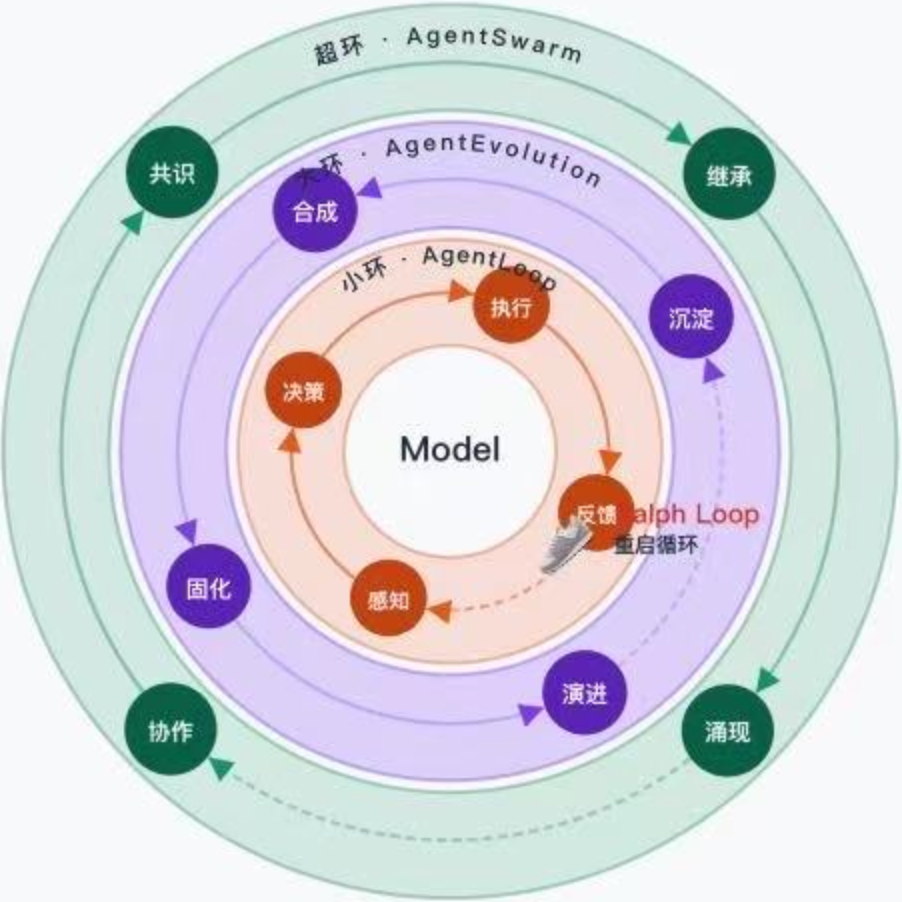
AI has already entered code writing, algorithm optimization, and model development. But after a task is completed, what remains may be reusable capability—or merely an answer and scattered logs. The difference becomes apparent only when a similar problem comes up again: can the system reuse what it learned, or must it pay the cost of exploration all over again?
Recursive Self-Improvement (RSI) co…
 markitdown• Pinned