China's interconnect chips move center stage as AI clusters stall on data movement
A 钛媒体 feature argues that chip supply is no longer the main constraint on AI compute: many data centers have GPUs and power but cannot keep clusters fully utilized, with China's CAICT cited as finding network communication accounts for 30% to 50% of time in large-scale distributed training. Huawei vice president Wang Lei is quoted from the 2026 China Internet Conference saying domestic token circulation efficiency is only 60%, with the rest lost to packet loss, latency jitter and data degradation, while 众星微 chief engineer Ning Zuolin estimates most clusters release no more than 50% of their compute. The piece also reports that 众星微 recently released three interconnect chips, including an AI NIC that integrates a PCIe Switch to cut board-level link length and latency, and it cites an estimate that interconnect chips make up roughly 8% to 9% of the value of supernode systems such as GB300 and VR200.
The article cites a Tencent Cloud analysis saying network communication is only 8% to 10% of AI cluster deployment cost but determines up to 90% of GPU training efficiency, framing interconnect as a lever on expensive GPU utilization.
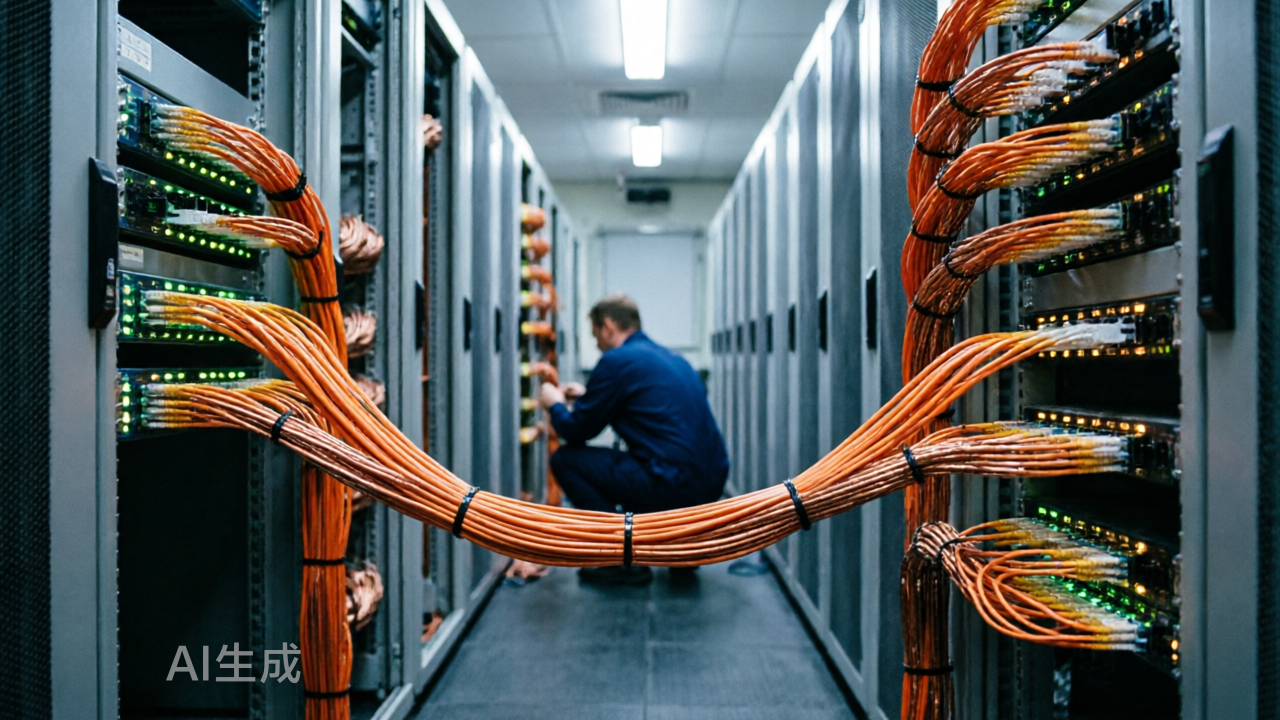
虽然芯片产能依旧有些许供不应求,但已不是制约AI算力发展的最大阻碍。如今,很多数据中心中,芯片有了,电力供应也充足,但集群却跑不满。
中国信通院的数据显示,大规模分布式训练中,网络通信耗时占比高达30%到50%。换句话说,企业花大价钱买来的GPU,有将近一半的时间在等数据。华为副总裁王雷在2026中国互联网大会上说得更直接:当前国内Token实际流通效率仅60%,剩余40%因为丢包、时延抖动、数据损耗被白白消耗掉了。
芯片越多,通道越窄
众星微副总经理兼总工程师宁佐林告诉我们,“整个集群真正让算力释放出来的,大部分不超过50%,有些好的可能是60%~70%。”这意味着超过一半的算力投资,事实上处于低效运转状态。
#众星微#China Academy of Information and Communications Technology#Huawei#Nvidia#Marvell#H3C#Dell#Tencent Cloud