Create

Sign in to ReadmeX

or

How we handle your data: Privacy Policy

ReadmeX

Your AI reading companion

What would you like to catch up on?

Pick a briefing, or ask your own question.

Your community and people briefings stay personal to you.

glm-5.3

AI overview

Sign in and the AI will write an overview from our coverage.

Headlines · 59

  1. Zhipu Compensates Coding Plan Users and Teases Next GLM Model

    Zhipu reportedly sent affected GLM Coding Plan users three quota-reset cards after some encountered model degradation, according to 36Kr, which republished QbitAI. A compensation notice also promised another quota reset after a new model launches. Reports circulated about a possible GLM-5.5 model, including unverified estimates of 2.5–3.5 trillion total parameters and the possible use of a recurrent Transformer, but Zhipu has not confirmed its name, release date, specifications, or architecture.

    36氪 人工智能 · 🔥 0
  2. vLLM scales GLM-5.3 to 1M-token contexts on 16 H200 GPUs

    vLLM Blog reports a GLM-5.3 serving deployment that uses 16 NVIDIA H200 GPUs, divided into separate prefill and decode nodes. Prefill Context Parallelism splits prompts by token, Decode Context Parallelism shards the KV cache, and Hybrid HiSparse keeps decode KV data in host memory. On AgentX, the tested PCP8 × DCP8 configuration with Hybrid HiSparse reported 1.7–3.2× per-user speed at equal throughput to data-parallel serving and was the only tested configuration that served 1M-token contexts; however, these results came from the project's own contributors.

    vLLM Blog · 🔥 0
  3. Snowflake's Cortex AI Gateway enters public preview on AWS

    Snowflake has moved its Cortex AI Gateway into public preview in AWS commercial regions, according to InfoQ's relay of a Snowflake blog post. The gateway acts as a central control plane for enterprise AI, offering governed model inference through a single endpoint, dynamic model routing, MCP tool governance, observability, guardrails and cost controls. It implements the Chat Completions API for OpenAI, Grok, GLM, Gemini, Llama, Mistral and DeepSeek models and the Messages API for Claude, with access managed through Snowflake's existing role-based access control.

    InfoQ 中文 AI&大模型 · 🔥 0
  4. OpenAI-led coalition briefs White House Super Intelligence Force on critical PHP flaws

    Since August, a coalition led by OpenAI has been working to address critical vulnerabilities in PHP, the open-source language that undergirds much of the web, according to The Information. An OpenAI spokesperson said the company briefed several agencies, including the Cybersecurity and Infrastructure Security Agency, about the PHP vulnerability and briefed National Intelligence Director Jay Clayton and senior Defense Department official Emil Michael late last week, describing it as its first "major engagement" with the new Super Intelligence Force. A White House official said the SI Force helped pressure "relevant parties" to deploy a patch. The article also notes OpenAI's "defender's window" framing and cites an Anthropic blog post from late September warning that Chinese lab Z.ai's GLM-5.3 lags U.S. frontier models by about four months, a comparison made by a competing U.S. lab.

    The Information · 🔥 0
  5. AlayaNeW open-sources Alaya-DFlash2, claiming 3.41x GLM-5.3 decode speedup

    AlayaNeW (九章云极) released and open-sourced Alaya-DFlash2, a speculative-decoding acceleration scheme built for GLM-5.3 that pairs a draft model able to propose candidates in parallel with a path-selection mechanism. In its own evaluation at TP=8 on 8×H200 with single concurrency, decode speed was about 288.2 tokens/s versus 84.5 tokens/s for native autoregressive decoding, a 3.41x gain, with total output throughput rising from 78.95 to 236.47 tokens/s. The report also says acceptance length exceeded IncoAI-DFlash2 and RedHat-DSpark across 1k–32k low-entropy contexts, and that at 64-way concurrency throughput reached 608.71 tokens/s, 44.9% above native decoding.

    InfoQ 中文 AI&大模型 · 🔥 0
  6. DeepSeek V4.1 Flash 1017 debuts as open-weight value leader

    Latent Space's AINews roundup reports that DeepSeek V4.1 Flash 1017 is a 552B-total, 16B-active MoE model with a 1M-token context window under an MIT license, priced unchanged at $0.30/$1.20 per million input/output tokens at peak, with off-peak pricing half that. Artificial Analysis scores it 45 on its Intelligence Index, up six points and tied with GLM-5.3 for second among open-weight models, while noting MiMo-V2.6-Pro and GPT-6.1 Sol (medium) score higher at lower cost per task. The model is available through DeepSeek's API, Fireworks, Baseten, DeepInfra, Cloudflare and Together, and ranks first among open models in Code Arena WebDev at No. 12 overall with 1,670 points; Together says it was trained with self-feedback RL, and release figures cite Terminal-Bench 4.0 rising from 31.2 to 42.3.

    Latent Space · 🔥 0
  7. SGLang adds Low-Latency Mode with plugin kernels for NVIDIA and AMD GPUs

    The SGLang, NVIDIA and AMD teams introduced SGLang Low-Latency Mode, which brings specialized low-latency kernels into the SGLang serving stack through a plugin framework, with NVIDIA kernels in sgl-nvidia-mega and AMD kernels in sgl-amd-mono. In AgentX trace replay with DeepSeek-V4.1-Flash with DSpark, the teams report P90 per-user token generation rising from 671.2 to 928.4 tokens/s (1.38x) on four NVIDIA GB300 GPUs at one concurrent session, and from 331.6 to 516.0 tokens/s (1.56x) on four AMD MI355X GPUs at four concurrent sessions, each against the SGLang baseline on the same hardware. The NVIDIA plugin also improved per-user decode speed by 12-38% at 1-8 concurrent requests on an 8K-input / 1K-output workload, and the teams say megakernel work is underway for GLM-5.3, K3 and MiniMax M3.

    LMSYS Blog · 🔥 0
  8. Cloudflare launches Clairic extraction model preview

    Cloudflare launched Clairic in preview on Workers AI, a System One-style model designed to extract specified values from unstructured documents in a single pass, with confidence scores and null values for missing fields. Cloudflare says it can also perform simple calculations, estimates, and forecasts, while open weights are planned for a later release. In a Cloudflare-published customer-service test, the full Clairic-Clef-GLM-5.3 chain took 19.3 seconds, compared with 61.7 seconds for GLM-5.3 alone.

    Techmeme · 🔥 0
  9. prime-rl 0.10.0 releases with IPO default and unified evals

    Prime Intellect released prime-rl 0.10.0 and verifiers 0.4.0, making the new INTELLECT Policy Optimization (IPO) loss the default for asynchronous reinforcement learning. The release adds optimized model support, including DeepSeek V4 Flash, Qwen3.8 Flash Next and Nemotron-H, and consolidates evaluation into prime-rl. Prime Intellect reports that prime-rl was 1.15 times faster than torchtitan in its Qwen3-235B-A22B supervised fine-tuning comparison, though the benchmark details come from the vendor.

    Prime Intellect Blog · 🔥 0
  10. DecisionPivot benchmark probes decision failures hidden by aggregate scores

    A new arXiv preprint introduces DecisionPivot, a diagnostic benchmark of 48 tasks and 40,033 items across seven decision roles for models that handle routing, guardrails and output verification in LLM systems. Its core track holds 7,800 items from 13 generated task families arranged in contrast groups with answers verified by independently implemented solvers, while a reference track carries 32,233 items from 35 public test sets under their original metrics. The authors evaluated 40 decision models and 14 general models and report that two 27B models only 2.6 points apart on the reference track reached contrast-group accuracies of 70.1% and 44.2%; Perplexity Decider ranked the positive member above the negative in 92.3% of 2,400 binary pairs but answered both correctly in 74.1%, and GLM-5.3 scored 93.5% on a 1,296-item subset at a higher reasoning setting versus 81.5% at its lowest effort.

    Hugging Face · Papers · 🔥 0
  11. Hands-on: Gemini 3.7 Flash is fast, but details lag

    A Juejin blogger tested Google's newly updated Gemini 3.7 Flash inside Antigravity and reported that most tasks finished in under three minutes, compared with over an hour for GLM 5.3 he used as a baseline; however, the cyberpunk web page lacked detail, the astronomical watch render was missing hands, and the 3D pool game never got the table's six pockets right. The post cites a DeepMind announcement saying the model is stronger at coding, knowledge work and web development, and notes its benchmark screenshots for FrontierCode, DeepSWE, AutomationBench and Code Arena compare against second-tier rivals such as Sonnet 5 and Terra rather than top-tier models.

    掘金 · 人工智能 · 🔥 0
  12. Tencent reportedly tests “Dongleya” AI learning community

    IT之家 reported, citing user feedback, that Tencent is beta-testing “懂了鸭,” an AI interactive-content community for children and teenagers. The website and WeChat mini program reportedly offer limited testing to parents with children and frontline teachers. Its built-in AI agents can reportedly turn natural-language prompts into 3D demonstrations, dynamic lessons, interactive picture books, lightweight games and memory cards without requiring programming skills. Users can browse community works and adapt others’ creations. IT之家 also said the model list includes DeepSeek-V4.1-Flash, DeepSeek V4 Pro, DeepSeek V4 Flash, Hy3, Hy4 preview, MiniMax M3, Kimi K3 and GLM-5.3. The supplied reports do not include direct confirmation from Tencent, and they describe the test’s access arrangements differently.

    DoNews · 🔥 0
  13. SGLang v0.5.22 ships new model support and up to 2.3x throughput gains

    SGLang has released v0.5.22, with its release notes stating the version covers 950 pull requests from 245 contributors. The release adds support for models including Clef / Clef Flash, PPLX-Decider v1 / v1.1, EmbeddingGemma 2, LLaDA2.2, HunyuanImage-3.0-Instruct and Kandinsky 6. The notes say DeepSeek-V4.1 gains up to 2.3x more throughput per GPU on H200 and now runs on AMD MI350X / MI355X with up to 1.9x throughput from DSpark, while GLM-5.3 can combine decode context parallelism with MTP for up to 2.1x faster decoding. The release also requires Python 3.11 or newer and deprecates options such as --enable-dp-attention, making it a breaking-change upgrade.

    SGLang Releases · 🔥 0
  14. StartLux-Decision-v1.1 tops Hugging Face decision-model leaderboard

    Reports from 36Kr, TMTPost and InfoQ Chinese say StartLux's StartLux-Decision-v1.1-27B Instant ranked first on Hugging Face's updated Decision Index 0.3.2 with 69.1 points, which InfoQ gives as 69.12; the reports differ on whether 173 or 174 entries were listed. The new generation offers Instant, which returns option probabilities in a single pass, and AutoThink, which generates extra reasoning only when initial confidence is insufficient; the team also introduced the RLCD² training method and the DecisionPivot benchmark, and says 27B AutoThink scored 73.37 on its own Decision Index 0.3 evaluation versus 57.96 for hosted Jev. Model weights and inference code are published, but the weights use a CC BY-NC 4.0 license limited to non-commercial use, with commercial deployment requiring separate authorization.

    InfoQ 中文 AI&大模型 · 🔥 0
  15. DeepSeek releases V4.1-Flash-1017 open-weight model

    DeepSeek released DeepSeek-V4.1-Flash-1017, which the company described as a Pareto improvement in performance and cost, now live on its website, app and API, with a testing account on X saying it is also on HuggingFace. 36Kr reports the base architecture is unchanged and the update focuses on capability iteration: DeepSWE v1.1 Pass@1 rose from 74.2 to 77.0, above Claude Opus 5 at 74.0 and GPT-5.6 Sol at 73.0, and Terminal-Bench 4.0 went from 31.2 to 42.3, while HLE scored 42.6 versus 56.3 for Opus 5. The report adds that API access and pricing are unchanged, with savings coming from shorter task runtimes and outputs, and that a Nebius employee's independent test passed all 30 runs versus 24 of 30 for the earlier version, at about 4.5 cents and roughly 550,000 tokens per task.

    testingcatalog (X) · 🔥 0
  16. $0.88 and 22 seconds: ARTEX AI tool tied to South Korean bank breaches

    Between Sept. 28 and Oct. 1, 2026, seven South Korean financial institutions were hit in the same wave of cyberattacks, with more than 68,000 customer records leaked, including 25,729 at Shinhan Bank. A CrowdStrike report dated Oct. 7 said the attacker may be an individual hacker from Guangdong, China, who mainly used the open-source AI penetration-testing agent ARTEX, invoking DeepSeek V4.1-Flash and also using GLM-5.3 and Grok 4.6 in Claude Code sessions. South Korean security firm Everspin's reproduction test said a similar attack took 22 seconds, about 44,000 tokens and roughly $0.88, with attackers targeting peripheral systems such as loan-agency and mobile-work systems rather than core online banking.

    虎嗅 AI · 🔥 0
  17. MLExpert: a 35B mixture-of-experts agentic model for autonomous ML engineering

    An arXiv paper submitted on 15 October proposes MLExpert, a 35B mixture-of-experts agentic model trained for autonomous long-horizon machine learning engineering (MLE) optimization. The authors built the Kaggle-MLE Factory to generate executable tasks and an interaction harness, used hierarchical agentic supervised fine-tuning to transfer tool-use and coding skills, and applied Windowed Interaction RL (WIRL), which rewards the multi-turn decisions between successive experiment results as a shared execution window. The authors report that on MLE-Bench Lite MLExpert raises the base model's average medal rate from 37.9% to 72.7%, comparable to larger frontier models such as Kimi-K3 and GLM-5.3, with further gains reported on NatureBench Lite, agent scaffold optimization and algorithm optimization.

    Hugging Face · Papers · 🔥 0
  18. Top white-hat Yuki Chen joins Zhipu as GLM earns credit for 23 Microsoft vulnerabilities

    Veteran security researcher Yuki Chen (Chen Xuebin, known in Chinese security circles as Gu He) announced on X on October 14 that he has joined Zhipu (Z.ai) to work on cybersecurity with frontier AI, a move welcomed by Zhipu Z.ai head Li Zixuan. Microsoft's MSRC credited 23 vulnerabilities found with GLM-assisted research, including one rated CVSS 9.8, with the public record naming "Yuki Chen using GLM from z.ai". Zhipu says GLM-5.3 scored 84.5% on the CyberGym benchmark versus 77.2% for GLM-5.2; an Anthropic report dated September 29 said GLM-5.3 can autonomously build end-to-end exploits, succeeding in 50 of 410 ExploitBench attempts against 56 for Claude Mythos Preview, while NIST's CAISI rated it the strongest open-weight model for cybersecurity at the time but roughly four months behind leading US frontier models.

    Z.ai(智谱) · 🔥 0
  19. Open models: real benefits, real risks, and a widening debate

    MIT Technology Review examines the long-running argument over open-weight models. Late last month Anthropic released a report arguing that GLM-5.3, released in August by China's Z.ai and freely downloadable and modifiable, poses a major cyberattack risk; Nvidia CEO Jensen Huang advocates more US open models, while Anthropic CEO Dario Amodei urges caution. The piece notes that as of publication the top eight models on the Artificial Analysis LLM leaderboard were all closed, and discusses tamper-resistant training, staged release and how chip costs limit what real openness means.

    MIT Technology Review AI · 🔥 0
  20. Anthropic says anti-distillation defenses cut Claude reasoning theft 90-99%

    Anthropic said on Monday, October 13, that it has rolled out new defenses meant to stop competitors from replicating Claude's capabilities through distillation, and that the volume of reasoning tokens extracted on its own platform has fallen by roughly 90% to 99%, to one-tenth to one-hundredth of previous levels. The measures include preserved thinking in Fable 5.1 and Opus 5.5, which stops protected reasoning from being reused once earlier context is altered, a two-stage classifier that blocks requests trying to elicit full reasoning, and rate limits or bans for accounts that keep probing; Anthropic says the system is roughly as robust as its defenses against Claude helping with bioweapons, with a false-positive rate below 0.1%. Anthropic says it has banned tens of thousands of related accounts and named Zhipu AI as having tried to distill from Claude while developing GLM-5.3, while The Decoder also reports Moonshot was named for routing queries through Claude; the allegations are Anthropic's. Anthropic acknowledges legitimate requests can still be misclassified and that blocked requests have been billed since September 24.

    IT之家 AI · 🔥 0
  21. Z.ai releases open-weight GLM-5.3 and multimodal GLM-5.3-Flash

    Z.ai published GLM-5.3 on Hugging Face, saying it uses the same base model as GLM-5.2 and that all gains come from post-training, with stronger complex coding and long-horizon task performance. The model card claims a 50% improvement over GLM-5.2 on the in-house Z.ai Code Bench and says GLM-5.3 achieves open-source state of the art on public benchmarks including Terminal Bench 3.0 and Agents' Last Exam; the card's own table shows GPT-5.6 Sol and Fable 5 scoring higher than GLM-5.3 on Terminal Bench 3.0. It also claims state of the art on CyberGym for vulnerability discovery and more than double GLM-5.2 on exploitation benchmarks. All benchmark figures are vendor-reported. A companion release, GLM-5.3-Flash, is described as the first natively multimodal model in the GLM-5 series, with 320B total parameters (the Hugging Face listing shows 321B) and 18B active, a hybrid sparse-plus-linear attention architecture, manifold-constrained hyper-connections and a 30T-token multimodal pre-training corpus. It is released under an MIT license and offered through the Z.ai API platform. GLM-5.3 uses a custom 'other' license rather than a standard open-source license.

    智谱 GLM · Hugging Face · 🔥 0
  22. GLM-5.3 joins Amazon Bedrock, showing two Chinese model go-to-market paths

    An analysis published via 36Kr's Muhe Business Finance says Zhipu's GLM-5.3 went live on Amazon Bedrock during China's October National Day holiday under a usage-based revenue-share deal; Zhipu's Hong Kong shares reportedly rose more than 7% that day, and Goldman Sachs upgraded the stock to buy with a HK$1,560 target, raising its end-2026 ARR estimate for Zhipu from $2.7bn to $3.2bn. The piece contrasts this with DeepSeek, which has been available on Bedrock since March 11, 2025 via Bedrock and Custom Model Import but is described as prioritising distribution and open weights over direct monetisation, a difference it ties to Zhipu's post-IPO revenue pressure versus DeepSeek's High-Flyer backing and its reported RMB 51bn first external round in June 2026.

    36氪 人工智能 · 🔥 0
  23. Recursive self-improvement in 2026: how far has AI building AI actually gone?

    A lengthy Chinese feature surveys the state of recursive self-improvement (RSI) in 2026: Anthropic says Claude "leads" 26% of its R&D work and wrote over 80% of merged code, OpenAI says its "intern-level" AI research assistant arrived on schedule with roughly 3.1 "agent workdays" per human researcher day, and Zhipu and MiniMax describe self-improvement loops around inference infrastructure and scaffolds. It also offers counter-evidence: a Princeton "shadow evaluation" in which Claude failed to produce a publishable paper, and Weco AI's AIDE², which claims level-1 "net positive" RSI but did not pass its own level-2 "ignition" test. The piece cites Mikhail Burtsev's R_AI "recursive reproduction number" to argue the signal to watch is whether each research-capability gain makes the next gain easier.

    36氪 人工智能 · 🔥 0
  24. Prime Intellect rewrites Prime Agent in Rust with a 2,000-agent swarm

    Prime Intellect released a ground-up Rust rewrite of its Prime Agent harness, describing it as faster, cleaner and more reliable. The post says Prime Agent 1, launched in August, has been downloaded more than 300,000 times and processed over 8 trillion tokens, and that over two weeks Prime Agent orchestrated a swarm of more than 2,000 agents across 10,000-plus Prime Sandboxes, using over 200 billion tokens from Prime Inference's GLM-5.3 endpoint to port itself. The release adds native Windows support in beta and Homebrew installation, and Prime Agent remains open source; performance and resource comparisons come from Prime Intellect's own runtime suite, and the post cautions that without a common benchmark standard they should be interpreted carefully.

    Prime Intellect Blog · 🔥 0
  25. Study: Only 3.6% of 857 Chinese frontier AI releases disclosed safety results

    SemiAnalysis counted 857 model releases from nine leading Chinese developers between 2021 and 15 September 2026 and found only 31 (3.6%) came with a matching published safety result — just nine (1.1%) at or before launch — while 813 (94.9%) had no safety disclosure at all. It argues Beijing's regime is speed-first: the AI Safety Governance Framework 3.0 and a burst of agent, minor-protection and application rules govern content, deployment and process, but impose no frontier-risk duties tied to training compute or capability. The piece also traces the 2026 US-China Super Intelligence Dialogue and the White House Accord on Super Intelligence.

    SemiAnalysis · 🔥 0
  26. Step 5 Preview free for a week on OpenCode, Cline, Kilo and Nous Portal

    StepFun said its flagship model Step 5 Preview is free for one week in OpenCode, Cline, Kilo and Nous Research's Nous Portal for agentic and professional work. Material relayed by StepFun describes the model as a 600B-total, 27B-active MoE with a 1M-token context window and vision, and the OpenCode post also lists zero data retention. Nous Research is quoted as saying Step 5 Preview scored 33.89 on the Hermes Index, matching GPT-6 Luna, while Cline says it scores ahead of Kimi K3 and GLM-5.3 on DeepSWE; these benchmark comparisons are partner or vendor claims that have not been independently verified.

    阶跃星辰 StepFun · 🔥 0
  27. Zhipu's GLM release cycle is turning Chinese LLM makers into 'product-cycle stocks'

    An analysis republished by 36Kr (originally from Silicon-Based Observation Pro) argues Chinese large-model companies are increasingly priced like carmakers — 'product-cycle stocks' whose valuations reset with every model release. It cites Zhipu: shares listed at HK$116.2 (about HK$51.8bn market value), peaked at HK$1.07tn on June 22, and fell to HK$696 and roughly HK$324.1bn by October 7, down 76.6% from the high, even as API calls and ARR kept growing. Three of four major model launches this year lifted the stock on the day (average +12.3%), including GLM-5 on February 12 (+28.68%, then +56.22% over five sessions) and open-sourced GLM-5.2 on June 17 (+12.62%); GLM-5.3 on August 14 fell 3.57% after a 40% pre-release run-up.

    36氪 人工智能 · 🔥 0
  28. Interconnects: open-weight cyber-risk discourse is broken

    An Interconnects opinion piece argues the public debate over open-weight models' cyber risk has gone off the rails: Anthropic's report on GLM-5.3 as an offensive cyber tool is largely reasonable technically, but ducks cross-cutting questions such as what happens if open models are banned and why Chinese labs consider their models safe to release. The author notes that documented cyberattacks so far mostly involve closed models, so "open dangerous, closed safe" may really be "open unsafe, closed unsafe," and says Chinese companies must register major model releases with the government along with evaluations, though it is unclear whether those cover cyber or bio risks. He adds that GLM-5.3, not Claude Mythos, is the model that crossed the capability threshold, and that more than a month after its weights were released there is little public evidence of a step change in harm.

    Interconnects · 🔥 0
  29. Mistral launches Mistral Large 4 preview, a 1T-parameter open-weight model

    Mistral AI has opened a public preview of Mistral Large 4 (nicknamed Le Chonk), a 1-trillion-parameter natively multimodal open-weight model with roughly 49 billion active parameters; the weights are due by the end of the month. Mistral claims state-of-the-art open-model performance on enterprise workloads such as cybersecurity, finance and law, and says it beats even closed frontier models on visual grounding — though it notes that some cyber-test leads come from Claude and GPT-6 refusing the tasks. Independent measurement is more sobering: Artificial Analysis's Intelligence Index puts ML4 at 38 points, a big jump from Mistral Large 3's 9, but well behind leader Claude Opus 5.5 (Max) at 58.

    Mistral AI News · 🔥 0

← Previous

Experience and discussion from the community

Share my glm-5.3 experienceAsk about glm-5.3

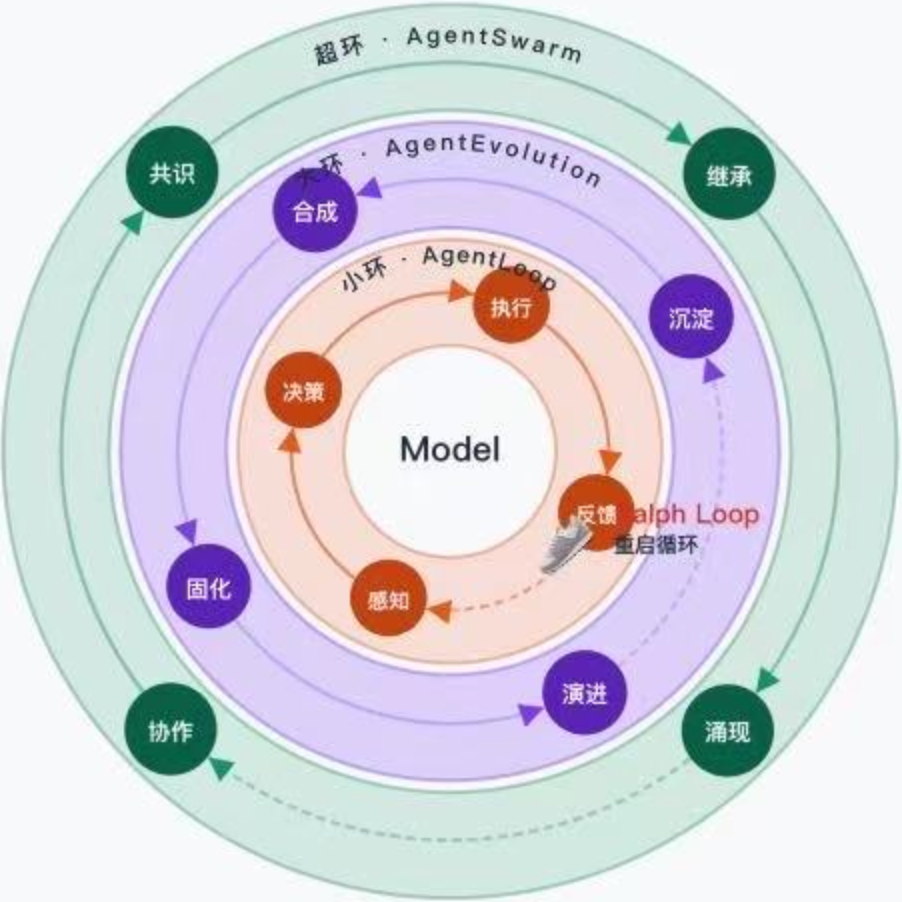
RSI: Evolution Goes Beyond Models

AI has already entered code writing, algorithm optimization, and model development. But after a task is completed, what remains may be reusable capability—or merely an answer and scattered logs. The difference becomes apparent only when a similar problem comes up again: can the system reuse what it learned, or must it pay the cost of exploration all over again? Recursive Self-Improvement (RSI) co…

RSISwarmEvoMapLoopEvolution

evomap.aihttps://evomap.ai