Reddit user hp1337 reported testing a DeepSeek V4.1 Flash 1017 EXL3 2.9bpw quantization with the APEX 2025 benchmark on six power-limited RTX 3090 GPUs. Using Project Maya, the system reached about 1,000 tokens per second prefill and 75 tokens per second decode, though the post excerpt does not include the underlying benchmark score.
During China’s 2026 Double 11 period, AI token packages appeared on major e-commerce platforms, with JD.com reporting a 20-fold increase in package sales during a two-hour livestream and Tmall reporting nearly 100,000 Qwen Office memberships sold in 30 minutes. CCID Research Institute figures cited by 36Kr said China’s inference data volume had exceeded training data volume for the first time, while daily token calls topped 175 trillion by June. 36Kr also reported discounted packages from official sellers alongside unofficial resellers whose reliability, pricing transparency, data privacy and operational accountability remain unclear.
OpenRouter Blog published a methodology for evaluating LLMs on application-specific tasks with script-checkable answers, repeated trials, verified costs and request-time measurements. In its 60-task synthetic benchmark, GPT-6.1 Sol passed all 180 trials across three repeats, while DeepSeek had the lowest response cost but passed 157 trials; the results showed weak agreement with public rankings, with a combined Spearman correlation of 0.109.
During its 11.11 campaign, JD launched an “AI Token Service Station” and an “AI Software Recharge Hall” offering model services from JD Cloud, DeepSeek, Zhipu GLM, Volcano Seed, MiniMax, Kimi and Qwen, along with model selection, Token recharge and membership subscriptions. It also offered a JD Cloud Token starter package with selected PC purchases. JD says the package supports more than 70 mainstream open-source models, JD’s proprietary models and agent creation, and is compatible with tools such as Workbuddy and Cursor. JD reported that searches for “Token” increased more than sevenfold on a period-over-period basis since the campaign began, while sales of model Token packages in a two-hour livestream rose twentyfold on a period-over-period basis.
JD launched a November 11 promotion in its “AI Software Recharge Hall” for model packages from Zhipu, DeepSeek and Doubao. Zhipu offered new-user trial cards at 10% of the regular price and weekly cards from 30%, while DeepSeek’s 100-million-Token package was offered from RMB 9.3 and Doubao’s video-model package cost RMB 9.9.
The WeChat account Bright Company reported that Anthropic began an IPO roadshow on November 10, one day after releasing Claude Fable 5.2. Based on a proposed share-price range of $70 to $78 and 825 million shares to be issued and sold, the report estimated an implied post-offering market capitalization of about $916 billion to $1.02 trillion. At the top of the range, its fully diluted valuation was about $1.4 trillion. The report said Anthropic recognized $33.24 billion in revenue during its first nine months, with about 80% generated from usage-based billing. It also reported $4.08 billion in adjusted operating profit and a $1.26 billion operating loss under U.S. GAAP.
An analysis argues that AI applications may build durable advantages by embedding models in recurring, task-specific workflows rather than relying on model capability or user acquisition alone. It cites QuestMobile data showing September 2026 monthly active users of 420 million for Doubao, 158 million for Qwen, and 123 million for DeepSeek, whose user base declined 15.2% year over year. The report also cites usage and revenue figures for products such as Kling, Manus, Meshy, and Fish Audio as examples of services built around recurring work. These figures are presented as cited data rather than independently verified findings.
36氪 reports that Anthropic is planning a Nasdaq IPO, with investor valuation expectations falling from $2 trillion to $1.5 trillion and then to discussion near $1 trillion as technology stocks adjusted, infrastructure financing costs rose, and investors reassessed its financial performance. The report also analyzes how Anthropic’s revenue growth, GAAP operating loss, adjusted profitability, and long-term compute commitments may affect valuation expectations for Chinese model developers such as DeepSeek, Moonshot AI, Zhipu AI, and MiniMax.
TechNews cited an Epoch AI estimate made in September that six major Chinese AI firms generated about $11 billion in combined annual revenue last year, roughly one-tenth of OpenAI and Anthropic's combined revenue. The estimate includes cloud and related AI revenue from companies such as DeepSeek, Zhipu AI, Alibaba and ByteDance, rather than only standalone AI product sales; ByteDance led the group with an estimated $4 billion. The report contrasted this with 2026 OpenRouter usage statistics showing DeepSeek with a 23.3% token share, above the 19.2% combined share of OpenAI and Anthropic. It also reported that the two U.S. companies accounted for 86% of global enterprise LLM API spending and attributed part of the Chinese firms' revenue constraints to price competition in the open-source ecosystem.
dsh-Go is an Android application that runs DeepSeek Harness on a phone, extending the open-source agent environment from developer-oriented terminal interfaces to mobile use. According to 36氪, the application’s GitHub star count passed 1,000 within three hours of its October 30 launch and reached 18,000 by publication; these figures were not independently verified in the supplied report. Its developer says running a complete Linux environment and the DSH kernel on a phone presents performance and compatibility challenges, including heat, lag and differences among Android devices and modified operating systems.
A V2EX user said Gmail notified them that their Claude account had been banned after they upgraded from Claude Pro to Claude Max and shifted their primary development workflow to Claude. The user said the appeal was unsuccessful and described Claude as fast and reassuring for long-running tasks and long-context work, while also noting that Codex, DeepSeek, and GLM remained part of their workflow.
In a three-day hands-on test, author 小虎 describes Loomy as an AI office assistant that selects models for tasks and deducts credits according to model multipliers. The author reports promotional credits for registration, daily login and other tasks, occupation-oriented skills, and model integrations using an OpenAI-compatible protocol. In the test, Loomy asked for meeting details before drafting a formal invitation, which consumed 13 credits; the author also reports a prior PPT task that consumed 1,578 credits. The report is promotional and does not independently verify Loomy's ownership, claimed benefits, model multipliers, skill quality or long-term pricing. It also notes that Loomy and WorkBuddy use different multiplier baselines, so their figures are not directly comparable.
A team said it built a benchmark of 202 real GitHub tasks across 13 programming languages that rarely appear in coding benchmarks. The team tested Qwen3.6 27B, Qwen3.8 27B and GLM-5.3 Flash, reporting that Qwen3.8 solved 43% of the tasks versus 17% for Qwen3.6. Its leaderboard also includes results for Kimi K3, DeepSeek, GLM and closed models, with a per-language breakdown. The author disclosed that Qwen3.8 was used to select difficult tasks, which may bias its reported score downward.
Recode China AI, translating and editing a first-person Daily People article, describes Ulanqab’s transformation from an agricultural city into a major AI data-center hub. The report cites Kuaishou’s first self-built facility, DeepSeek recruitment and reported expansion plans, and 28.2 billion yuan in project commitments secured in 2024. It also describes growing demand for data-center workers alongside rising qualification and age requirements.
A report presents a runnable multi-model debate project built with LangGraph and FastAPI. GPT, Claude, Qwen, and DeepSeek models answer independently, critique one another, and then provide their answers to a chief model for synthesis. The author documents three implementation problems encountered in the project: reasoning-model timeouts, out-of-order SSE frames, and missing discussion bubbles in saved histories. The author reports that one local debate involving three models, four responses, and a summary took 19.3 seconds.
36Kr reports that AI companies are turning agent runtime harnesses into hosted services. Microsoft expanded Copilot Harness across its products and offered managed services through the cloud, while Moonshot AI released Kimi Hosted Agents with a “Harness as a Service” offering. OpenAI and Anthropic had also made their internal runtime systems available to developers, while DeepSeek open-sourced its harness framework.
In a Microsoft technical white paper, Microsoft reported that keeping Claude Opus 4.8 unchanged but switching the harness behind Copilot Studio increased the complex-task pass rate by 22.1 percentage points. The new system nearly doubled model calls per task, yet reduced calculated input-token consumption by 21%.
The second installment of a Python reimplementation of Teernage’s powercode Agent tutorial adds a read_file tool to a terminal chatbot. The model requests a file with a JSON Schema tool call; Python code reads the file from the project directory, returns its contents to the model, and uses the supplied text to answer. The tutorial also demonstrates path confinement and an 8,000-byte read limit. It notes that DeepSeek thinking models require reasoning_content to be preserved during the second call.
Interviews with publishing practitioners, reported in content from 疯狂科技厅 authorized for publication by 36氪, describe AI being used for topic planning, drafting, illustrations, design, proofreading and marketing. A 2025 survey from the Shanghai Research Institute of Publishing at East China Normal University found that 55.5% of 1,049 valid respondents frequently or often used AIGC tools at work. Interviewed editors said AI-generated drafts can contain errors and logical gaps, while proofreading tools may produce false positives and require extensive manual review. South African author Coral Hart said AI-assisted creation helped her publish 371 books with more than one million copies sold; those figures are her own claims and were not independently verified in the supplied reports.
A 智讯智库 report says AI assistants are increasingly shaping product evaluation even though direct AI checkout remains limited. Attentive found that 88% of surveyed US adults had used a chat assistant to evaluate products, while only 10% of final purchasers completed a purchase inside AI. The report also examines Doubao’s new Douyin Life Services fees and estimates that, under its baseline scenario, AI-influenced decisions and AI-originated transactions could represent 28% and 8% of Chinese physical-goods online retail sales by 2030.
In a first-hand account, author 老金 describes using Magpie as a local gateway for coding agents such as Codex, Claude Code and OpenCode. The report says Magpie can route requests across providers and accounts, arrange models in ordered fallback groups, and assign models by user intent. Its resource library can distribute MCP tools, Skills, Rules and Hooks to selected clients. The tutorial also covers privacy masking, web search, automatic check-ins, configuration profiles and CLI control. The author warns that two of more than ten imported CC Switch channels did not work and recommends testing imported channels individually.
A first-person technical build record describes a local QQ voice chatbot using NapCat, AstrBot, an OpenAI-compatible model service and GPT-SoVITS. It covers a four-layer pipeline, reverse WebSocket setup, SILK v3 conversion through ffmpeg, zero-shot voice cloning with 3–10 seconds of clean reference audio, private and group memory, proactive-reply controls, latency tuning and layered troubleshooting. The report also says third-party protocol clients that use simulated login carry platform-rule, risk-control and possible account-ban risks. Its deployment experience and troubleshooting observations are not independently verified.
InfoQ 中文 AI&大模型 reports that Jeff Dean has founded Discovery Loop after leaving Google, where he worked for 27 years. At a Stanford HAI event, Dean said the startup is developing AI systems that design experiments, validate results and learn from prior research, initially focusing on machine learning research, machine learning engineering and hardware design. He also said the company has built an Agent Harness for large-scale agent collaboration and is running about 20 automated improvement loops, though these claims have not been independently verified.
Developer c1overzz released dsh-bili-scroll 2.1.0 on October 24 with a security fix after an agent could read all local session records while Bilibili APIs provided an external communication channel. The update confines the agent to a smaller set of fixed tools. Separately, Yu Pi developed a Bilibili plugin that marks suspected AI-generated comments and hides them locally, rather than deleting them.
A Juejin AI analysis compares Agent development with full-stack engineering using job descriptions, salary data and practitioner views. It argues that full-stack capability provides the application and architecture foundation, while Agent development adds skills such as LLM integration, tool calling and agent frameworks; the piece advises programmers to validate demand through concrete projects and job applications rather than treating Agent work as an escape route.
A report from the WeChat account TOP创新区研究院 said Goldman Sachs’ team led by chief China equity strategist Liu Jingjin issued an assessment on Oct. 11. It estimated that Chinese AI stocks had added about $5 trillion in market value since the “DeepSeek moment,” including roughly $2.8 trillion from share-price gains and $2 trillion from newly listed companies. The report also described global AI as two ecosystems, one centered on the United States and its main trading partners and another centered on China, and said China may already match or lead global competitors in some areas of AI power, infrastructure, models and physical AI.
A Juejin author’s Python probe found that GLM-4-Flash answered a current-product question from training memory despite receiving a valid web_search tool, with no search-result fields in the response. After the author switched the same Zhipu AI engine to GLM-5.3-Flash on November 2, the test returned search citations and a currently available model. The report also documents a separate Java binding bug and says cross-implementation checks ruled it out as the cause of the earlier behavior.
A reverse-engineering account describes modifying and reflashing a Tuya-based IP camera’s firmware with LLM assistance. The camera’s ONVIF-related server and ports were disabled in the original firmware, and the author investigated why configuration changes had not worked. After rebuilding and flashing the modified image, an Nmap scan showed TCP ports 8000 and 8554 open. The supplied report does not establish that a usable RTSP stream was restored; the author described the ending as possibly unsatisfying. The workflow remained largely hands-on, and the author reported spending $0.22 to run a DeepSeek model through OpenRouter.
A lawyer reportedly built an in-office AI server from eight used 2018-era Nvidia Tesla V100-SXM2 32GB GPUs to keep case files from leaving the office. According to Tom’s Hardware, the two four-GPU NVLink boards run DeepSeek V4.1 Flash with its experts in GPU memory, reaching up to 215 tokens per second for code and 118 tokens per second for legal writing in the builder’s measurements. The system is used for first-pass document analysis and routine drafting, with human review required before any output leaves the office.
A TMTPost analysis reports that Taobao, JD.com, Douyin E-commerce and Kuaishou have integrated AI into shopping, customer service, content creation and merchant operations. E-commerce operator Liu Pei said his store's transaction volume rose 15% to 20% from October 20 to 26, while he estimated AI had made him about three times as efficient. The report says these efficiency gains had not produced clearly attributable incremental growth, and notes that Liu's estimate was not independently measured.
游戏葡萄, republished by 36Kr, argues that AI may be beginning to compete with mobile games for users’ time and spending. The article combines anecdotes about DeepSeek-based virtual companions and AI-assisted creation, while acknowledging that AI has not yet become a mass-market alternative to games.
What problem it solves
Stock analysis often requires users to gather market quotes, news, technical indicators, financial information, and AI-assisted interpretation across multiple sources. The project addresses this by bringing supported-market data, analysis tools, AI agents, alerts, and review workflows into a locally focused desktop application.
Key features
Multi-market market data — The app…
What problem it solves
AI coding tools often expect particular provider protocols, making it difficult to use the models and providers a user prefers. A local gateway can translate between supported client APIs and provider APIs while preserving capabilities such as streaming, tool calls, reasoning, and images.
Key features
Provider protocol translation — The gateway translates Responses, Chat Com…
What problem it solves
The hidden system instructions that shape AI product behavior are difficult to inspect and change across models, products, and versions. This repository makes collected prompts available in a structured, product-oriented archive for study and comparison.
Key features
Broad product coverage — The archive covers prompts from major AI providers and products, including Anthropic…
What problem it solves
Image creation often requires switching between separate tools, manually translating visual ideas into parameters, and losing the context of an ongoing conversation. This project brings generation, editing, reference workflows, model comparison, and asset management into a DeepSeek Harness conversation and canvas.
Key features
Chat-Based Image Creation and Editing — Describe…
Optimizing a GPU kernel or completing a set of formal proofs often requires repeated trial and error: try a different implementation, run an evaluation, and keep iterating in whichever direction proves effective. When giving a model more test-time compute, the most direct approach is to let more agents try simultaneously; if the task only needs one best result, the value of the other attempts lies…
What problem it solves
Complex trading decisions require evaluation across financial fundamentals, market sentiment, news, technical indicators, portfolio holdings, and risk. TradingAgents addresses this by decomposing trading tasks into specialized LLM-powered roles that discuss findings and assess proposed transactions.
Key features
Parallel analyst research — Fundamental, sentiment, news, and t…
What problem it solves
DeepSeek Harness workspaces, tools, and project setup normally remain tied to the computer running the Harness instance. The project addresses the need to continue using that environment from another computer, phone, or browser without requiring a public listening port or public IP on the Host.
Key features
Remote workspace access — Open local workspaces from a web browser, …
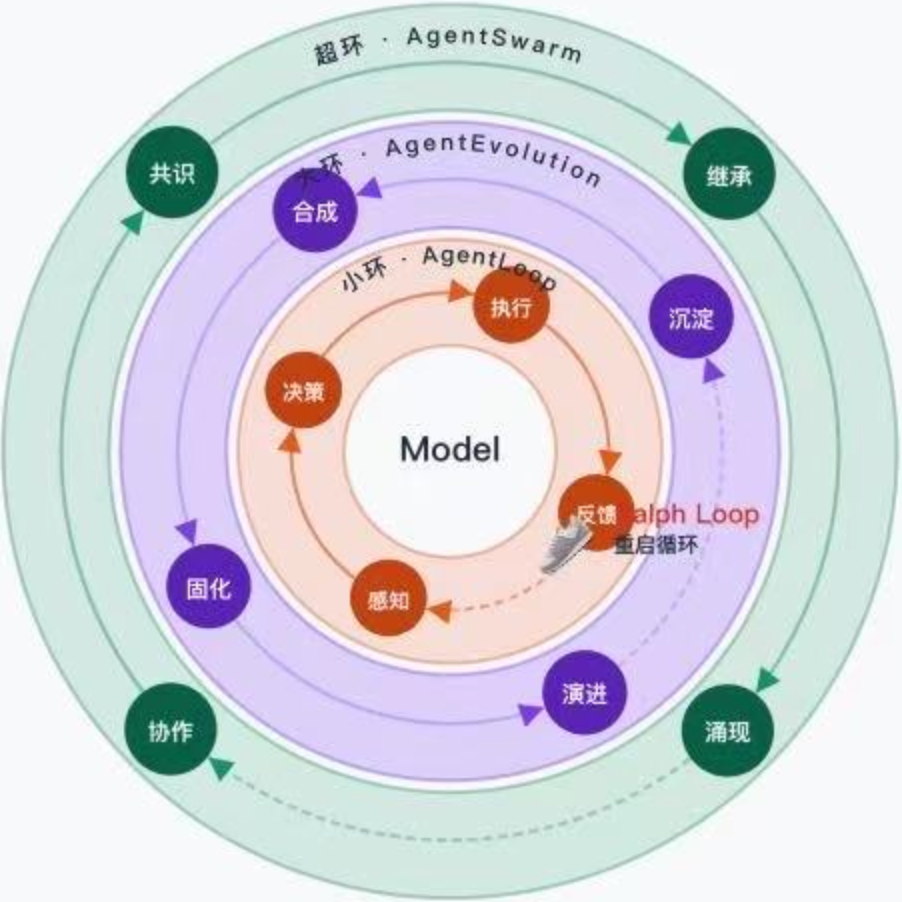
After an Agent completes a task, what it leaves behind is often more than an answer. There is also an expensive exploration path: which files it read, which tools it tried, where it failed, and what checks it used to confirm the result. The problem is that the next execution may not be able to use those experiences. The model parameters have not changed, and a new session will not naturally inheri…
0x01
At the end of 2022, ChatGPT exploded onto the scene, triggering the first wave of excitement in the tech industry. But traditional state-owned enterprises did not act immediately. The real action began in 2023. Domestic large models were open-sourced one after another, and integrated hardware-and-software delivery formats such as “large-model all-in-one machines” became the default option. Mo…
AI has already entered code writing, algorithm optimization, and model development. But after a task is completed, what remains may be reusable capability—or merely an answer and scattered logs. The difference becomes apparent only when a similar problem comes up again: can the system reuse what it learned, or must it pay the cost of exploration all over again?
Recursive Self-Improvement (RSI) co…
My current development workflow for my own projects is to use agent tools like deepseek harness locally to write code and make git commits, then install deepseek harness on the server and connect to it through a tunnel, allowing the server-side deepseek harness to handle deployment. The server is Ubuntu, and the local Mac establishes the tunnel connection. Deployment only requires sending a deploy…
First, the result: over the course of four months, on and off, I built a WeChat Mini Program called “随了么小管家” for keeping track of gift-giving and reciprocity. It currently has about 40 pages, with roughly 29,000 lines of frontend code and 14,000 lines of backend code, 85 commits, and a version number that has reached 1.1.9.
The tech stack is pretty ordinary: uni-app + Vue 3 + Pinia on the fronten…
 go-stock• Pinned