A report provides a macOS workflow for adding FluxLane as a custom model provider for the Codex feature in the newer ChatGPT desktop app. The steps include installing CC Switch, creating a FluxLane API key, completing the official ChatGPT account login, entering the API key and Base URL, adding Claude Sonnet 5.5 to the model list, selecting the Chat Completions upstream format, and routing Codex to the new provider. The desktop app must then be restarted and reopened before the selected model is shown. The report says the graphical process does not require editing complex configuration files or installing Codex CLI.
This tutorial uses a DeepSeek conversation to explain how text is tokenized, converted into embeddings, processed by Transformer attention and MLPs, and scored into candidate tokens. It also distinguishes parallel processing of existing input from step-by-step generation of new output, while noting that KV Cache can reuse earlier computations. The reported token counts and IDs were reproduced with the DeepSeek-V4-Pro-Base tokenizer, while illustrative logits and probabilities are not measured model outputs.
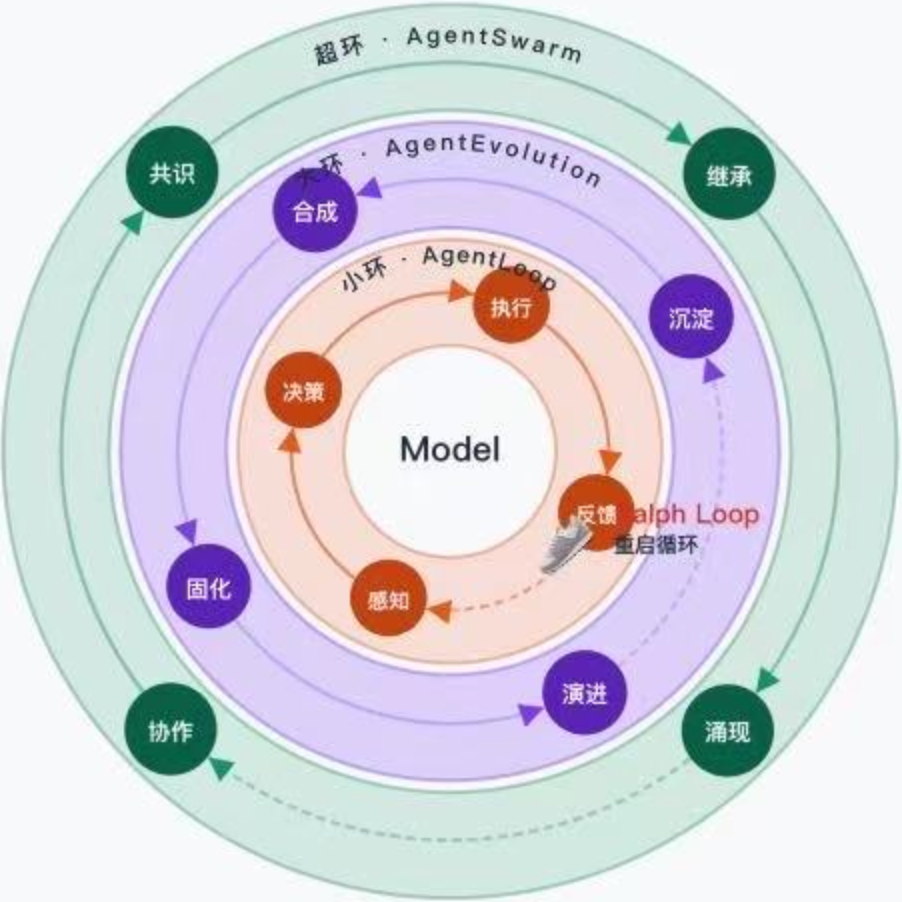
DeepSeek's Harness team published a design exploration for Super-Agent, an architecture intended to move multi-task, cross-channel, and continuous-runtime coordination from users to the system layer. According to the design, a resident Router maintains shared context, dispatches isolated Workers for concurrent execution, unifies external responses, and uses event-driven monitoring with a Watchdog for long-running work and recovery. A secondary Juejin tutorial also shows AgentKit Studio deploying Super-Agent with Feishu and GitHub for a code-review task, although the architectural benefits remain vendor claims.
In a firsthand test published by QbitAI, editor agent Sienna coordinated three specialist agents covering AI model developments, open-source projects, and personnel changes. According to the report, Sienna delegated research and reviewed the submissions before compiling six story leads in under eight minutes. It then created development and QA workers that reused the brief to produce a searchable, filterable news dashboard in about 30 minutes, with QA identifying two issues for correction. The report is a single firsthand account with promotional framing; its timing and output claims were not independently verified or supported by repeated measurements.
AFK AI's Comma uses a resident Router and multiple context-isolated Workers to coordinate parallel tasks from one main conversation, according to 36Kr. The report also describes long-term memory, cross-app execution through the Salix framework, always-on monitoring, and publicly available open-source code, though these operational and performance claims lack independent benchmarks.
Acronis disclosed that a Hualien-based actor built BossAI, a 12-agent system that targeted organizations across 11 countries over 12 days. Its agents coordinated reconnaissance, vulnerability scanning, attack-code writing and exploitation through MCP-connected tools including Nmap, sqlmap, Metasploit, Hydra and Ghidra. Acronis says modified DeepSeek, GLM and Qwen models performed much of the work, while Hermes led reconnaissance, weakness analysis and exploitation, and attackers accessed sensitive Taipei emergency-care and 119 dispatch records.
AIbase, citing Bloomberg, reported that DeepSeek's open-source agent application framework Harness reached 1.54 million daily active API users in under three months. The platform reportedly consumed about 92 trillion tokens daily, while its plugin ecosystem included roughly 35,000 custom plugins. DeepSeek plans an official plugin marketplace and a creator incentive program offering token grants, technical support, and promotional support.
An explainer collected in the WeChat public account AngryCode describes the context window as the amount of text a language model can process at one time, measured in tokens rather than characters. It explains that system instructions, conversation history, the current prompt, pasted documents, and generated output share the same capacity, so older information may be dropped or summarized when the limit is reached. The article also offers practical guidance on retaining key facts, summarizing older conversations, including only relevant document sections, and leaving room for the response.
A Juejin AI tutorial walks through the full RLHF pipeline: SFT cold start with roughly 13,000 prompts, training a reward model from ranked human preferences on about 33,000 prompts, and PPO reinforcement learning that scores complete generations with the reward model. It explains the Bradley-Terry loss used to fit the reward model, the score head swapped in for the vocabulary projection, and the four models loaded during PPO (Actor, Reward, Reference, Critic), including the KL penalty that limits reward hacking. It cites OpenAI's 2022 InstructGPT paper, in which a 1.3B InstructGPT reportedly outperformed the 175B GPT-3 on human preference evaluations, and closes by previewing DPO and DeepSeek's GRPO as simpler alternatives.
DeepSeek released adoption figures indicating that its AI agent platform reached 1.54 million daily users. The company has continued to challenge Anthropic and OpenAI with applications built around open-source AI technologies.
A Juejin AI article reviews DeepSeek's October 17 release of V4.1-Flash-1017, highlighting reported gains in Terminal-Bench, Automation-Bench and ProgramBench, plus vendor claims of lower task costs through token and agent-workflow optimization. The author reproduced DeepSeek's “wish-driven programming” racing-game example through DeepSeek Harness, finding that a one-line request produced a playable game with basic driving, tracks and timers, while a more detailed prompt improved its visuals and polish. The reported second run took 51 minutes and 14 seconds, consumed 60.1 million tokens alongside another smaller task and cost about 3 yuan.
A Reddit user reports that clustering two 256GB M5U systems produced worse results than running two models separately, citing concurrency issues and inconsistent decode-speed gains. The poster currently runs Qwen Flash Next q6 and GLM3.5 Flash q4 locally, while using DeepSeek through an API, and says GLM q4 outperformed the API for their coding work.
36Kr/量子位 reports that early RoboDojo evaluations found GPT-6 Astra could improve robot-task scores without task-specific post-training or demonstrations in some tests. The evaluation was primarily conducted in simulation, and real-robot testing was halted for safety reasons, so the results do not establish stable real-world performance. The report also cites unverified industry claims that some embodied-AI companies are eliminating algorithm positions.
In a community article, the author argues that personal AI products should remain single-agent, while workplace AI will increasingly use multiple agents with distinct roles, contexts, and permissions. The proposed company-level Agent Team would be shared across employees, with agents collaborating, reviewing one another’s work, and operating under defined access rights. The author cites ChatGPT, Claude Code, Meta Muse, and Grok bot as current approaches that only partly match this model.
A commentary says that on November 2, a ByteDance Coze developer posted that Coze might be taken offline; the article cites no official confirmation. It interprets the developer's description of drag-and-drop nodes as a low-code transitional form and contrasts predetermined workflows with autonomous agents that plan each step. The author argues that workflows may remain the better choice when reliability, accuracy and reproducibility require consistent execution, while autonomous agents suit tasks whose paths cannot be fixed in advance.
A Juejin AI article argues that GUI Agent loops often persist because actions execute successfully while the screen remains unchanged, and that exact-action matching can miss repeated clicks with shifted descriptions or coordinates. It recommends treating visual progress as success, using screenshot hashing, a wait-screenshot-verify sequence, coordinate-drift detection, and a hard iteration cap. The article also includes runnable Python code for detecting unchanged frames and stopping repeated execution.
In a first-person essay published by the WeChat public account Future浮标, an overseas AI short-drama director who says they have worked on more than ten productions describes a recurring problem: multimodal models often refuse to write storyboards for suggestive scenes, while models that accept them may produce weaker storyboards. The director says splitting the work between models is less efficient than manually writing prompts, and estimates that suggestive scenes consume roughly three times as many tokens as other scenes of comparable length. The essay also says Facebook, Google and TikTok tightened enforcement against non-compliant material from late September and that DramaBox was temporarily removed from iOS, but cites no official platform statements explaining either development.
DeepSeek’s web and API services experienced a partial interruption on November 7, with users encountering a “server temporarily unavailable” message. DeepSeek’s official status page said the interruption lasted from 3:11 p.m. to 3:56 p.m., totaling 45 minutes, and that service had been restored.
An article describes OpenTeam, a self-reported Chrome extension that brings the web versions of ChatGPT, Claude, Gemini, DeepSeek and Grok into a shared group chat. Members can @ one another, see each other’s replies and challenge one another. The extension uses logged-in web sessions rather than API keys, with per-site adapters, isolated iframes and DOM-based completion detection because the sites do not expose a finish_reason signal. It assigns context budgets separately for each model and supports independent and collaborative modes. The article also documents limitations: reliance on DOM selectors, exposure to site risk controls, no token-level usage data, no tool execution, limited support for Chromium-based browsers, and a PolyForm Noncommercial 1.0.0 license that permits personal, non-commercial use. Its capabilities and implementation details have not been independently verified.
A Reddit user compiled release dates and parameter counts for open models produced by multiple companies, plotting the results over time with jitter to reduce overlapping points. The post also includes separate charts for Qwen, DeepSeek, and Google, while the legend indicates how many models each company contributes to the tracking.
ArtificialAnlys reports that DeepSeek V4.1 Flash running on NVIDIA GB300 NVL72 gained up to 1.5x tokens per second per agent over the past month on its AA-AgentPerf benchmark, which tests datacenter systems running realistic agentic coding workloads. A single agent reached 848 tok/s, up from 596 (1.42x), while throughput per GPU rose roughly 1.6x at about 80 tok/s per agent. ArtificialAnlys attributes the gains to a newer vLLM version, new vLLM kernels for DeepSeek V4.1 on GB300, FlashInfer autotuning, fuller CUDA graph coverage, tuned speculative decoding, and running prefill and decode on the same GPUs in NVIDIA’s updated Dynamo + vLLM setup.
Vals tested AI models on multi-step network intrusion tasks in two simulated scenarios involving mock corporate systems. OpenAI's trusted-access Daybreak completed an average of 81% of assigned tasks, while the open-weight DeepSeek completed 73%, with some tasks tied. Vals estimated token costs of $17–$46 for GPT-6-Sol attacks versus $2–$3 for DeepSeek, while experts cautioned that the simulations do not establish real-world impact or whether AI creates a new cyber threat.
Reddit user ashokallu shared a private, community-modified ChatGPT desktop app that the developer says connects 12 harnesses from the official ACP registry. A main orchestrator can select roles such as investigator, planner, workhorse and code reviewer, then coordinate agents in parallel. The developer also reports adding terminal IDs, real-time token and speed statistics, and an attention alert that beeps for 30 seconds when a task finishes. The developer says an official ChatGPT release once crashed on launch and was fixed locally. The repository remains private, so the claimed orchestration has not been independently validated.
36氪, citing Goldman Sachs and official media, reports that Ulanqab had 12.5GW of operating and planned data-center capacity as of June 2026. Official media also reported 109 signed computing-center projects and 190,000P of operating computing capacity, although the report did not specify how much of the 12.5GW was already operating. The report identifies projects involving Huawei, Kuaishou, ByteDance, Alibaba and DeepSeek, and describes Envision Technology Group's planned 2GW Xinghe complex. It also says a 2026–2028 action plan aims to move the city from producing computing power toward computing services, Token trading and intelligent applications.
According to a Juejin report, Apache RocketMQ and Higress received the Open Source Pioneer Community Award at the eighth Direct to Wuzhen Global Internet Competition, organized by the World Internet Conference and the Zhejiang Provincial People’s Government. The competition included five industry tracks, an open-source competition and an OPC feature competition, with 1,347 entries from 31 countries and 112 finalists. The report says RocketMQ 5.5 introduced LiteTopic-based asynchronous messaging for AI model services and agent systems, with native MCP and A2A support. It also says Higress opened AI gateway capabilities in July 2024 for proxying Tongyi Qianwen, OpenAI and DeepSeek APIs, and released an MCP Marketplace in April 2025.
A Reddit discussion compares ChatGPT Temporary Chat and Claude incognito chats, which the post says exclude conversations from history, memory and training but may still be retained by the providers for safety. It presents local models through Ollama or LM Studio as the most private option, while noting hardware requirements and the absence of public ChatGPT or Claude models. The post also promotes Dreamfort AI’s approach of encrypting prompts on-device and separating user identity from prompts before model processing.
A Tech商业 article republished by 36氪 argues that scarce compute is pressuring Kimi, Zhipu, MiniMax and StepFun to adopt different strategies: securing GPUs through capital, building infrastructure, shifting toward higher-margin business revenue, and exploring mobile deployment. It frames these responses as four ways independent model companies are paying an increasingly rigid “compute rent,” while arguing that large technology companies’ infrastructure and distribution advantages are weakening the case for four comparable independent contenders.
Menlo Ventures' 2026 State of Enterprise AI report found that Chinese models accounted for 89% of the surveyed enterprise open-weight model spending, with Kimi leading at 61%, followed by DeepSeek at 15% and GLM at 11%. Llama, described as the leading Western model, held 7%, while 36Kr said the survey covered nearly 400 US enterprise AI leaders responsible for more than $4 billion in AI spending. Reports conflict over whether the spending denominator covers US enterprises or enterprises globally.
TMTPost and 36Kr report that a Qwen Office personal basic monthly plan priced at 0.01 yuan sold nearly 100,000 copies in about 30 minutes during Li Jiaqi’s November 2 livestream, representing roughly 2 trillion tokens. Tmall and JD also promoted token packages and subscription plans during Double 11, with JD reporting that AI computers bundled with Token packages rose 100% in sales. The low-priced promotion generated little direct revenue, while retention and recurring paid conversion remain unproven.
A Juejin technical analysis reviewed DeepSeek Harness’s README, safety notice and release history, finding that the runtime remains a rapidly iterating developer preview with expected compatibility-breaking changes and no completed security audit. The article proposes a four-check admission framework covering version status, security boundaries, upgrade cost and rollback readiness, supported by dependency checks, an interface adapter and container examples. Its tests used a single demo project, and the container snippet was not verified with Docker.
What problem it solves
Stock analysis often requires users to gather market quotes, news, technical indicators, financial information, and AI-assisted interpretation across multiple sources. The project addresses this by bringing supported-market data, analysis tools, AI agents, alerts, and review workflows into a locally focused desktop application.
Key features
Multi-market market data — The app…
What problem it solves
AI coding tools often expect particular provider protocols, making it difficult to use the models and providers a user prefers. A local gateway can translate between supported client APIs and provider APIs while preserving capabilities such as streaming, tool calls, reasoning, and images.
Key features
Provider protocol translation — The gateway translates Responses, Chat Com…
What problem it solves
The hidden system instructions that shape AI product behavior are difficult to inspect and change across models, products, and versions. This repository makes collected prompts available in a structured, product-oriented archive for study and comparison.
Key features
Broad product coverage — The archive covers prompts from major AI providers and products, including Anthropic…
What problem it solves
Image creation often requires switching between separate tools, manually translating visual ideas into parameters, and losing the context of an ongoing conversation. This project brings generation, editing, reference workflows, model comparison, and asset management into a DeepSeek Harness conversation and canvas.
Key features
Chat-Based Image Creation and Editing — Describe…
Optimizing a GPU kernel or completing a set of formal proofs often requires repeated trial and error: try a different implementation, run an evaluation, and keep iterating in whichever direction proves effective. When giving a model more test-time compute, the most direct approach is to let more agents try simultaneously; if the task only needs one best result, the value of the other attempts lies…
What problem it solves
Complex trading decisions require evaluation across financial fundamentals, market sentiment, news, technical indicators, portfolio holdings, and risk. TradingAgents addresses this by decomposing trading tasks into specialized LLM-powered roles that discuss findings and assess proposed transactions.
Key features
Parallel analyst research — Fundamental, sentiment, news, and t…
What problem it solves
DeepSeek Harness workspaces, tools, and project setup normally remain tied to the computer running the Harness instance. The project addresses the need to continue using that environment from another computer, phone, or browser without requiring a public listening port or public IP on the Host.
Key features
Remote workspace access — Open local workspaces from a web browser, …
After an Agent completes a task, what it leaves behind is often more than an answer. There is also an expensive exploration path: which files it read, which tools it tried, where it failed, and what checks it used to confirm the result. The problem is that the next execution may not be able to use those experiences. The model parameters have not changed, and a new session will not naturally inheri…
0x01
At the end of 2022, ChatGPT exploded onto the scene, triggering the first wave of excitement in the tech industry. But traditional state-owned enterprises did not act immediately. The real action began in 2023. Domestic large models were open-sourced one after another, and integrated hardware-and-software delivery formats such as “large-model all-in-one machines” became the default option. Mo…
AI has already entered code writing, algorithm optimization, and model development. But after a task is completed, what remains may be reusable capability—or merely an answer and scattered logs. The difference becomes apparent only when a similar problem comes up again: can the system reuse what it learned, or must it pay the cost of exploration all over again?
Recursive Self-Improvement (RSI) co…
My current development workflow for my own projects is to use agent tools like deepseek harness locally to write code and make git commits, then install deepseek harness on the server and connect to it through a tunnel, allowing the server-side deepseek harness to handle deployment. The server is Ubuntu, and the local Mac establishes the tunnel connection. Deployment only requires sending a deploy…
First, the result: over the course of four months, on and off, I built a WeChat Mini Program called “随了么小管家” for keeping track of gift-giving and reciprocity. It currently has about 40 pages, with roughly 29,000 lines of frontend code and 14,000 lines of backend code, 85 commits, and a version number that has reached 1.1.9.
The tech stack is pretty ordinary: uni-app + Vue 3 + Pinia on the fronten…
 go-stock• Pinned