Doubao announced that Doubao Work surpassed 8 million daily active users and RMB 2 billion in enterprise annual recurring revenue three months after launch, according to AIbase AI News. The product added Workbench features for 21 vertical domains on November 16 and integrated Kimi, GLM, and DeepSeek with selectable model quota multipliers; the usage and revenue figures are vendor claims relayed by the outlet.
Yang Wan and Linchao Zhu introduced TwinLab-Bench, a benchmark with 52 tasks drawn from physical science, life science, and engineering laboratories to evaluate AI agents that design their own experiments. Each task uses a TwinLab agent to execute the designed experiment against laboratory records, supports more than 100 action types, and scores the agent’s report against a hidden answer. The paper reports that Claude Fable 5.2 was the strongest of 13 evaluated agents, with an average score of 45.0.
DeepSeek announced that its search and crawling services are free starting immediately. The available report does not specify eligibility criteria, usage limits, geographic availability, or other conditions.
Doubao announced that Doubao Work, its AI product and brand for productivity scenarios, exceeded 8 million daily active users and RMB 2 billion in enterprise customer annual recurring revenue after three months. These figures are vendor claims that have not been independently verified by the reports. Doubao Work was released on August 25, 2026. On November 16, it launched a workbench covering 21 professional scenarios and recently added integrations with Kimi, GLM and DeepSeek.
DeepSeek changed its API pricing on November 18, 2026, so server-side search and web fetching triggered by model calls are no longer charged separately; only model token usage is billed. The rule applies to DeepSeek’s online tool and the web_search tools in the Anthropic API and Responses API. Standalone Search API and Fetch API calls remain charged at RMB 5 per 1,000 successful requests.
AIbase AI新闻 and 36Kr 人工智能 report that DeepSeek has limited long-context conversations and free-tier usage amid computing capacity constraints. The restrictions reportedly disrupted users relying on the free app and web service for old chats, lengthy documents, fiction writing, and extended role-playing, triggering negative ratings and complaints, while some users posted five-star ratings in support of the change.
A commentary examines Baidu’s AI strategy and product lineup at Baidu World 2026, focusing on the Baidu Dazi work assistant, the Kuku and overseas-version KooKo knowledge-work products, and the Ciyuan suo model-trading platform. It says Baidu Dazi added multi-person collaboration, upgraded enterprise features, opened the Harness engine and professional capabilities, and introduced industry Mate+ offerings. Kuku grew from Baidu Wenku and Baidu Netdisk, while Ciyuan suo uses model verification, testing, monitoring, and credit ratings. The report also describes Baidu’s four-layer stack spanning chips, cloud infrastructure, models, and applications.
The project author reports that DPO reduced validation loss from 0.628564 to 0.155683 and raised the validation preference score, but Qwen3-0.6B answered 29 of 32 controlled cases correctly versus 30 for the original model. The evaluation workflow included rule-based scoring, pairwise LLM judges, position-bias checks, human calibration and paired bootstrap; all six model comparisons were ultimately marked inconclusive. The 32-case study covered controlled chain-of-thought samples involving arithmetic and multistep numerical updates, and its human labels came from one annotator.
Readers posted AI-detection results for Jinjiang Literary City novels, including works by ranked authors and titles whose rights had been sold, prompting questions about refunds and disclosure to rights buyers. Entertainment Capital Theory tested more than 30 web-fiction samples with Zhuque and found inconsistent results: some fully AI-generated text was partly labeled as human, while the outlet's test generally did not classify human text as AI. Separately, social-media users reported that Zhuque flagged some handwritten passages as suspected AI and gave inconsistent results for human and AI-generated versions of the same outline. Jinjiang's rules permit limited AI assistance and require at least three detection tools, with AI-suspicion scores above 60% in three or more tools, before content is deemed a violation. At publication, the platform had not publicly responded to the latest dispute.
According to a report reviewing ModelFold's pricing page and integration documentation on November 17, 2026, the service offers monthly subscriptions covering Claude, GPT, Gemini, DeepSeek, Kimi, GLM, Grok, Qwen and other conversational models. Subscription calls do not consume credits and can be made through the web Playground or API, including connections to coding agents such as Claude Code and Codex. Pro, Max and Ultra were listed at $20, $100 and $200 per month, respectively, with the same models but different usage allowances and concurrent-request caps of two, four and eight. Image generation, video, voice and other online tools remain credit-based. Prices and discounts may change, with the purchase page determining the final amount.
Vals reported that models from Anthropic, Google, xAI, DeepSeek and OpenAI sometimes identified civilians, ambulances, a school and surrendering or incapacitated soldiers as military targets in simulated battlefield tasks. The study combined generated imagery with real satellite and drone footage from Ukraine and Iran. Researchers said framing a scenario as a game often caused models to continue after initially refusing. Vals said the tests did not ask models to make firing decisions.
A Reddit user described building IVY, an assistant that combines local Qwen3.8-27B inference on two RTX 3090 GPUs with DeepSeek and Claude models hosted in the cloud. The system also includes a web chat, voice and facial-animation pipelines, GPU-accelerated retrieval, and additional creative models served through llama-swap. The post provides a detailed personal build account, but its claims are not independently verified.
Mistral AI announced that Mistral Vibe is free in Europe for the first three months, with access available on a limited, first-come, first-served basis. The company said Mistral Vibe paired with the Le Chonk code model forms the world’s best open model-harness duo and performs better than GLM and DeepSeek at coding, but supplied no independent benchmark or corroborating measurement.
A hands-on test used SoduWork to switch one conversation among Pi 1.4.0, Qwen Code 0.21.8, and Google Harness² 0.2.0 while processing 120 cloud-gateway incident tickets. The test showed that shared artifacts and established rules carried across the handoff, but the first switch became blocked on macOS by runner-admission logic. After adding a temporary zero-concurrency bypass to a local runner, the Qwen Code and Google Harness² stages proceeded on the patched copy. Missing billable Qwen Code usage and a short test using one model provider prevented conclusions about total relay cost, long-history reliability, backend performance rankings, or provider failover.
A commentary argues that coding agents could be an important part of progress toward AGI. It cites three advantages of programming: digital tasks can be automated, mature open-source projects provide low-cost training corpora, and software results can be checked quickly for bugs. The author describes Codex, Claude Code, Kimi Code and Grok as coding agents, while offering subjective assessments of Google’s Antigravity, Gemini 4 Carbon and DeepSeek’s agent products.
A supplied report said DeepSeek introduced three-tier usage limits for free users. It did not provide details about the limits, the meaning of the tiers, or an effective date.
A TMTPost commentary reports that CATL has strengthened its position as a leading EV battery supplier, citing a 39.1% share of global EV battery installations and strong profitability. It contrasts this with weaker domestic EV demand and thinner automotive-industry margins, as some automakers develop battery capabilities and work with alternative suppliers. The commentary says CATL is pursuing battery swapping and investing in robotics, AI energy and DeepSeek, alongside other reported AI-related companies. It also presents, as a rough proposal rather than an established policy, the idea that CATL could pass some battery-cost savings to automakers.
In a commentary from the WeChat account 卫夕指北, author Wei Xi uses the Cowan, Solow and Jevons paradoxes to examine why AI may increase workloads without yet producing clearly visible productivity gains. Wei argues that faster drafting and lower model prices can lead to higher standards, more output and greater usage, potentially raising aggregate spending. The commentary also notes disagreement over when measurable productivity improvements will appear.
Island found 186 typo-squatted domains impersonating 27 popular AI brands, including ChatGPT, Claude, Perplexity, Midjourney, Cursor and DeepSeek. The sites redirected visitors toward ClickFix-style commands, a browser-hijacking application called Net Guard, or malicious extensions that altered search settings and harvested queries. Researchers said the campaign remained active and linked it to 211 entry domains, including lookalikes for banks, insurers, telecom firms and enterprise software providers.
Xint.io found that three of seven tested AI models discovered a privately reported Google V8 zero-day, CVE-2026-102321, according to ZDNET. GPT 6 Sol found it in 13 minutes for $4.24, while GPT 5.6 Sol required 44 minutes and $22; Claude Opus 5 succeeded on its first attempt at a reported cost of $43.40. DeepSeek and Z.ai models failed, and earlier models had missed the same flaw after 25 hours and $350 of scanning.
A 36Kr analysis says Zhipu AI’s market capitalization fell from a June peak of HK$1.33 trillion to HK$199.1 billion by November 13, while the company reported strong revenue growth alongside a declining gross margin and more than RMB 2 billion in net losses. It portrays MiniMax’s losses, tighter financing for mid-tier startups, and weak enterprise AI returns as evidence that capital is increasingly evaluating foundation-model companies on commercial performance rather than technical capability alone. The report also acknowledges that task-execution capabilities continue to improve and that leading companies can still raise substantial funding.
Multiple users reported that DeepSeek temporarily blocked older long-running conversations, with prompts citing insufficient computing capacity and suggesting that chats be exported elsewhere. Reports also mentioned input-length, edit-count and message-count limits, but disagreed on whether the inactivity threshold was 72 hours or seven days and whether the web interface was affected; DeepSeek had not issued an official explanation at publication.
TARS won Ant Lingbo’s inaugural embodied model challenge after 15 teams completed a 48-hour on-site robot final in Shanghai. The teams used the same LingBot-VLA 2.0 foundation model, COBOT MAGIC robot hardware and on-site computing resources for single-arm produce handling, transparent-box placement and dual-arm table cleaning. Reports consistently identify TARS as the champion, but report its winning score as either 82 or 82.5. They also conflict on the number of additional demonstrations collected by SST, giving either 13 or three.
cnBeta, citing LatePost, says a Goldman Sachs report characterized Ulanqab as Asia-Pacific's largest and fastest-growing AI computing cluster. LatePost reported that 22 data centers are under construction in the Bayin area, where CICC Data, Zhonglian, Huawei, Kuaishou and 21Vianet are building computing facilities. It also reported that DeepSeek has recruited operations engineers at monthly salaries of 30,000 yuan. Data centers accounted for 5% of Ulanqab's electricity consumption in 2025, while the computing industry generated 368 million yuan in tax, according to the report.
DeepSeek opened its application-layer API suite on November 13, integrating managed web search, URL reading, file parsing, OCR, ASR, and TTS into its developer offerings for V4.1-Flash. The APIs support Anthropic Messages, OpenAI Responses, and OpenAI Chat Completions formats, while standalone Search and Fetch interfaces let developers retain more control over retrieval workflows. InfoQ 中文 AI&大模型 and 36氪 人工智能 reported the release, while 掘金 · 人工智能 documented an integration that excluded TTS and ASR.
In a Juejin deployment account, the author documents a local DeepSeek Superagent setup using @deepseek-ai/dsh 0.2.1-rc.3 and a separately built GitHub plugin. The tested configuration routed requests through GitHub rather than assistant chat, but only the third of three consecutive Issues received a reply; the second request’s exact failure point remained undetermined. The author also explains account separation, repository permissions, whitelisting, admission modes, and the fact that the local service stops when its host computer shuts down.
BMW China said the first locally built Neue Klasse BMW iX3 has entered full production at its Shenyang plant. The model is scheduled to launch on Nov. 25, when test drives and customer deliveries are due to begin, following a gradual rollout of deliveries in November. Built on the Neue Klasse electric platform, the China-specific long-wheelbase model has an end-to-end assisted-driving system co-developed with Momenta and a cabin integrating Alibaba language models and DeepSeek reasoning. BMW says it offers more than 900 km of CLTC range and consumes 15.1 kWh per 100 km; the dual-motor version is rated at 351 kW and can add 400 km of range in 10 minutes. These performance figures were not independently verified in the supplied report.
TMTPost cites Menlo Ventures’ 2026 State of Enterprise AI report saying Chinese models received 89% of US enterprise spending on open-source models, led by Kimi at 61%, DeepSeek at 15%, and GLM at 11%. The report also placed open-source models at 19% of token usage but only 4% of total enterprise model spending. TMTPost additionally argues that long-running agent sessions can make memory and storage costs diverge from revenue billed by token count.
Users reported that DeepSeek limited long conversations, single-input text length, and daily usage in its App and web service, citing insufficient computing capacity. Some prompts said chats inactive for more than seven days were unsupported, while others showed a 72-hour cutoff; Zhidx also found that a 430-page upload was read only in part. IT之家 reported that DeepSeek had not published a standalone policy statement or restoration schedule.
A Workrun developer reported that the greeting “Hello, how is your day today?” returned normally but consumed 5,671 tokens, prompting an investigation into hidden agent costs. The account describes adding Langfuse observability alongside OpenTelemetry, splitting routing from task execution, using LiteLLM Proxy for team access and usage attribution, and adapting JSON output for a DeepSeek model path. The developer also proposes evaluating workflow requests by routing correctness, usable outputs, verification status, usage, latency, and repair counts rather than token count alone.
What problem it solves
Stock analysis often requires users to gather market quotes, news, technical indicators, financial information, and AI-assisted interpretation across multiple sources. The project addresses this by bringing supported-market data, analysis tools, AI agents, alerts, and review workflows into a locally focused desktop application.
Key features
Multi-market market data — The app…
What problem it solves
AI coding tools often expect particular provider protocols, making it difficult to use the models and providers a user prefers. A local gateway can translate between supported client APIs and provider APIs while preserving capabilities such as streaming, tool calls, reasoning, and images.
Key features
Provider protocol translation — The gateway translates Responses, Chat Com…
What problem it solves
The hidden system instructions that shape AI product behavior are difficult to inspect and change across models, products, and versions. This repository makes collected prompts available in a structured, product-oriented archive for study and comparison.
Key features
Broad product coverage — The archive covers prompts from major AI providers and products, including Anthropic…
What problem it solves
Image creation often requires switching between separate tools, manually translating visual ideas into parameters, and losing the context of an ongoing conversation. This project brings generation, editing, reference workflows, model comparison, and asset management into a DeepSeek Harness conversation and canvas.
Key features
Chat-Based Image Creation and Editing — Describe…
Optimizing a GPU kernel or completing a set of formal proofs often requires repeated trial and error: try a different implementation, run an evaluation, and keep iterating in whichever direction proves effective. When giving a model more test-time compute, the most direct approach is to let more agents try simultaneously; if the task only needs one best result, the value of the other attempts lies…
What problem it solves
Complex trading decisions require evaluation across financial fundamentals, market sentiment, news, technical indicators, portfolio holdings, and risk. TradingAgents addresses this by decomposing trading tasks into specialized LLM-powered roles that discuss findings and assess proposed transactions.
Key features
Parallel analyst research — Fundamental, sentiment, news, and t…
What problem it solves
DeepSeek Harness workspaces, tools, and project setup normally remain tied to the computer running the Harness instance. The project addresses the need to continue using that environment from another computer, phone, or browser without requiring a public listening port or public IP on the Host.
Key features
Remote workspace access — Open local workspaces from a web browser, …
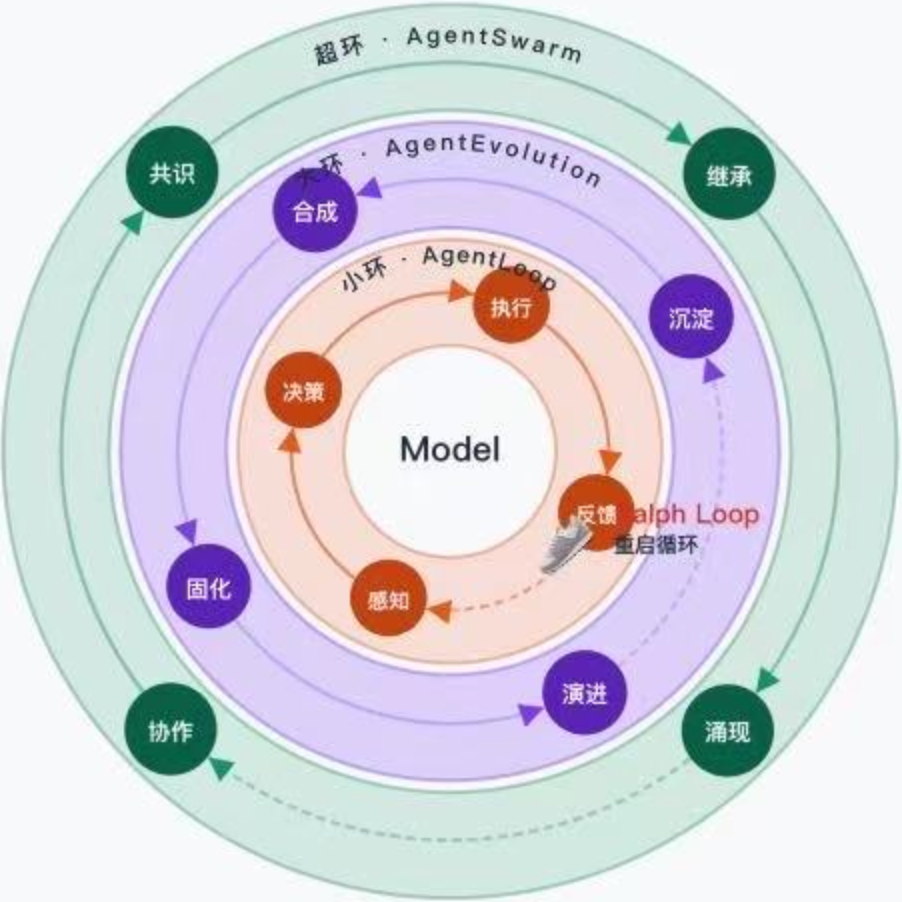
After an Agent completes a task, what it leaves behind is often more than an answer. There is also an expensive exploration path: which files it read, which tools it tried, where it failed, and what checks it used to confirm the result. The problem is that the next execution may not be able to use those experiences. The model parameters have not changed, and a new session will not naturally inheri…
0x01
At the end of 2022, ChatGPT exploded onto the scene, triggering the first wave of excitement in the tech industry. But traditional state-owned enterprises did not act immediately. The real action began in 2023. Domestic large models were open-sourced one after another, and integrated hardware-and-software delivery formats such as “large-model all-in-one machines” became the default option. Mo…
AI has already entered code writing, algorithm optimization, and model development. But after a task is completed, what remains may be reusable capability—or merely an answer and scattered logs. The difference becomes apparent only when a similar problem comes up again: can the system reuse what it learned, or must it pay the cost of exploration all over again?
Recursive Self-Improvement (RSI) co…
My current development workflow for my own projects is to use agent tools like deepseek harness locally to write code and make git commits, then install deepseek harness on the server and connect to it through a tunnel, allowing the server-side deepseek harness to handle deployment. The server is Ubuntu, and the local Mac establishes the tunnel connection. Deployment only requires sending a deploy…
First, the result: over the course of four months, on and off, I built a WeChat Mini Program called “随了么小管家” for keeping track of gift-giving and reciprocity. It currently has about 40 pages, with roughly 29,000 lines of frontend code and 14,000 lines of backend code, 85 commits, and a version number that has reached 1.1.9.
The tech stack is pretty ordinary: uni-app + Vue 3 + Pinia on the fronten…
 go-stock• Pinned