ManageEngine (Zoho's enterprise IT management unit) released more than 30 Zia AI agents for the Chinese market on October 20, and says it plans to expand the line to over 100 agents by the end of 2026, according to a 智东西 report. The agents run on ManageEngine's self-developed Zia large model and are embedded in products customers already use, so the company says they add no token fees and reuse existing operational context without buying a separate AI platform. ManageEngine claims the agents can cut mean time to resolution by 40%–60% and autonomously handle 40%–60% of frontline service-desk tickets, and says the series will be formally shown at its Shenzhen user conference on October 28; the company also says it supports domestic stacks including Kingbase, Kylin, Euler and Arm, and is compatible with models such as DeepSeek.
A China Voice report relayed by IT之家 AI found sellers on second-hand platforms offering discounted Doubao, DeepSeek and Kimi access through supposed cracking tutorials, shared account rentals and resold API keys. A reporter purchased one tutorial and a Kimi account session, while Doubao and Kimi said the unauthorized services were unsupported and warned of data leakage, fraud and account violations.
DeepSeek announced on October 20 that it is fully open-sourcing DeepInfer, its internal inference framework, following earlier open releases of models, the TileLang compilation tool and inference operator libraries, according to a Geek Park report. DeepSeek says DeepInfer already powers high-throughput, low-latency large-scale serving for DeepSeek V4.1 Flash, and that inference code and future optimizations for new DeepSeek models will continue to be updated there. The report cites DeepSeek's own statements and gives no technical details, benchmarks or license terms for the release.
Tomasz Tunguz compares two new data points on inference economics: DeepSeek's published calculation of a theoretical maximum of $38 in revenue per GPU card-hour, and SpaceX's third-quarter report. Tunguz places those against a B200 spot rental price of $8.77 per card-hour settled on 2026-10-20 per the ORNN Compute Price Index, a $5.27 negotiated rate implied from SpaceX's S-1, and a derived realized AI revenue figure of $2.44 per card-hour from its 8-K. He notes every figure is an estimate: DeepSeek's number describes a single best cluster running its cheapest model at off-peak prices, not a fleet average, and SpaceX's realized revenue uses installed rather than utilized capacity. SpaceX CFO Bret Johnsen said on the Q3 2026 earnings call that new compute deployments are generating payback of less than a year at current pricing, while Tunguz also cites GPU rental prices doubling in six months, from $4.40 to $8.08 per card-hour, against faster falls in the price of intelligence.
DeepSeek announced on October 20 that it plans to fully open-source its internal DeepInfer inference framework. The announcement followed the open-sourcing of several models, the TileLang compiler and an inference-operator library. The supplied report does not provide a repository URL, release-package details or confirmation that the code is already available.
DeepSeek announced that it will fully open-source DeepInfer, an internal inference framework it has used to deliver high-throughput, low-latency large-scale inference for DeepSeek V4.1 Flash. The company said inference code and subsequent optimizations for new models would continue to be updated through the framework.
Interconnects reports that DeepSeek released DeepSeek-V4.1-Flash-1017 as a 552B-A16B open-weight model that supports image inputs and carries the MIT license. The newsletter says DeepSeek has introduced two model iterations, but does not identify the second one. Interconnects also says the model has drawn attention for its performance at a low price and presents a performance-to-price comparison on the DeepSWE benchmark.
AI前线 reports, citing multiple media outlets, that ByteDance Seed model-evaluation lead Huang Wenhao left the team recently. He joined Seed in August 2024 and initially handled technical project management and planning; his responsibilities later shifted toward model evaluation, technical planning discussions and talent recruitment. Phoenix News cited people familiar with the matter who said he may next start a company, but his plans, direction and financing remain unclear, and ByteDance has not publicly confirmed his post-departure arrangements.
Bloomberg Technology reports that DeepSeek is releasing the software it uses to run its artificial intelligence models at scale. The report says this could make DeepSeek's technology cheaper and easier for businesses to run, but it provides no independent cost measurements or benchmarks. The name of the tool, its version and its licensing terms were not disclosed in the supplied report.
A column by the WeChat account Naojiti, republished by Huxiu AI and TMTPost, argues that China's AI office competition is being fought on three fronts: foundation models, marketing and channels, and industry-specific workflows. It says Tencent announced that WorkBuddy's built-in models now support Kimi K3, after previously offering Hunyuan, DeepSeek, GLM and MiniMax, and that Kimi K3's context window reaches up to one million tokens. It also cites an AICPB July 2026 desktop ranking with WorkBuddy first at 11.15 million monthly active users and Baidu Dazi second at 6.74 million, and describes Huawei Cloud's upgraded OfficeAce with more than 20 preset expert agents plus expanded finance skills.
A Chinese-language tech report says DeepSeek has open-sourced its inference framework DeepInfer. The report states this is not a model but the middle layer that determines compute costs and electricity bills, describing it as the final piece of the serving chain. It says that when large numbers of users call the service, the inference framework coordinates and schedules large compute clusters, and its efficiency directly determines AI service compute cost and electricity cost. The report notes that ordinary users do not feel this layer, though it operates every day, framing training as making models \"learn\" and inference as making them \"usable.\" The excerpt provides no version number, license, repository link, release date, or performance benchmarks, and no publisher is identified in the supplied text.
China's Foreign Ministry spokesperson Mao Ning said on October 20 that Beijing opposes overstretching national-security concepts and politicizing technology and trade issues, and will resolutely safeguard Chinese companies' lawful rights, according to CCTV News as relayed by IT之家. She was responding to reports that the US government has told its agencies to stop using DeepSeek and other Chinese AI tools. Separately, the New York Times, as summarized by Techmeme, reported that China criticized a Department of Homeland Security ban on DeepSeek, vowed "resolute countermeasures" and rejected FBI and AI-lab allegations of illicit distillation, after DHS ordered the removal and exclusion of products developed by the Chinese company.
DeepSeek has open-sourced DeepInfer, the inference framework used for large-scale DeepSeek V4.1 Flash services, along with the deepseek-recipe token-conversion component. The supplied reports describe support for distributed inference, speculative decoding, structured output, NVIDIA SM100 Blackwell GPUs and Huawei Ascend 950 NPUs. The public release does not include all infrastructure required for online services, including KVCache management and load balancing. DeepSeek says one cluster serves 155 trillion tokens per day and generates $38 per GPU-hour at off-peak pricing; the supplied reports provide no independent measurement of those figures.
Joseph Sifakis, winner of the 2007 Turing Award and founder of the Verimag laboratory, used a speech at the 2026 Sustainable Global Leaders Conference in Shanghai to call for global standards and regulation for AI, urging coordination with like-minded countries. He said current AI systems cannot understand the real world or make safe decisions, arguing that even though ChatGPT or DeepSeek can outperform humans on medical exams, that does not mean models can serve as doctors, because they do not grasp social norms and value systems. He also said the real danger is that superintelligence may mask unsafe and uncontrollable risks, while some large companies use this to dodge responsibility and profit from regulatory gaps, and argued the priority is governing the systems we already have rather than preparing for self-evolution.
Latent Space's AINews roundup reports that DeepSeek V4.1 Flash 1017 is a 552B-total, 16B-active MoE model with a 1M-token context window under an MIT license, priced unchanged at $0.30/$1.20 per million input/output tokens at peak, with off-peak pricing half that. Artificial Analysis scores it 45 on its Intelligence Index, up six points and tied with GLM-5.3 for second among open-weight models, while noting MiMo-V2.6-Pro and GPT-6.1 Sol (medium) score higher at lower cost per task. The model is available through DeepSeek's API, Fireworks, Baseten, DeepInfra, Cloudflare and Together, and ranks first among open models in Code Arena WebDev at No. 12 overall with 1,670 points; Together says it was trained with self-feedback RL, and release figures cite Terminal-Bench 4.0 rising from 31.2 to 42.3.
A feature by Jingzhe Research Institute, republished by 36Kr, Huxiu and TMTPost, describes a small market in China in which creators sell AI role-play persona prompts through social platforms, from bundled templates costing a few yuan to made-to-order character settings. One buyer quoted says custom prompts typically cost 5–8 yuan and arrive in two to three days, with rush orders or buyouts costing double, while the report says per-role pricing generally stays under 10 yuan per 1,000 characters. The article links the trade to the OC (original character) community's commission culture and notes emerging friction over copying, character ownership and edge-case content as generative AI rules tighten.
A TMTPost reviewer tested the WeCom–WorkBuddy integration announced on October 14, which adds a WorkBuddy bot to the WeCom chat list so users can create and bind a bot and then hand messages, files, meetings, mail, calendars and contacts to the AI; admins can centrally purchase quotas, configure models such as Hunyuan and DeepSeek, and upload private skills and MCP connectors. The test also hit failures: a scheduled task reported the model queue was full, and switching to models labelled “idle” did not help, with repeated attempts from 10:10 to 10:47 all failing. Another task pushed content dated October 2025, and execution logs showed the wrong year was written into the search keywords at the retrieval stage. The author cites official documentation saying local scheduled tasks run on the user's own client and WeCom push is only a result notification, so time-sensitive automation still needs human verification.
TMTPost tore down a 99-yuan AI toy cat and estimated that of the roughly 90 yuan it costs above a 9.9-yuan free-shipping plush toy, about 70 yuan goes to hardware upgrades such as the chip, module, battery and speaker, while cloud AI costs about 10 yuan as a bought-out license or one to two yuan on a per-call basis — 1% to 10% of the price. The article cites Taobao data showing AI toy sales up more than 1,600% in 2025 and a 500-fold year-on-year jump for the category during the 2026 Tmall New Year sale, and cites MIIT figures putting China's AI toy market at about 29 billion yuan in 2025 and a projected 34.2 billion yuan in 2026. It also reports return rates of roughly 30% to 40% for AI plush toys on e-commerce platforms, up to 80% in livestream channels, and that 7 of 15 AI toys in a comparative test by consumer associations in Yunnan, Guizhou and Guangxi fell below the 75% pass line for voice-interaction success.
QuestMobile published its Q3 2026 China AI application market report on October 20. As of September 2026, AI native apps reached 546 million monthly active users, up 82.1% year over year, with Doubao at 419 million, Qwen at 158 million and DeepSeek at 123 million; AI office MAU reached 142 million, up 50.6%, with Tencent WorkBuddy leading office Agents at 32.353 million, ahead of Baidu Dazi at 9.77 million and Qianwen Office at 7.905 million. Office Agent figures grew 518.4% year over year on the AI native app side and 512.2% on PC clients. 钛媒体 cited Analysys data putting September desktop visits at 85.34 million for WorkBuddy, 46.55 million for Qianwen Office and 30.39 million for Doubao Work, and noted that QuestMobile adds MAU across covered endpoints without deduplicating cross-device users, while Analysys counts desktop interactions. AIX财经 noted Qwen grew 5076.6% year over year and surpassed DeepSeek in scale, partly reflecting a low early baseline, while Qwen fell 5.4% quarter over quarter; DeepSeek fell 15.2% year over year.
Zihao is an iOS input method built on the Rime engine, comes with the Rime Ice (雾凇拼音) schema and ships dedicated keyboards for iPhone, iPad and iPhone Duo; its developer says the app deploys the schema on-device at first launch and downloads a roughly 6.8 MB sentence-level language model called Zihao Kouyu. Users can import Rime config folders, ZIPs, YAML or public GitHub repositories, and the personal dictionary is stored in Rime format in an iCloud sync folder so it can be merged with Rime's Squirrel on the Mac. The developer reports internal simulated tests where one-pass accuracy for sentences with two mistyped letters rose from 36% to 56% and three-letter cases from 26% to 53%; typing, correction and two small models run locally, while AI translate, polish and reply features require users to enter their own OpenAI, Claude, Gemini or DeepSeek keys, and the app is a free App Store download that does not launch in mainland China or the EU.
Arena said on October 19 that DeepSeek-V4.1-Flash-1017 (Max), released October 17, scored 1670 on the Code Arena: WebDev leaderboard to become the highest-ranked open-source model, ahead of Kimi K3 (Max) and other open models and also ahead of closed models including Muse Spark 1.3 (Max), Claude Opus 5 (High) and Grok 4.7 (xHigh), trailing GPT-6 Sol (Max) by 12 points. The report says the model scored above GPT-6 Astra, GPT-6.1 Sol and Claude Opus 5 on the DeepSWE v1.1 software engineering test, with average cost per task down about 60% from the previous version; peak-hour pricing is 2 yuan per million input tokens on a cache miss and 8 yuan for output, falling to 0.04 yuan for cached input. DeepSeek says the model supports "wish-style programming" that generates games and 3D modeling in one click, and one netizen's test reported faster generation than GPT-6.1's ultra-fast mode.
vLLM released vLLM TorchTPU, an out-of-tree platform plugin that lets vLLM run on Google Cloud TPUs, and Google said it also launched a native PyTorch backend for SGLang built with RadixArk. Both engines are built on Google's TorchTPU stack, reuse existing model definitions and keep upstream schedulers, KV cache managers and OpenAI-compatible servers, with TPU-specific Pallas kernels for attention, mixture-of-experts and quantized matmuls. Google says the engines are running in production with preview customers and cites SemiAnalysis InferenceX results including 2.01 cents per million tokens, while vLLM lists TPU v7x (Ironwood) as recommended hardware and v6e, v5e and v5p as experimental.
Unsloth released GGUF builds of DeepSeek V4.1-Flash-1017 for local use, including a 1-bit configuration that it says retains about 88.2% accuracy while reducing model size from 508GB to 250GB. The company also claims strong benchmark rankings, but the reports provide no independent measurements, and the stated RAM requirement varies between 64GB and 128GB across its posts.
DeepSeek and Huawei are reportedly working together on future AI chip designs, with DeepSeek influencing decisions about computation and data movement between processors. Huawei engineers have reportedly spent extended periods at DeepSeek's offices to incorporate the model maker's requirements. Separate reports also say DeepSeek plans to pretrain V5 on Huawei Ascend 950DT systems, but the schedule and technical details remain unconfirmed.
The U.S. Department of Homeland Security ordered federal civilian agencies to remove DeepSeek products and third-party services built with DeepSeek implementations from government IT systems, while prohibiting future purchases of related offerings. The order invokes federal supply-chain procurement law and allows agencies to seek exceptions, with CISA assisting implementation and the Homeland Security Secretary required to reconsider the directive annually. The notice was made public on October 19, though TechSpot, citing the Associated Press, said the underlying decision dated to late July.
NorForge principal threat researcher Snorre Fagerland reported that a Chinese-speaking hacker used AI agents orchestrated through Cairn, an open-source multi-agent problem-solving platform, to target more than 1,200 websites and breach over 100, according to Reuters. Reuters identified Deere, SharkNinja and Cummins among the victims; Deere said it had taken remediation steps and saw no sign sensitive information was accessed, SharkNinja said a standalone product-support site was hit and the threat contained, and Cummins said it was investigating a report about a website run by one of its vendors. Fagerland estimated the campaign consumed about $5,000 in tokens, roughly $50 per successful breach, with successful intrusions averaging about 23 hours; the worker reportedly combined Claude Code with a DeepSeek model, though researchers said the model was hard to determine.
Reddit user whiteh4cker (r/LocalLLaMA) says they built DeepSeek-V4.1-Flash-1017-dsx-2.6bit, a 2.6-bit quantization made with lxe's dsx engine for programming and agentic tasks, and that the full weights would be uploaded within two hours of the post. The post self-reports that the 2.6127 bpw build scored 82.59% top-1 and 9.3626 perplexity against the FP8/FP4 teacher model, and reached 26 t/s generation and 170 t/s prompt processing at 262,144 context with Engram tables on two RTX 3090s with 192 GB DDR5. The author also notes the engine does not yet support images and that loading the 187.6 GB weight from an HDD takes 90–110 minutes.
According to 智东西, Arena announced on October 19 that DeepSeek-V4.1-Flash-1017 (Max) became the highest-ranked open model on its Code Arena: WebDev leaderboard. The model scored 1670 points, ahead of Kimi K3 (Max) and Mimo-V2.6 Flash and also ahead of closed models including Muse Spark 1.3, Claude Opus 5 and Grok 4.7, while finishing 12 points behind GPT-6 Sol (Max). IT之家 reported on October 20 that Arena also ranked the model first among open models and 11th overall on Agent Arena; IT之家 cited 7,498 real usage sessions and a 5.13% net improvement, while an Arena post cited a 5.1% net improvement across more than 7,500 sessions. IT之家 put median cost per task at about $0.18–0.19, while the Arena post cited $0.20; Arena listed the model on its performance-versus-cost Pareto frontier. The model was released on October 17. DeepSeek says it supports “wish-style programming” that can generate games and 3D models in one click, and 智东西 reported that its average cost per task on the DeepSWE v1.1 software engineering test fell about 60% from the previous version.
AI chip startup Tenstorrent closed a $1.5 billion Series E round at a $6.2 billion post-money valuation, led by Trace Capital and Innovation X, according to Bloomberg and other reports. CEO Jim Keller said the independent company will scale its Galaxy servers and develop licensable AI and CPU designs; The Next Web reported that these servers have demonstrated running DeepSeek models. Tenstorrent will use the proceeds for large-scale deployment and commercialization, while its open-source software stack and RISC-V processors support open-weight models.
A Juejin tutorial article says DeepSeek released DeepSeek Harness (dsh), described as its first agent product, and open-sourced it under the MIT license. The article describes a graphical web UI agent harness assembled on the Cordis framework, with capabilities delivered as plugins, approval prompts before sensitive operations, and launch via a single npx command requiring Node.js 22 or later. It also says 769 developers signed up during internal testing and roughly 300 community plugins appeared, and likens the tool to Claude Code and Codex, though those figures and comparisons are not confirmed by DeepSeek or any independent source.
What problem it solves
Stock analysis often requires users to gather market quotes, news, technical indicators, financial information, and AI-assisted interpretation across multiple sources. The project addresses this by bringing supported-market data, analysis tools, AI agents, alerts, and review workflows into a locally focused desktop application.
Key features
Multi-market market data — The app…
What problem it solves
AI coding tools often expect particular provider protocols, making it difficult to use the models and providers a user prefers. A local gateway can translate between supported client APIs and provider APIs while preserving capabilities such as streaming, tool calls, reasoning, and images.
Key features
Provider protocol translation — The gateway translates Responses, Chat Com…
What problem it solves
The hidden system instructions that shape AI product behavior are difficult to inspect and change across models, products, and versions. This repository makes collected prompts available in a structured, product-oriented archive for study and comparison.
Key features
Broad product coverage — The archive covers prompts from major AI providers and products, including Anthropic…
What problem it solves
Image creation often requires switching between separate tools, manually translating visual ideas into parameters, and losing the context of an ongoing conversation. This project brings generation, editing, reference workflows, model comparison, and asset management into a DeepSeek Harness conversation and canvas.
Key features
Chat-Based Image Creation and Editing — Describe…
Optimizing a GPU kernel or completing a set of formal proofs often requires repeated trial and error: try a different implementation, run an evaluation, and keep iterating in whichever direction proves effective. When giving a model more test-time compute, the most direct approach is to let more agents try simultaneously; if the task only needs one best result, the value of the other attempts lies…
What problem it solves
Complex trading decisions require evaluation across financial fundamentals, market sentiment, news, technical indicators, portfolio holdings, and risk. TradingAgents addresses this by decomposing trading tasks into specialized LLM-powered roles that discuss findings and assess proposed transactions.
Key features
Parallel analyst research — Fundamental, sentiment, news, and t…
What problem it solves
DeepSeek Harness workspaces, tools, and project setup normally remain tied to the computer running the Harness instance. The project addresses the need to continue using that environment from another computer, phone, or browser without requiring a public listening port or public IP on the Host.
Key features
Remote workspace access — Open local workspaces from a web browser, …
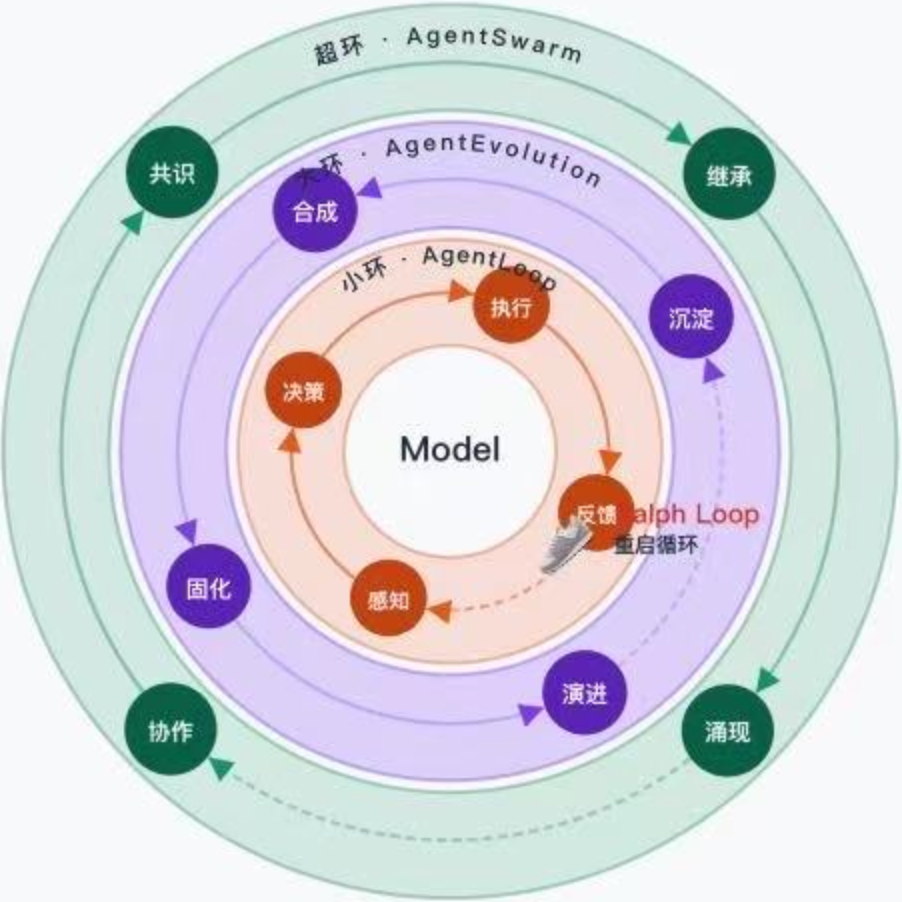
After an Agent completes a task, what it leaves behind is often more than an answer. There is also an expensive exploration path: which files it read, which tools it tried, where it failed, and what checks it used to confirm the result. The problem is that the next execution may not be able to use those experiences. The model parameters have not changed, and a new session will not naturally inheri…
0x01
At the end of 2022, ChatGPT exploded onto the scene, triggering the first wave of excitement in the tech industry. But traditional state-owned enterprises did not act immediately. The real action began in 2023. Domestic large models were open-sourced one after another, and integrated hardware-and-software delivery formats such as “large-model all-in-one machines” became the default option. Mo…
AI has already entered code writing, algorithm optimization, and model development. But after a task is completed, what remains may be reusable capability—or merely an answer and scattered logs. The difference becomes apparent only when a similar problem comes up again: can the system reuse what it learned, or must it pay the cost of exploration all over again?
Recursive Self-Improvement (RSI) co…
My current development workflow for my own projects is to use agent tools like deepseek harness locally to write code and make git commits, then install deepseek harness on the server and connect to it through a tunnel, allowing the server-side deepseek harness to handle deployment. The server is Ubuntu, and the local Mac establishes the tunnel connection. Deployment only requires sending a deploy…
First, the result: over the course of four months, on and off, I built a WeChat Mini Program called “随了么小管家” for keeping track of gift-giving and reciprocity. It currently has about 40 pages, with roughly 29,000 lines of frontend code and 14,000 lines of backend code, 85 commits, and a version number that has reached 1.1.9.
The tech stack is pretty ordinary: uni-app + Vue 3 + Pinia on the fronten…
 go-stock• Pinned