Create

Sign in to ReadmeX

or

How we handle your data: Privacy Policy

ReadmeX

Your AI reading companion

What would you like to catch up on?

Pick a briefing, or ask your own question.

Your community and people briefings stay personal to you.

Bytedance

AI overview

Sign in and the AI will write an overview from our coverage.

Headlines · 284

  1. Essay: Hongguo short dramas and AI in a 'pure living' era

    A commentary republished by Huxiu AI argues that Chinese users are entering a "pure living era": AI chat handles translation, proposals and resumes that once required favors from friends, saving time while removing reasons to reach out to people. The article says ByteDance's free short-drama app Hongguo launched in April 2023 with only 320,000 monthly users, grew to 356 million three years later and passed 100 million daily users in January 2026; it cites QuestMobile data putting May 2026 short-drama viewers at 851 million. It also pairs Tencent's cited Q2 capital spending of 52.8 billion yuan, up 176% year on year, with a lower-consumption, low-social "low-power" lifestyle, framed by director Jia Zhangke's Aug. 6 Weibo post saying he had been watching Hongguo.

    虎嗅 AI · 🔥 0
  2. AI infra spending boom meets idle GPUs at Beijing salon

    A closed-door salon on AI infrastructure hosted by Touzhongwang with Zhongguancun partners, republished by 36Kr, examined the gap between huge AI infrastructure spending and weak efficiency. It cites ByteDance's $29.6 billion syndicated loan, Alibaba's HK$80 billion placement, more than $80 billion raised earlier by Google and Amazon, and NVIDIA's $500 billion plan, while noting China's daily token calls topped 140 trillion in March, over a thousand times early-2024 levels. Participants cited a Carnegie Mellon test of 756 GPUs running 31 days with the cluster waiting nearly 20% of the time, claimed over half of OpenAI's inference energy goes to idle work, and said average GPU utilization at Chinese smart-computing centers is below 30%. Several investors called lowering token cost and raising utilization the new deciding factor; SGLang's RadixArk reportedly raised a $100 million seed at a $400 million valuation, while one dissenting view argued inference revenue will fall sharply as algorithms compress token use by orders of magnitude.

    36氪 人工智能 · 🔥 0
  3. Tian Keyu's World-Model Startup Reportedly Raised Nearly $30M

    36Kr reported that former ByteDance intern Tian Keyu raised nearly US$30 million for a world-model startup at a US$200 million post-money valuation, adding that the financing had been disclosed about three months earlier. TMT reported that the round closed after a first-instance court judgment ordered Tian to pay ByteDance 500,000 yuan for breach of contract and confiscate his salary. Tian acknowledged improperly stopping another intern’s project, while ByteDance alleged that he interfered with internal model training; the technical allegations remain disputed.

    36氪 人工智能 · 🔥 0
  4. ByteDance AI drug spinout Anew Labs raises $290M angel round

    Anew Labs, which spun out of ByteDance in June 2026, raised a $290 million angel round in September 2026 at a reported valuation of about 10 billion yuan, which the report calls China's first AI drug-discovery company to reach that valuation in a first round. Investors include Sequoia China, IDG Capital, Hillhouse Venture Capital, Five Source Capital, Gaorong Ventures, Primavera Venture Partners and Boyu Capital, with Sino Biopharmaceutical and the Shanghai Future Industry Fund joining as strategic investors; ByteDance remains the controlling shareholder and continues to supply Volcano Engine compute. The company has released biological AI models Protenix and PXDesign along with AnewMind, a scientific reasoning model for drug-development decisions, and lists four preclinical pipeline assets, with a lead oral small-molecule candidate it describes as the world's first to target both IL-17A and IL-17F, currently in preclinical lead optimization. Anew Labs said it is focused on R&D and declined an interview.

    虎嗅 AI · 🔥 0
  5. China's Golden Week OTA split: Doubao sells answers, Fliggy and Tongcheng sell inventory

    A TMTPost retrospective on China's National Day Golden Week says AI entry points became a key battleground for online travel platforms. Doubao launched a dedicated travel hub covering maps, transport, hotels and dining before the holiday, and Douyin Life Services said Doubao hotel bookings rose over 56% month-on-month; Fliggy's Bangbang assistant saw interactions up 158% and guided flight and hotel bookings up 110%, while Tongcheng Travel's DeepTrip agent and Meituan's “Xiaotuan” assistant also reported holiday gains. The piece argues that legacy OTAs stress interaction and traffic while Doubao stresses transaction conversion, and that AI itineraries still struggle to adjust for weather, crowds, fares and traffic, so turning plans into real fulfillment rather than chat quality will decide the winner.

    钛媒体 · 🔥 0
  6. Volcano Engine launches Seedance film program, up to ¥1M per project

    At the Pingyao International Film Festival, ByteDance's cloud unit Volcano Engine announced a Seedance film cooperation program offering token subsidies, marketing resources and technical support to professional film and series, animation and short-film projects worldwide, with incentives of up to 1 million RMB per project. The push follows Volcano Engine's Cannes appearance with Seedance 2.0 in May, where the source says Higgsfield's 95-minute AI feature "Hell Grind," with nearly all video and voice generated by Seedance 2.0, was made for under $500,000 in 14 days. Separately, Bona Film Group's "Sanxingdui: Future Past," in which Bona says Seedance 2.0 was used only to enhance some scenes, reaches theaters on Oct. 23, while ByteDance's Jimeng AI launched a film label, Jimeng Film Studio, on Aug. 26 and Douyin hosted an AI short-film hackathon with computing support from Volcano Engine.

    钛媒体 · 🔥 0
  7. ByteDance, Tencent speed up personal AI agents to chase Meta Muse

    According to a Caixin report, Chinese tech giants moved quickly to follow Meta's September launch of the personal agent Muse, which can send emails and book travel for users, accesses data across email, calendar, payments, health, shopping and smart home only with user authorization, and lets users revoke access at any time; Mark Zuckerberg has described it as a key product on the path to "personal superintelligence." A ByteDance insider said the company stepped up work on its own personal agent project before China's National Day holiday: the effort began in April under the codename "Spell," extends its 2025 Doubao phone-assistant personal agent direction, and is led by the Doubao phone assistant team jointly with the Doubao conversation team, with plans to combine Spell with Doubao and launch it as soon as possible. Tencent, meanwhile, launched a personal agent product called LightVela in late September, positioning it as a "cloud personal assistant" that connects through WeChat and stays online around the clock to handle daily requests; it remains in a developer-experience stage.

    IT之家 AI · 🔥 0
  8. ByteDance paper finds periodic blind spots in DeepSeek V4 chunked KV-cache compression

    A ByteDance team paper, “Periodic Weak Spots: Phase Sensitivity from Chunked KV-Cache Compression,” says the chunked KV-cache compression used by the DeepSeek V4 series creates “phase sensitivity”: adding only decorative equals signs ahead of a code snippet flipped DeepSeek-V4-Flash-Base's completion between 8 and 32, with an error rate of about 71.3% when the count of equals signs modulo 4 was 0 or 1 and about 91.5% accuracy when it was 2 or 3. In a 128K-token needle-in-a-haystack test with roughly 16,000 key-value pairs, moving a single pair changed accuracy by up to 40.2% for V4-Flash-Base and 34.8% for V4-Pro-Base, with gaps of 19.1% and 14.8% remaining after post-training; halving the compression stride in DeepSeek-V4.1-Flash narrowed the gap to 6.1% but did not remove it. Control models trained from scratch on the Qwen3-0.6B architecture showed the same periodic swings whenever fixed-length chunked compression was used, while a full-attention baseline did not, which the authors present as a structural flaw rather than a tuning issue.

    雷峰网 AI · 🔥 0
  9. The AI capital loop: $1.65T off-balance-sheet pledges and a 166x token price gap

    A signed analysis republished by Huxiu walks through the AI capital cycle: the author says about 87% of Alphabet's $112.1B Q2 2026 net profit came from paper gains on its SpaceX and Anthropic equity stakes, and roughly 85% of Amazon's $62.6B profit from fair-value adjustments on its Anthropic investment — neither reflecting cash inflows. Citing a Nikkei Asia review, it puts the five big tech firms' off-balance-sheet lease and purchase commitments at about $1.65T, above roughly $1.35T of on-balance-sheet debt, and says CICC estimates AI applications need about $1T a year in revenue to cover capex versus roughly $200B in combined ARR for leading US model makers. On monetisation, the author contrasts OpenAI's $30 per million output tokens with DeepSeek's $0.18 — a 166x spread — and lays out three endgames, judging a localised blow-up with chain effects most likely.

    虎嗅 AI · 🔥 0
  10. ByteDance AI roles reach 42.8% of job postings in 'full-stack' hiring push

    An analysis of ByteDance's careers site counted 11,187 open China social-recruitment roles on Oct 5, of which 4,791 (42.8%) relate to AI — with AI's share of newly posted roles rising from 33% to 55%. By unit, the Seed model team was 96.1% AI roles, Doubao and other AI-native apps 77.2% and CapCut 74.3%, while e-commerce (26.4%) and local services (16.9%) trailed. The author argues ByteDance is hiring across six layers — chips, compute, foundation models, cloud, applications and devices — a "saturated, full-stack" push that comes at the cost of focus.

    创业邦 科技 · 🔥 0
  11. Huawei says Ascend tops Nvidia in China share as supply stays tight

    According to a media briefing summary published by Jiemian, Huawei rotating chairman Xu Zhijun said Ascend is still far from meeting domestic demand and that Huawei has no plan to expand broadly overseas, urging the supply chain to "go faster, produce more"; he said Huawei's own data suggests Ascend's China market share has surpassed Nvidia's, though the note gave no figure or methodology. Nvidia said in its quarterly report that H200 shipments to some Chinese customers permitted since February accounted for less than 1% of data center revenue in the quarter, and it excluded China data center compute revenue from next-quarter guidance. The article also reports intent prices for Ascend 950DT accelerator cards up 20%-50% in two months to over 250,000 yuan and 950PR up from about 60,000 yuan early this year to over 80,000 yuan (intent quotes, not final prices), and that DeepSeek published Ascend-targeted software components including TileKernels and DeepGEMM-Ascend on September 30.

    虎嗅 AI · 🔥 0
  12. Doubao moves toward personal agent with utility payments, taking aim at Alipay

    According to a report by 字母榜 (Zimubang), Doubao now supports paying water, electricity and gas bills, with the payment screen handled by a Douyin life-services mini program rather than embedded inside Doubao. Doubao had earlier launched "Travel with Doubao," which bundles navigation, ride-hailing, flights and hotels, plus "Ask Doubao before buying" for purchase advice. The piece argues ByteDance is steering Doubao from a chatbot toward a personal agent, starting with travel, local services and bill payments — a path that could eventually erode Alipay's core turf; it cites 380 million MAU and 140 million DAU for Doubao without sourcing the figures.

    36氪 人工智能 · 🔥 0
  13. AI glasses boom meets 'China's eyewear capital': Danyang shops hesitate

    In Q1 2026 global smart glasses shipments hit 3.566 million units, up 130.1% year on year; Tmall's first 618 phase saw AI glasses sales rise ninefold, and smart glasses joined China's national subsidy list, with 15% off devices under 6,000 yuan. Yet in Danyang, Jiangsu — known as "China's eyewear capital" — small shop owners hesitate: display-equipped AI glasses cost nearly 1,800 yuan wholesale, models iterate fast and merchants lack stock-return guarantees, while industry monitoring puts average AI glasses return rates near 30% on major e-commerce platforms and 40%–50% on Douyin livestreams. Danyang has 1,600+ eyewear companies and 50,000+ workers making over 400 million lens pairs a year — about 75% of China's lens output and half the world's — and local leader Mingyue Optical Lens has been Xiaomi's exclusive optical partner for its AI glasses since June 2025, reporting 6.51 million yuan in cumulative revenue from that business as of Sept 30, 2025 and a 78.6% gross margin on smart-glasses lenses.

    虎嗅 AI · 🔥 0
  14. World models framed as key to physical AI, easing robot training-data scarcity

    An industry analysis argues that world models differ fundamentally from LLMs: rather than generating text, they predict how the physical world will change based on environment observations and actions, making them a cornerstone of "physical AI." Their biggest claimed value is easing the extreme scarcity of embodied training data — robots' actions, contact and force responses have no ready-made datasets, so an accurate world model could generate near-unlimited practice experience in simulation while cutting the cost and safety risk of real-world data collection. The piece cautions the approach is still early, citing weak long-horizon consistency, insufficient physical accuracy and high compute and memory costs, plus the sim-to-real gap, a shortage of physically annotated action data and partial observability; the most commercially mature use remains autonomous-driving simulation and validation, while general-purpose and humanoid robotics largely stay at demo or loss-making R&D stage.

    科技新报 · 🔥 0
  15. Making 'good enough' AI a business: cheap models, cost tiers and the budget gap

    This analysis (originally by 最话FunTalk, republished by 36Kr and TMTPost) examines how AI vendors are turning "good enough" intelligence into a business. It notes that on October 6 OpenAI published math research produced by its internal frontier model, saying each result took compute equivalent to roughly three hours of ChatGPT Pro thinking, and that on October 7 Anthropic released the small model Haiku 5.5 for high-volume tasks such as summarization, classification and database queries, while OpenAI pushed GPT-6 to more ChatGPT users and gave free users the lighter Luna. Citing published API prices, it says GPT-6 Astra costs $50 per million output tokens versus $0.5 for Luna, while Haiku 5.5 is priced at $0.1 per million input tokens and $0.5 per million output tokens for prompts under 100,000 tokens, with Anthropic claiming roughly 75% average savings versus its predecessor on real tasks and halving Sonnet 5.5 cache-read prices. In China, Alibaba's Qwen Office, Tencent's Marvis and WorkBuddy, and ByteDance's Doubao Work integration with Feishu are all embedding AI into office workflows; the article argues the test is winning incremental budget, not topping leaderboards.

    36氪 人工智能 · 🔥 0
  16. China's personal AI agents stall on ecosystem access, not model power

    A TMTPost analysis argues that ByteDance's Doubao, Alibaba's Qwen and Tencent's Yuanbao are all pushing personal agents, but the binding constraint is not model quality — it is whether platforms will open up accounts, payments and fulfillment to a third-party assistant. The dispute over Meta's Muse, which Amazon restricted from its store, illustrates that user consent does not equal platform permission; Doubao's phone assistant on Nubia's NaviX Ultra could complete a coffee order inside Douyin after authorization but could not drive Taobao Flash Purchase, JD.com or WeChat messaging. Each group is leaning on in-house ecosystems to cut integration costs, yet inference and task-state management still consume resources, and merchants will only keep participating if agents bring incremental demand.

    钛媒体 · 🔥 0
  17. A month in, Meta's Muse kicks off a personal-agent land grab

    Meta launched its personal agent Muse in the US on Sept. 8, giving users a dedicated cloud computer where tasks keep running after the app is closed; internal data cited by The Information put weekly active instruction-givers above 3 million. Manus released Cue, a standalone personal agent app, on Sept. 28 with its own email, phone number, wallet and computer, while OpenAI introduced Dots on Sept. 29. Amazon blocked Muse on Sept. 20 over unauthorized AI agents, but Instacart said two days later it plans to plug grocery shopping into Muse; Reuters, citing Citi, reported on Oct. 6 that Muse revenue could exceed $27 billion by 2030.

    36氪 人工智能 · 🔥 0
  18. Why China's personal agents stall: the bottleneck is app ecosystems, not models

    This analysis (by the WeChat account Xiangxianzhi, republished by 36Kr and TMTPost) argues that ByteDance's Doubao, Alibaba's Qwen, Tencent's Yuanbao and WeChat's Xiaowei are all pushing personal agents, but the real obstacle is whether third-party platforms will accept an assistant acting and checking out on a user's behalf. It cites reports of a roughly six-day sprint by the Doubao product line to produce an internal test build around Mid-Autumn, notes that the Nubia NaviX Ultra shipping Doubao's phone assistant has launched, and points to tests where Taobao Shangou, JD.com and WeChat refused delegated operations; Meta's Muse was likewise blocked by Amazon from accessing and shopping for users. The authors conclude that in-house ecosystems (Taobao, Douyin, WeChat mini programs) cut some build costs, but cross-platform tasks still require external partners and revenue-sharing terms.

    36氪 人工智能 · 🔥 0
  19. China's model labs stay quiet over the holiday as OpenAI and Anthropic keep shipping

    A 36Kr roundup notes that during China's week-long National Day holiday, DeepSeek, Zhipu, Moonshot AI, MiniMax, Alibaba, ByteDance and Tencent released no new flagship models, while OpenAI announced a 28-day release streak after its DevDay updates and Anthropic launched Haiku 5.5 on Oct 7. The companies were still active in other ways: DeepSeek updated its Harness and open-sourced Ascend-oriented compute and communication components, and Zhipu's GLM-5.3 went live on Amazon Bedrock on Oct 5. Reuters reported DeepSeek is raising over 80 billion yuan and Bloomberg reported Moonshot AI completed a pre-IPO private round, neither confirmed by the companies, while awaited models like DeepSeek V4.1 Pro and Doubao 2.2 have yet to appear.

    36氪 人工智能 · 🔥 0
  20. AI phone entry war: Huawei, Alibaba, ByteDance and Tencent chart four paths

    An analysis piece published by TMTPost lays out how China's biggest tech players are approaching AI phones: Huawei's Mate 90 series, launched Oct 1, is described as running a 30B MoE omni-modal model on-device via the Kirin 9050 Pro; Alibaba pairs its Qwen Intelligence stack with Honor for device-cloud co-development; ByteDance and Nubia launched the second-gen Doubao phone, NaviX Ultra, billed as the "world's first AI agent phone"; and Tencent avoids the system-level agent race, instead plugging into Huawei, Xiaomi, Honor, OPPO and vivo through WeChat's A2A protocol while working with Qualcomm to deploy Hunyuan 7B/3B on-device. The article cites an IDC forecast of 147 million next-gen AI phones shipping in China in 2026, up 31.6% year on year and 53% of the market.

    钛媒体 · 🔥 0
  21. AI hardware splinters across devices, leaving the hub layer unclaimed

    A 36Kr "AI Wuzhao" analysis argues the AI hardware industry has shifted from betting on a single "next iPhone" to scattered, multi-form experimentation: glasses, pendants, earbuds, speakers, home devices and toys are all getting AI, while Humane's AI Pin has exited and Rabbit moved its OS3 to the cloud. The missing piece, the author says, is the layer above devices — identity, memory and permissions remain siloed per ecosystem, so context does not carry across hardware; cited examples include Volcengine's claim of over 1 million AIoT units running Doubao as of June 2025, JD's JoyInside across 40-plus toy brands, and Xiaomi's 1.1 billion-plus connected IoT devices with Miloco 2.0 trying to make the home the hub.

    36氪 人工智能 · 🔥 0
  22. AI-generated pet videos and short dramas turn into a monetization business

    A TMTPost/Zinc Scale report says AI-generated cat-and-dog clips and short dramas are spreading across Douyin, Xiaohongshu, YouTube and TikTok, with Douyin's #AI萌宠 topic reaching 2.64 billion cumulative views and more than 124,000 participating creators. Cited examples include 《胖橘的故事》 at 103 episodes and over 190 million views, and 《AI猫咪演绎人生系列》 at 127 episodes and over 450 million views. The article describes monetization through brand deals, in-video storefront sales, paid tutorials and apprenticeships, citing third-party data that account @LT 小狗日记 commands up to 80,000 yuan per custom ad while @川岛小猪 charges 4,500 yuan per post and has taken eight brand deals including KFC, Haidilao and FamilyMart. It says the workflow is DeepSeek for scripts, Jimeng or Kling for images and video, and CapCut for editing, producing a clip in 15–30 minutes — though templated content is now crowding the niche and making monetization harder for smaller accounts.

    钛媒体 · 🔥 0
  23. An AI phone that runs errands: Nubia NaviX Ultra raises questions

    Nubia's NaviX Ultra, a production phone promoted as the second-generation "Doubao phone," went on sale last month starting at 5,999 yuan (5,499 yuan after China's national subsidy), with Nubia saying first-sale revenue "broke 100 million in one second." Its assistant can open apps such as WeChat, JD.com and Meituan but cannot yet complete in-app actions: ByteDance's Doubao introduced SAEP, a screen-automation declaration protocol giving third-party apps a 30-day notice period to say whether they accept GUI agent operations, and the commentary warns the device could become a "ByteDance-only phone" if mainstream apps refuse. The piece questions whether the efficiency pitch matches real usage, citing 201 minutes of daily online audiovisual use per user, a meta-analysis of 71 studies with 98,299 participants finding a moderate negative correlation (r = -0.34) between short-video use and cognitive function, and a study of 26,811 students that reported short-term homework gains but declines in later exam scores.

    钛媒体 · 🔥 0
  24. Expert: compute-power coordination is key to China's AI compute costs

    Lin Boqiang of Xiamen University's China Institute for Studies in Energy Policy said in an interview that "compute-power coordination" was written into China's Government Work Report for 2026, and the National Data Administration requires new computing facilities at hub nodes to use at least 80% green electricity. He said power prices are the top factor in siting decisions, followed by green-power compliance, with capacity electricity pricing and direct green-power connections the biggest bottlenecks; China had over 500 intelligent computing centres in use as of June 2026, yet computing workloads used only 36.8% of capacity in 2025. He estimates electricity could make up roughly 40% of a computing centre's costs within three years, and that generators could bundle green power, storage and supply guarantees to become holders of "token capacity", though returns remain uncertain because token demand is tied to model iteration cycles.

    36氪 人工智能 · 🔥 0
  25. China's AI Hackathon Boom: ~500 Events in Six Months, Paid For by Whom

    A TMTPost feature reports that nearly 500 hackathons were held across China in the first half of 2026 — roughly two to three a day — as AI coding tools and vibe coding lowered the barrier to entry. Costs per event ranged from under 20,000 yuan to 1.2 million yuan, with organizers using resource swaps, sponsored compute and volunteer labor to cut cash spending. The piece argues hackathons themselves are hard to run profitably, with commercialization shifting toward corporate-themed events and government partnerships.

    钛媒体 · 🔥 0
  26. Doubao Work adds infinite canvas and Seedream 5.0 Flash image model

    On October 9, ByteDance's Doubao announced a two-part update to its Doubao Work product: the work-task mode gains a canvas feature that lets users lay out assets, plans and generated results on one infinite canvas for viewing, comparison and organization, then keep editing text, colors and layout after generation, with images, video and HTML auto-flowing into the same canvas from the "creative design" and "creative video" skills. The update also adds the new Seedream 5.0 Flash image model and puts Doubao 2.1 Lite (0921 build) into Doubao Work; the company says the model targets high-frequency office work such as Q&A, document writing, spreadsheets and slide creation with faster delivery and lower quota use, and claims leading multimodal understanding. Doubao 2.1 Lite sits alongside Doubao 2.1 Turbo and Doubao 2.1 Pro in the model picker, with adjustable reasoning effort.

    AIbase AI新闻 · 🔥 0
  27. ByteDance Seed says it found cause of DeepSeek's long-context performance drift

    According to a DoNews report, ByteDance's Seed team says it has identified the cause of DeepSeek models "acting up" (producing erratic outputs), pointing to possible performance drift in long-context scenarios. The report carries headline-level information only, with no model versions, test methods or detailed conclusions given, and no public response from ByteDance or DeepSeek.

    DoNews · 🔥 0
  28. ByteDance Seed ties long-context swings to chunked KV cache 'phase sensitivity'

    ByteDance's Seed team says in a new research paper that large language models' performance swings on very long inputs stem mainly from "phase sensitivity" introduced by chunked KV cache compression. To cut memory use in long-context inference, the method compresses consecutive token windows into fewer entries at a fixed stride, creating a new positional coordinate: a token's "phase" relative to the compression window boundary. Experiments show the same information becomes much harder or easier to retrieve at different phases, with long-context retrieval accuracy gaps of up to 40 percentage points in some large open-source models.

    AIbase AI新闻 · 🔥 0
  29. Doubao app adds utility bill payment via voice or text

    ByteDance's AI assistant Doubao has added a "life services payment" feature inside its app: users speak or type a command such as "pay the water bill" and a service card appears, linking to a dedicated page where water, electricity and gas bills can be paid. A person close to Doubao said the assistant is building out multi-scenario task capability spanning travel services and bill payments.

    DoNews · 🔥 0
  30. Epoch Brief: AI costs down 13x a year, up to 2B agents

    Epoch AI's October 8 brief estimates that AI chips shipped through 2027 could support about 30–170 million concurrent frontier-model agents — or nearly 2 billion running cheaper models — and that the cost of a fixed level of AI performance has fallen roughly 47% per quarter over three years, about 13x a year and four times faster than DNA sequencing. The brief also says six leading Chinese AI companies (Alibaba, ByteDance, Z.ai, Moonshot, DeepSeek, MiniMax) generate about a tenth of OpenAI and Anthropic's combined AI-related revenue, that trade data is consistent with more than $3 billion of chips smuggled into China via Malaysia, and that the share of US adults using AI six to seven days a week rose from 8% in March to 19% in August 2026. On internal use and evaluation, it cites OpenAI's finding that its median researcher's daily coding-agent usage, valued at API prices, grew from under $1 in January 2026 to about $600 by mid-August, and reports that no model came close on its new InnovationEval test of automating AI R&D, while its Benchmark Reviews audit graded 4 of 15 benchmarks verified and 9 flawed.

    Epoch AI · Gradient Updates · 🔥 0

← PreviousNext →

Experience and discussion from the community

Share my Bytedance experienceAsk about Bytedance

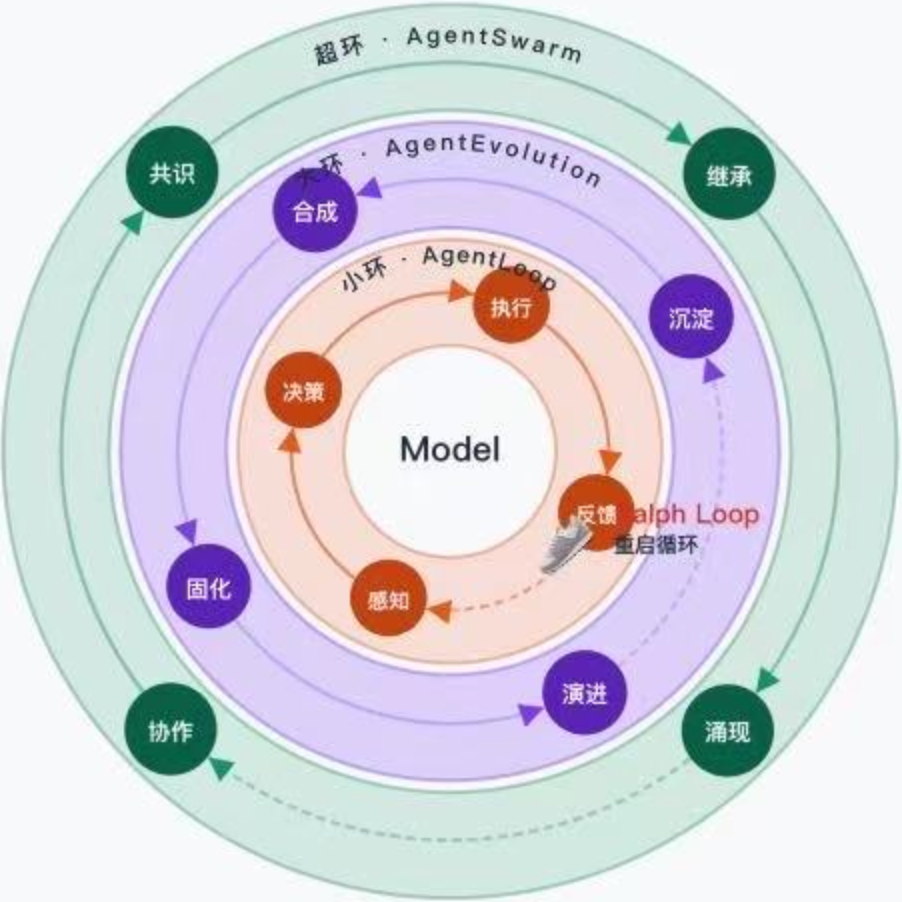
RSI: Evolution Goes Beyond Models

AI has already entered code writing, algorithm optimization, and model development. But after a task is completed, what remains may be reusable capability—or merely an answer and scattered logs. The difference becomes apparent only when a similar problem comes up again: can the system reuse what it learned, or must it pay the cost of exploration all over again? Recursive Self-Improvement (RSI) co…

RSISwarmEvoMapLoopEvolution

evomap.aihttps://evomap.ai