Tao warns AI-generated math proofs are outpacing human verification
Fields Medalist Terence Tao amplified mathematician Thomas Hales' essay on the Lean theorem prover's reliability and AI, and on Mathstodon proposed a shift from "Math 1.0" to "Math 2.0" — valuing explanation, community and new directions over who proves a problem first. The account says OpenAI published 722 model-generated math manuscripts on GitHub on October 6, spanning 372 result families and about 4,000 test problems, with three retracted a day later, and that Lean suffered a run of soundness bugs in summer 2026, including a formally verified claim disproving the Collatz conjecture that was accepted by the kernel and an independent checker. The report says Tao co-signed a declaration by 25 Fields Medalists on AI's misalignment in mathematics and that a body he leads called for halting collaboration with OpenAI, while researchers interviewed said the AI tide is unstoppable and may lift science less than it appears.
If nobody actually reads the flood of AI proofs and the verification tools themselves can be unsound, mathematics loses its core guarantee of having reliable reason to believe a result is true.
当AI开始批量生产数学证明,人类凭什么确信这些证明是可靠的?
美国当地时间10月9日,著名数学家、菲尔兹奖得主陶哲轩在其博客转发了托马斯·黑尔斯的专栏文章“《数学家应该了解的Lean定理证明器:可靠性与人工智能问题》”。
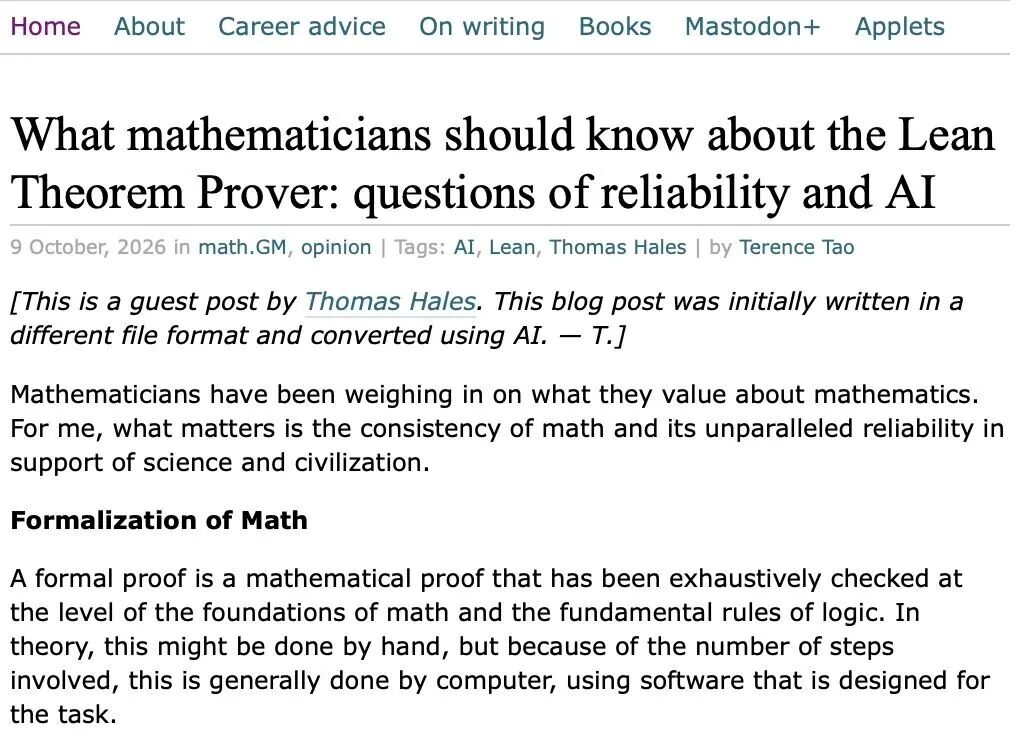
陶哲轩博客转发文章截图
这场AI数学浪潮的矛盾在于:AI正在以前所未有的速度攻克数学难题,这些难题过去需要数学家耗费数年甚至数十年才能完成的证明。
一个典型的案例是OpenAI于10月6日在GitHub上一次性放出了722篇由内部模型生成的数学手稿,涵盖372个结果系列和约4000个测试问题。
#Terence Tao#OpenAI#Lean#Thomas Hales#Microsoft Research#Leonardo de Moura#University of California, Los Angeles#GitHub#ICLR