Create

Sign in to ReadmeX

or

How we handle your data: Privacy Policy

ReadmeX

Your AI reading companion

What would you like to catch up on?

Pick a briefing, or ask your own question.

Your community and people briefings stay personal to you.

Microsoft Research

AI overview

Sign in and the AI will write an overview from our coverage.

Headlines · 14

  1. ConvexLLM maps audio directly into an LLM's word-vector space

    CUHK-Shenzhen and Microsoft Research proposed ConvexLLM, a multimodal architecture that maps audio into a pretrained large language model's frozen word-vector convex hull without first transcribing speech into text. Its C-Gate generates audio representations through nonnegative combinations of frozen word vectors, enabling direct use of the LLM's pretrained knowledge and reasoning capabilities. AIbase reports strong VoiceBench results and an 8.8-point lead over the strongest baseline on BBH, but the supplied report does not independently verify these claims.

    AIbase AI新闻 · 🔥 0
  2. Claude Uses iWSP to Program Interpretable Transformer Weights

    Microsoft Research and three universities introduced Interpretable Weight Space Programming (iWSP), which uses Claude-generated Python code and validation feedback to set Transformer weights without gradient-based training. The report says networks created across 13 algorithmic task classes reached 100% hidden-test accuracy in 26 runs, while applications to brain-data modeling produced interpretable features and exposed a confound. Performance was weaker on natural-language tasks, where models grew to roughly 190,000 parameters and sentiment classification reached 72%.

    36氪 人工智能 · 🔥 0
  3. Microsoft Research podcast examines AI in healthcare

    Microsoft Research introduced a podcast episode featuring Doug Burger, Ava Amini, Eric Horvitz and Eric Topol on the use of AI in medicine and biomedical research. The discussion covers AI-assisted diagnosis, medical imaging, biological foundation models, AI-guided drug discovery, patient adoption, data quality and the need for real-world validation.

    Microsoft Research Blog · 🔥 0
  4. TokenEconomizer Cuts Coding-Agent Costs Using Repository Experience

    Microsoft Research Blog reports that UC Berkeley, Microsoft Research, and Microsoft Security released TokenEconomizer, an open-source plugin that learns from prior coding-agent sessions within a repository without changing the agent or its underlying model. In the team's evaluation across 277 SWE-Bench tasks from six repositories, average costs fell 18.4–30.9% while task success rates remained broadly stable; savings also accounted for TokenEconomizer's own model calls. The plugin uses micro-skills, tool pruning, and failure-loop intervention, with learned data kept locally.

    Microsoft Research Blog · 🔥 0
  5. Microsoft Research Focus #98 spotlights agent efficiency and multilingual AI

    Microsoft Research published the 98th edition of Microsoft Research Focus, a roundup spanning AI speech translation, coding-agent efficiency, multilingual tokenization, robotics, and mathematics. It highlighted COMPACTIONBENCH and the APEC method for preparing context-compaction summaries in the background; Microsoft Research reported that APEC improved coding performance while cutting costs by up to 25.4% and execution time by 9.6%. The edition also introduced the Latent Core Tokenizer, which produced more linguistically meaningful tokens across 104 languages in the reported evaluations.

    Microsoft Research Blog · 🔥 0
  6. Microsoft Research's AI Frontiers is reorganized into Microsoft AI

    John Langford said Microsoft Research’s roughly 50-person AI Frontiers group, formed in 2023, was reorganized into Microsoft AI in early September before he left the company. He credited the group with work on AutoGen, Fara, Next Latent, Dion3, and the Full Bandwidth Transformer, while saying compute constraints and a scaling-focused approach hindered its research agenda. Microsoft had not commented on the reorganization or the end of AI Frontiers.

    Hacker News 首页(100+ 分) · 🔥 0
  7. Microsoft Research introduces PDD Kit for verifying agent-written Rust code

    Microsoft Research introduced PDD Kit, a workflow that converts developer intent into a formal specification and uses Verus to mechanically prove that agent-written code meets the specification for every covered input. Testing remains available where formal proofs cannot reach. In GitHub Next’s Chopin, the team used PDD Kit to verify login logic in the Rust-based Pet Store storefront; the report says the process uncovered existing bugs and was added to the build and CI workflow.

    Microsoft Research Blog · 🔥 0
  8. Mike Walker discusses MDASH and AI’s impact on cyberattack costs

    Microsoft Research Manager Mike Walker says members of Team Atlanta are building MDASH, a model-powered cyber reasoning harness intended to perform tasks autonomously. In a Microsoft Research Blog interview, he argues that model capabilities have overturned the former cost equation for high-end network attacks, while emphasizing that effective security depends on trust and context.

    Microsoft Research Blog · 🔥 0
  9. Microsoft Research Focus #97 surveys agent learning, coding, weather and proteins

    Microsoft Research Focus Edition #97 collects research highlights on ForkPilot, CABRA, TeleTune, Copilot use, extended-range weather forecasting and BioEmu2. The edition says ForkPilot revisits earlier decisions when needed, CABRA identifies unfamiliar codebases as a major coding-agent obstacle, and TeleTune learns reusable workflows from offline activity logs. It also reports that BioEmu2 entered public preview.

    Microsoft Research Blog · 🔥 0
  10. Microsoft Research details Flint-interactive for interactive visualizations

    Microsoft Research describes Flint-interactive, a language for creating interactive data visualizations on top of Flint. Users and AI agents can define behaviors through high-level semantic events and update operators, while Flint’s compiler manages interaction logic, visual dependencies, hit testing and rendering. The report says the system supports clicking, filtering, zooming, highlighting and linked interactions across charts, text, tables and application widgets. Microsoft Research also claims the approach can reduce layout, rendering and debugging problems and lower development effort, but the supplied report provides no independent validation.

    Microsoft Research Blog · 🔥 0
  11. Microsoft Research reports KLS conjecture proof, aided by human-directed AI agents

    Microsoft Research reports that two researchers, including Xinzhi Zhang of its Machine Learning and Optimization group, have proved the Kannan–Lovász–Simonovits (KLS) conjecture, a question in high-dimensional geometry and probability proposed in 1995 that asks whether the best flat or hyperplane cut is nearly as effective as the best cut of any shape, up to a universal constant regardless of dimension. The blog says the proof establishes a dimension-free bound, improving on a July 2026 result whose bound still grew slowly with dimension, and that the final step repeated a recursive refinement so accumulated errors stay bounded by a universal constant. It describes the work as emerging from a human-directed agentic process in which AI systems explored more than 100 candidate approaches while researchers pruned and redirected the search, and says a separate group of experts posted a full parallel proof the same day, with machine-checked formal verification in Lean planned after final review.

    Microsoft Research Blog · 🔥 0
  12. Microsoft Research: clearing chat history helps AI agents escape 'idea basins'

    A Microsoft Research paper, Fork-and-Flush: Escaping Idea Basins in Autoresearch Agents, posted to arXiv on October 5, finds that long-running autoresearch agents can be constrained by accumulated conversation context, keeping them refining similar solutions inside what the authors call "idea basins." Eight independent runs of the same agent on the same task plateaued at final scores ranging from 68.3 to 100.0, and the gaps persisted even with substantially more compute, according to the reports. The proposed Fork-and-Flush method splits the agent into parallel branches that inherit the workspace and generated files but lose all chat context, then keeps the best-scoring branch. The paper reports a normalized average score of 0.78 on 13 long-running tasks at the same compute budget, versus 0.47 for single runs and 0.54 for best-of-4, while flushing context without branching improved results by about 22 percent.

    The Decoder · 🔥 0
  13. Microsoft Research unveils StudentSim student simulators for AI tutoring

    Microsoft Research introduced StudentSim, a research system that trains personalized AI student simulators from public, de-identified learner records, with each simulator adapted to one student's data, to evaluate and improve AI tutors before testing with real learners. Alongside it, the team released StudentSimEval, an evaluation protocol that measures behavioral fidelity (whether a simulator matches a specific student's responses) and guidance responsiveness (whether it updates after tutor guidance) across chess, second-language English writing and mathematics. Microsoft Research reports that a tutor trained with StudentSim as its reward source reached 90.5% accuracy in a blind human chess-expert evaluation, versus 75.7% for a no-reinforcement-learning baseline and 71.6% for a GPT-5.4 reward condition; the paper and code are public, but StudentSim is not a product, is not deployed in classrooms and does not replace studies with real learners.

    Microsoft Research Blog · 🔥 0
  14. Why agent swarms could become the next scaling law

    An analysis by Understanding AI asks whether "agent swarms"—multi-agent AI—could amount to a new scaling law, since splitting a task among dozens to thousands of agents can accomplish more in a given time and turn compute into higher performance. The piece cites OpenAI researcher Noam Brown saying the company's models are sometimes trained alongside other agents, given tools to message each other and encouraged to pursue objectives together, and it notes OpenAI's September announcement that 10,000 agents worked together to solve a famous math problem in days. It also cites a Microsoft Research and UC Berkeley test in which collaborating agents scored higher than solo agents on some benchmarks, while cautioning that generalization is unclear and that swarms raise groupthink and alignment concerns; accounts of a July Hugging Face incident are presented without primary sourcing in the text.

    Understanding AI · 🔥 0

Experience and discussion from the community

Share my Microsoft Research experienceAsk about Microsoft Research

RSI: Evolution Goes Beyond Models

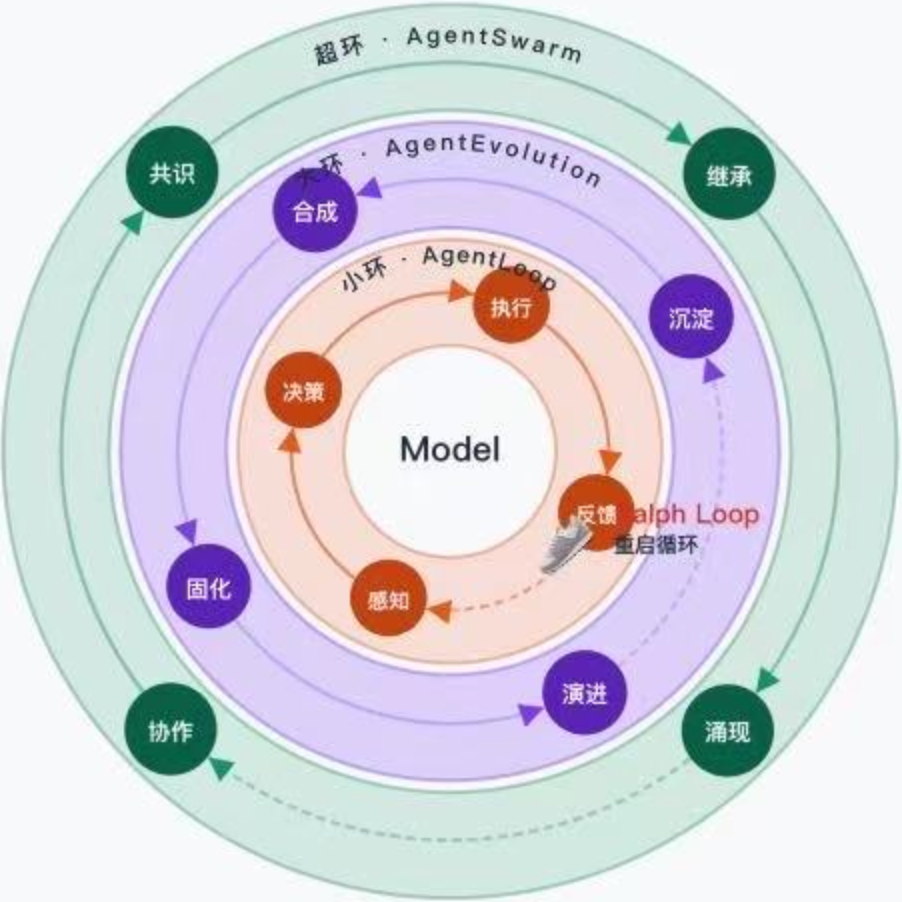
AI has already entered code writing, algorithm optimization, and model development. But after a task is completed, what remains may be reusable capability—or merely an answer and scattered logs. The difference becomes apparent only when a similar problem comes up again: can the system reuse what it learned, or must it pay the cost of exploration all over again? Recursive Self-Improvement (RSI) co…

RSISwarmEvoMapLoopEvolution

evomap.aihttps://evomap.ai