Claude Uses iWSP to Program Interpretable Transformer Weights
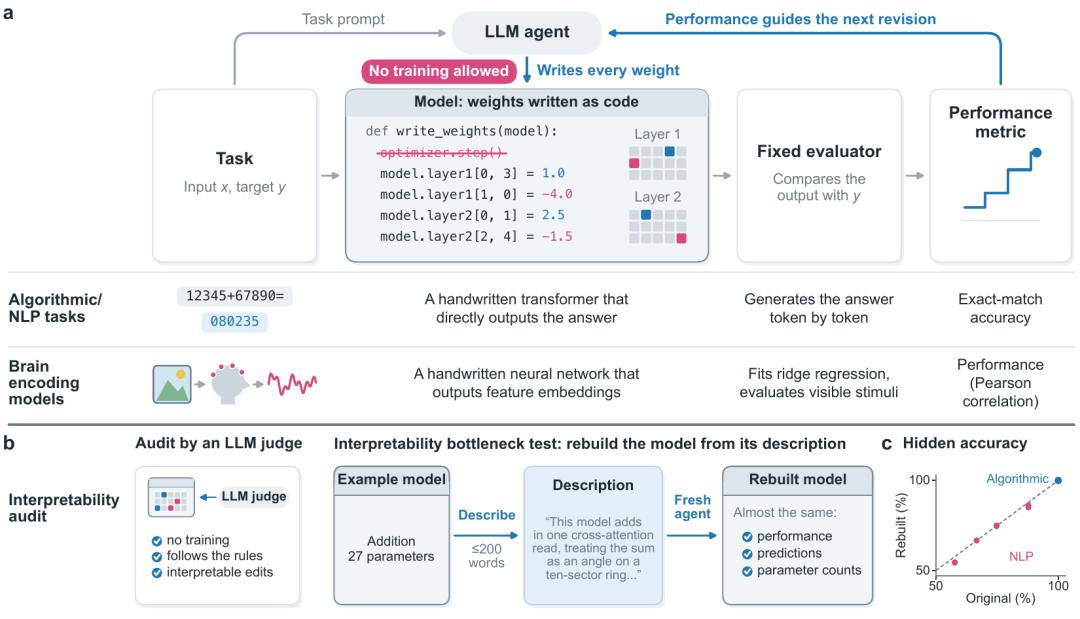
Microsoft Research and three universities introduced Interpretable Weight Space Programming (iWSP), which uses Claude-generated Python code and validation feedback to set Transformer weights without gradient-based training. The report says networks created across 13 algorithmic task classes reached 100% hidden-test accuracy in 26 runs, while applications to brain-data modeling produced interpretable features and exposed a confound. Performance was weaker on natural-language tasks, where models grew to roughly 190,000 parameters and sentiment classification reached 72%.
The study offers a new route to inspectable neural-network construction, but its strong algorithmic results do not establish that gradient-based training is unnecessary for complex language tasks or foundation models.
在13类复杂的算法任务、26次独立运行中,一个全新的神经网络在隐藏测试集上全部达到了100%的准确率。
更不可思议的是,整个过程没有喂给它海量数据,甚至完全没有使用「反向传播」和「梯度下降」。
这个晶莹剔透、小巧至极的满分神经网络,是Claude Opus 5.5,用代码一行一行直接「手写」出来的。
近日,微软研究院联合约翰斯·霍普金斯大学、哥伦比亚大学和纽约大学的团队,发表了新研究「可解释权重空间编程(iWSP)」。
这项研究证明:前沿大语言模型已经可以直接越过传统的优化器,依据固定的评测反馈,像外科医生一样精准构思计算逻辑,并用代码将算法直接写进Transformer的权重里。
#Microsoft Research#Johns Hopkins University#Columbia University#New York University#Anthropic#Claude Opus 5.5#Claude Opus 4.7#Claude Sonnet 5.5#Claude Haiku 5.5