LineShine Retains TOP500 Lead as Advanced Computing Shifts Toward AI
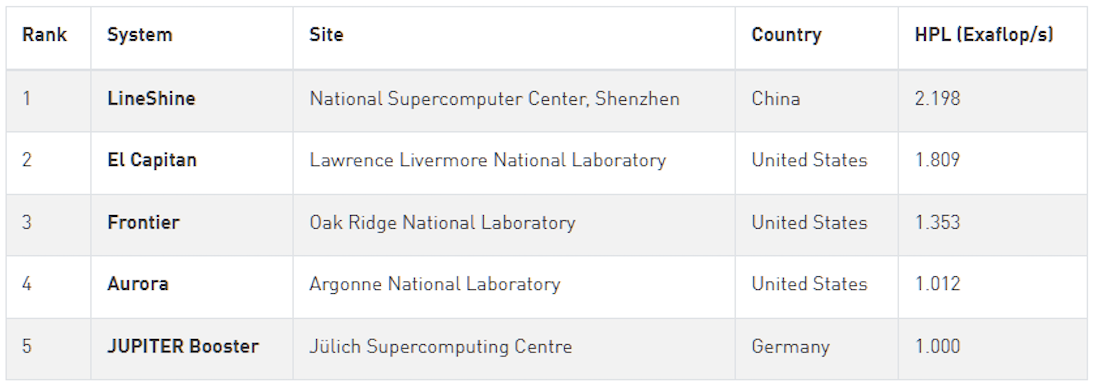
China’s LineShine remains the world’s top-ranked supercomputer in the 68th TOP500 list, with 2.198 FP64 ExaFLOPS on the HPL benchmark. The top 10 remained unchanged, while only 27 systems joined the list—the fewest since it began in 1993. Reports cited in the coverage said much advanced hardware is being deployed in AI data centers rather than traditional supercomputers.
The reports said the low number of new entrants reflects a broader deployment of advanced computing across both traditional HPC and AI factories. As some of the newest GPU resources go to AI data centers and are optimized for AI workloads rather than HPL rankings, the TOP500 alone does not capture the full distribution of advanced compute.
China's LineShine remains the world's highest-performing supercomputer, according to the 68th edition of the Top500 list published at SC26 in Chicago on Monday. For the first time in decades, the supercomputer ranking saw exceptionally few additions despite unprecedented demand for high-performance computing hardware, as the vast amounts of compute resources deployed these days are destined for artificial intelligence (AI) data centers rather than traditional supercomputers.
Top 10 supercomputers unchanged
China's LineShine, installed at the National Supercomputer Center in Shenzhen, offers sustained FP64 compute performance of 2.198 FP64 ExaFLOPS in the High Performance Linpack (HPL) benchmark at 42.22 MW. The machine relies on the homegrown LingKun platform with 304-core Armx9-based LX2 processors clocked at 1.55 GHz (13,789,440 cores in total) and the proprietary LingQi interconnect. Unlike the other four exascale-class supercomputers, LineShine does not use any compute accelerators and exclusively relies on CPUs, which is largely why it only gains 3.6X performance when moving from FP64 to mixed-precision data, which is lower than systems that use low-precision accelerators.
#LineShine#TOP500#El Capitan#Frontier#Aurora#JUPITER Booster#Hanggang#Lux#AMD#Nvidia#HPE#Epoch AI