EVO-WAM lets world action models self-train on verified imagined trajectories
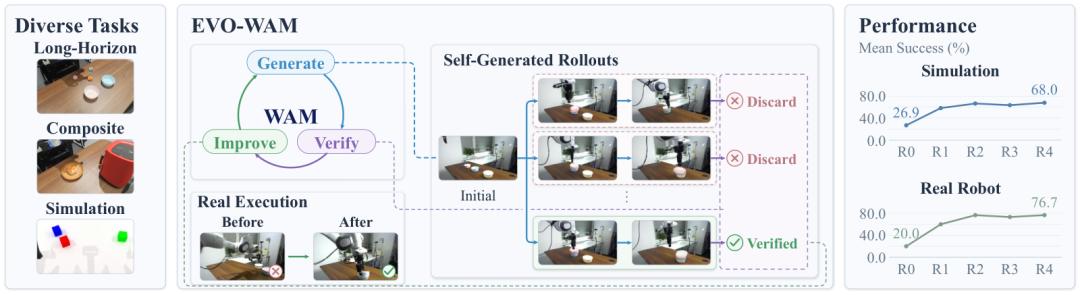
Researchers behind EVO-WAM report a self-training loop in which a world action model generates complete imagined video-action trajectories, a vision-language model checks whether the task was completed, and an inverse dynamics model checks that the generated actions match the imagery before verified segments are used for fine-tuning. The team reports that Cosmos3's average success rate rose from 26.9% to 68.0% on seven unseen RoboTwin 2.0 simulation tasks and from 20.0% to 76.7% on three unseen long-horizon real-robot tasks with 10 trials each, while DreamZero improved from 28.5% to 46.4%. An ablation found 43.7% fourth-round success with vision-only filtering versus 68.0% with the action-consistency check, and the authors note gains were not monotonic, with a dip in round three.
The reported results suggest a world action model can improve on unseen tasks by learning from its own verified imagined trajectories, without new expert demonstrations or trying every candidate action in the environment.
不新增专家示范,也不把候选动作放进外部环境里试错,世界动作模型能否依靠自己的想象继续进化?
当前,已有部分模型能同时预测未来视频和机器人动作,并将视频预训练中积累的知识迁移到陌生任务上。然而,这些模型往往很难产出稳定表现。视频里完成了任务,配套动作却未必与画面一致,生成结果也无法直接用于训练。
EVO-WAM关注的正是这个问题:能否从模型自己生成的轨迹中找出可靠经验,用来改善它在未见任务上的表现?
它让模型自主生成完整的执行画面与动作,筛选通过验证的经验,再用这些经验训练自己,完成想象→验证→学习的循环迭代。
几轮迭代后,在基本保留已见任务性能的同时,模型Cosmos3在七个未见仿真任务上的平均成功率从26.9%提高到68.0%;在三个未见真机长时序组合任务上,从20.0%提高到76.7%。