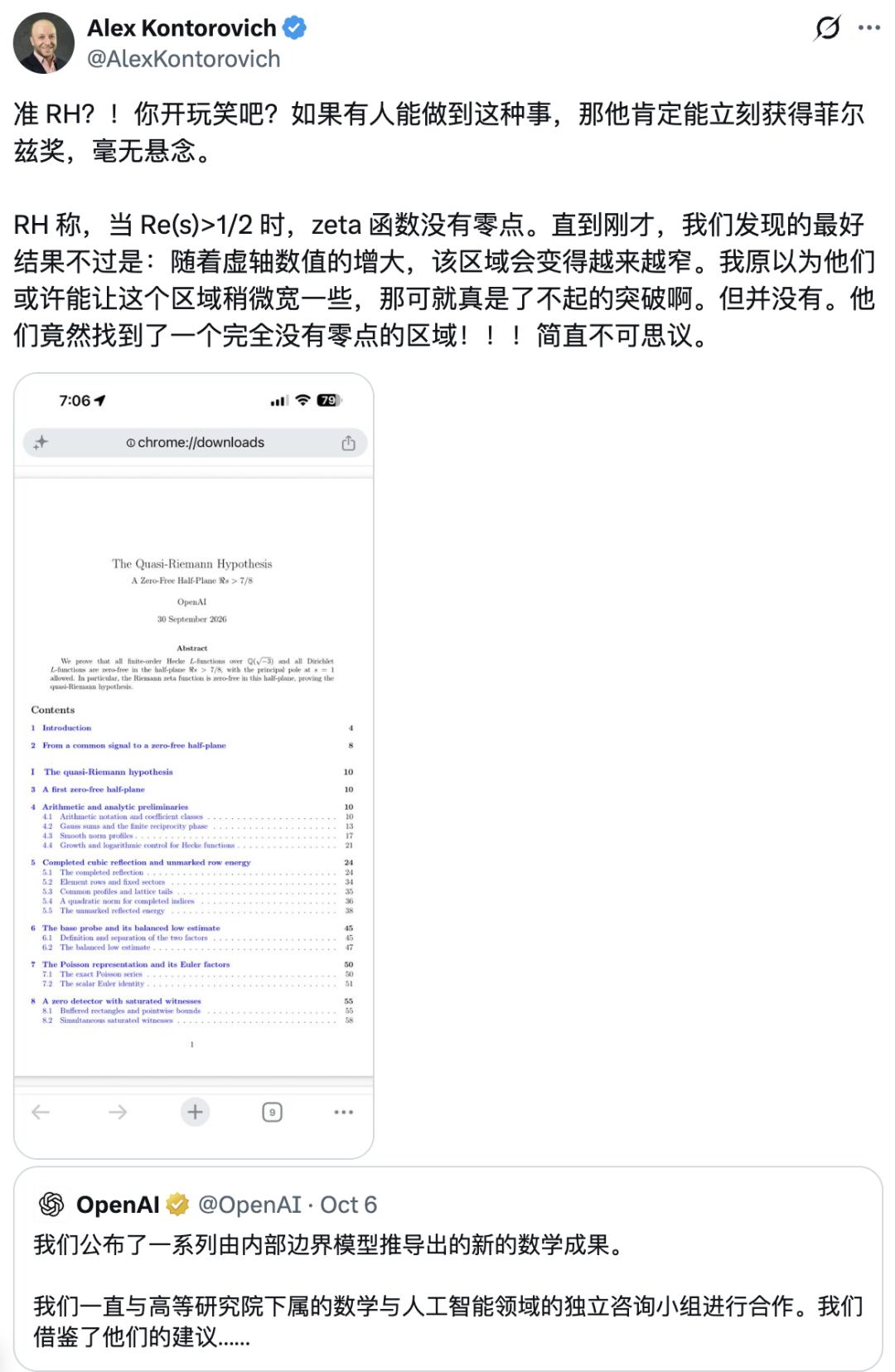
After OpenAI's quasi-Riemann claim, mathematicians push number-theory results
According to a 36Kr repost of a New Zhiyuan article, OpenAI claimed on October 6 that its AI proved a quasi-Riemann hypothesis, excluding Landau–Siegel zeros, drawing positive comments from number theorist Hector Pasten and others. The report says Cureton and Thorner posted a Hexagon preprint on October 12 applying the tools to finite-order Hecke L-functions to obtain a zero-free region to the right of 1-1/6000, which an open-source community then pushed to 1/32, with a Lean formalization generated by the math agent AxiomProver. It adds that a preprint by Frei, Somos and Widmer on arXiv used these results to prove unconditionally the 2007 Ellenberg–Venkatesh bound on ℓ-torsion in class groups, and that the paper states no artificial intelligence tools were used. cnBeta's republished headline says AI again broke the generalized Riemann hypothesis, but the described work concerns zero-free regions rather than the full GRH.
The reports present the new zero-free regions as the missing input that made a 19-year-old conditional bound on class-group torsion unconditional, while the final paper says its work used no AI tools.
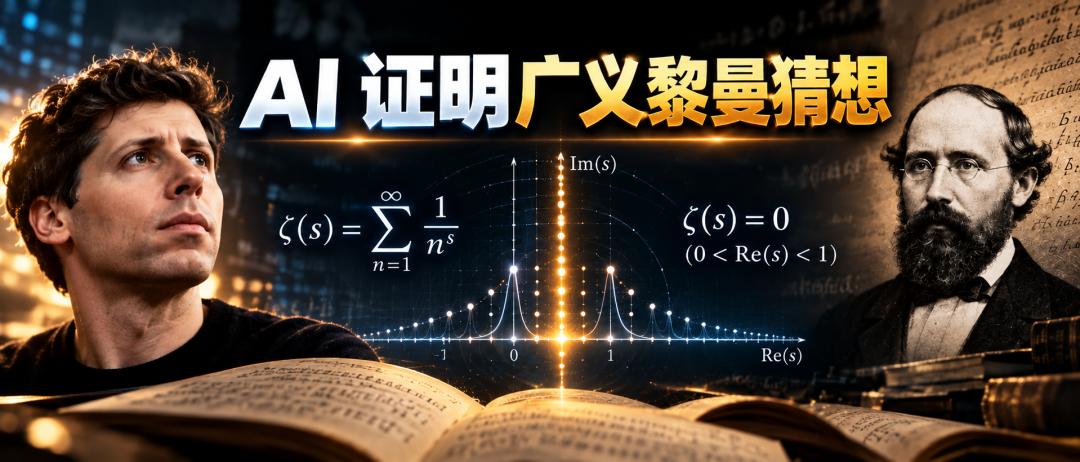
不到十天,数学界经历了一场终极过山车!
10月6日,OpenAI宣称AI证明了准黎曼假设。
数学家 Alex Kontororvin直言:
如果有人觉得了这一成果,那他肯定能立刻获得菲尔茨奖,毫无悬念 !