MIT professor says OpenAI's math proofs are beyond human reading
According to a 36Kr repost of a New Zhiyuan article, OpenAI published 722 math papers at once, said to include a counterexample showing failure of solutions to the Navier-Stokes equations and other claimed results on well-known open problems; the report also notes the papers still await verification. On Bloomberg's Odd Lots podcast, MIT associate dean of engineering education Justin Solomon said the proof is dense with technical detail, counterintuitive inequalities and extreme bounds, and that he stalled after two pages, able only to say it is "probably right." Fields Medalist Terence Tao, in a Caltech "Math 2.0" talk, offered a thought experiment about an AI-designed cancer therapy that passes formal verification and trials but whose mechanism no human understands, raising questions of interpretability and alignment.
If AI can produce proofs and solutions that may be correct yet unreadable to humans, verification and understanding become the new bottleneck in science, and how compute and review capacity are distributed will need rethinking.
最近,全世界的数学圈都被AI核爆了。
OpenAI一口气发表了722篇论文。
这些论文虽仍接受核查,但看起来,从唯一博弈猜想到准黎曼假设,许多知名的未解数学难题已攻克了。
数学家一觉醒来,发现自己的研究可能被终结了!
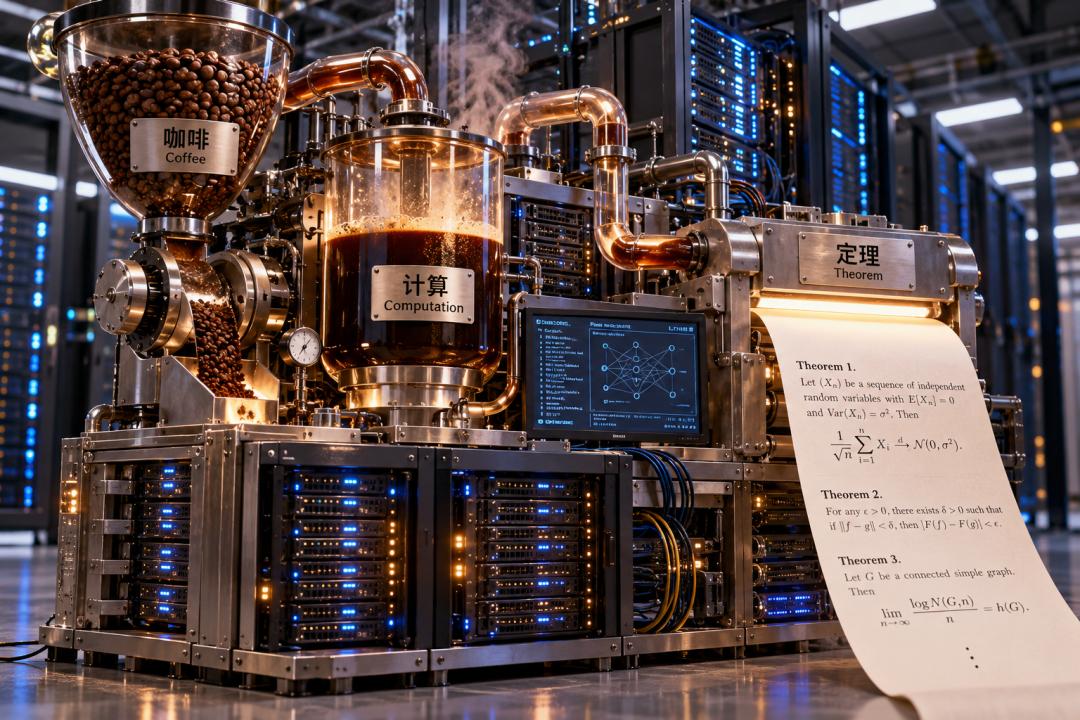
匈牙利概率论学家Alfred Renyi曾把数学家称为「一台把咖啡变成定理的机器」。如今真有了一台这样的机器,而它用的是数据中心。
#OpenAI#MIT#Justin Solomon#Terence Tao#Navier-Stokes equations#Clay Mathematics Institute#ICLR#Lean#Caltech