vLLM integrates FlyDSL MonoKernels to reduce AMD decode latency
A vLLM blog post describes integrating FlyDSL MonoKernels into vLLM for interactive, low-concurrency LLM serving on AMD Instinct GPUs. The approach combines dependent operator stages within a single kernel launch using a persistent GPU schedule, reducing repeated kernel startup, drain and scheduling overhead. The blog reports same-node concurrency-1 interactivity gains of 1.20× to 2.26× over stock vLLM, while noting that results vary by model, workload and system configuration.
Decode latency is on the critical path of coding-agent tool use because an agent must finish generating its current action before calling the next tool. The report says low-concurrency serving prioritizes per-user responsiveness, making decode-latency reductions directly relevant to interactive AI applications.
Introduction
Interactive LLM applications depend on low decode latency. A coding agent must finish generating its current action before it can call the next tool, so decode sits on the task’s critical path. Serving these workloads at low concurrency prioritizes per-user responsiveness over aggregate throughput.
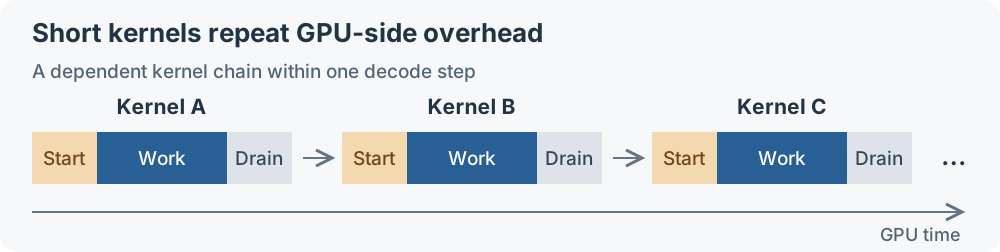
A decode step executes a chain of GPU kernels for operations such as projections, attention, and expert computation. At small batch sizes, many of these kernels do only a little work, yet each still incurs GPU-side dispatch, startup, and completion costs. A dependent kernel cannot proceed until its inputs are ready, so whole-kernel boundaries also limit overlap. Repeated across a long chain, these costs can account for a substantial part of decode latency, while the small amount of parallel work leaves GPU capacity unused. HIP graphs reduce CPU launch overhead, but do not eliminate these GPU-side costs. Figure 1 illustrates the repeated stages; widths and gaps are schematic, not measured durations or an overhead breakdown.
#vLLM#FlyDSL#AMD Instinct#DeepSeek-V4.1-Flash#MiniMax-M3#Muse Spark#AgentX