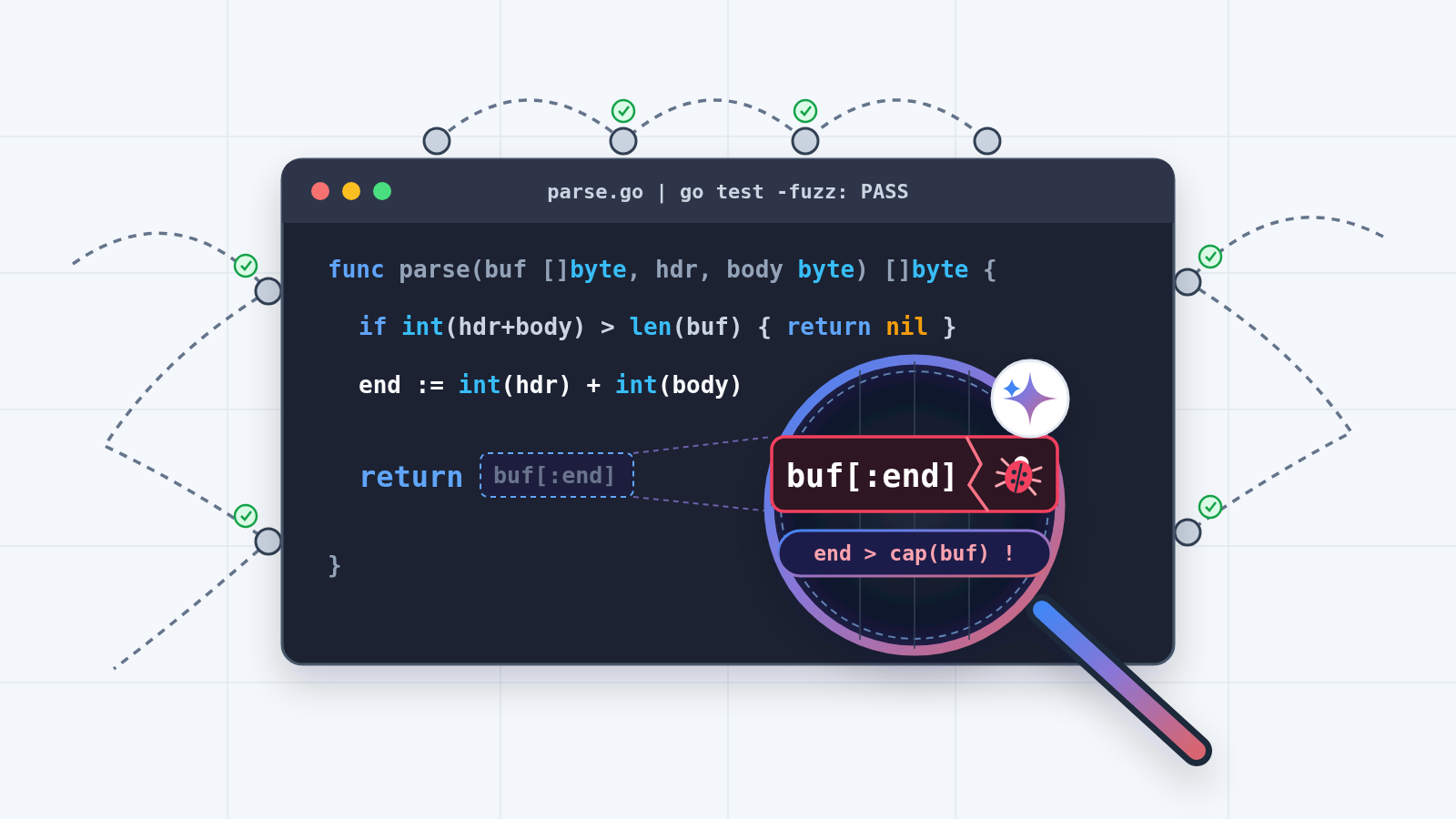
Using Gemini and Z3 to find Go crashes missed by fuzzing
In a Google Developers Blog case study, developer Karl Weinmeister describes a workflow that compiles Go functions, identifies bounds-check panic traps left after optimization, and uses Gemini 4 Argon to translate their paths into Z3 constraints. Solver results become concrete Go reproducers that are verified with go test. The author reports that the workflow caught all three bugs he planted in test parsers and found three latent bugs in skill-lint; go test -fuzz missed two of those crashes. He notes that an LLM-written solver model is not a sound proof system, although each reported crash was reproduced directly by go test.
The case study demonstrates how translating Go code and assembly into a constraint solver can expose runtime panics that a quick fuzz run misses, particularly in parsers and editors that calculate offsets. It is a single developer account rather than broad validation, and the solver approach does not replace fuzzing, race detection, or deterministic concurrency testing.
Catch Go bugs that fuzzing misses with Gemini and a constraint solver - Google Developers Blog
Catch Go bugs that fuzzing misses with Gemini and a constraint solver
NOV. 12, 2026
Karl Weinmeister Director, Developer Relations