Microsoft announced on November 17, 2026 that Word, Excel and PowerPoint editing was generally available in Copilot, following a preview for Frontier customers. Eligible users can generate editable Office files through natural-language requests, open them alongside the chat, continue asking AI to revise them or edit them manually, and collaborate without switching to another application. Microsoft says files are stored in OneDrive and governed by enterprise security and compliance policies. The full paid experience requires both a qualifying base subscription and a Copilot license; perpetual Office editions do not include built-in Copilot functionality. According to Microsoft 365 Message Center notice MC1530611, worldwide deployment was expected to finish by mid-November, with deferred release beginning in early December, so access may vary.
Google’s second edition of its SRE book updates a first edition that standardized practices such as SLOs, error budgets, toil reduction and blameless postmortems. Authors told InfoQ 中文 AI&大模型 that platform engineering and AI are changing reliability work, including managing nondeterministic model outputs and reviewing AI-generated incident responses, so the rewrite emphasizes first principles, organizational culture and practices from other companies. The book also gives greater space to social-technical systems and the business value of reliability while trimming technical details that have become commodity features or easier to generate with LLM tools.
A Fudan University School of Management lecture excerpt examined how heavy spending on AI infrastructure, high financing costs and unproven commercial returns are prompting investors to reassess the AI investment boom. The discussion cited Bank for International Settlements data showing combined capital expenditure by Alphabet, Amazon, Meta, Microsoft and Oracle rising from nearly $100 billion in 2020 to about $400 billion in 2025, with roughly $800 billion projected for 2026. Liu Yiru and Luo Yan also discussed the similarities and differences between the AI spending cycle and earlier technology bubbles.
Microsoft CEO Satya Nadella said he had become an “AGI believer” because the political and economic organization of a world shaped by AGI needs to be considered. He nevertheless said frontier models such as Claude do not possess consciousness and agreed with Microsoft AI chief Mustafa Suleyman that companies should not grant AI models rights or treat them as having moral status. Nadella said the immediate priority should be ensuring economic systems enable broad adoption of AI.
Microsoft announced the AI Transparency Initiative at its Ignite conference, working with more than 40 organizations including Accenture, Adobe, KPMG, Mastercard and Volvo Cars. According to Microsoft, the initiative aims to develop common open standards for observing, verifying and controlling AI systems across closed-source and open-weight models, with planned participation in NIST's AI Agent Standards Initiative and planned integration into Microsoft AI, Microsoft Foundry and Microsoft Copilot.
Tomasz Tunguz says NVIDIA faces a choice about which customers to support as it signals tighter financing terms for neoclouds. Non-hyperscalers’ share of NVIDIA Data Center revenue slipped from 45% to 44% in Q3, while AI Clouds, Industrial & Enterprise revenue reached $47.5 billion, according to NVIDIA disclosures cited in the analysis.
Microsoft announced at Ignite 2026 that its second-generation Maia 200 AI accelerator has entered mass production and is running Microsoft’s largest frontier AI models in data centers. The TSMC 3nm inference chip has FP4 and FP8 tensor cores, 216GB of HBM3e memory, and can scale over Ethernet into clusters of up to 6,144 accelerators. Microsoft claims up to 1.7 times the token throughput per watt of leading GPU infrastructure across built-in features including Teams, Copilot, and Cowork, but this figure has not been independently verified.
Microsoft announced at Ignite 2026 that Dragon Copilot Transcribe now uses its in-house MAI-Transcribe-2 model for all clinician-patient conversation transcription. Microsoft says the model handles multilingual and code-switched conversations, supports speaker separation and word-level timestamps, and averages a 5.2% word error rate across 60 languages on FLEURS. The company also reports that the service processes about 10 million patient encounters per month and has cut errors by roughly 50% in multilingual workflows.
Microsoft announced MAI Realtime 1 at Ignite 2026 as its first speech-to-speech model, positioned for enterprise voice AI. Microsoft says it can handle interruptions, rapid confirmations, noisy environments and requests from multiple speakers; it can also invoke a stronger reasoning engine when needed and connect with enterprise systems for tasks such as bookings and customer service. The company set base speech-to-speech pricing at $0.01 per audio minute, with inference charged separately at $1 per million input tokens and $5 per million output tokens. The model is compatible with the OpenAI Realtime API, and Agoda and Reservations.ai have begun testing it. Microsoft also plans to use it in Dynamics 365 Contact Center and Dragon Copilot; those deployments remain planned.
Microsoft introduced MAI Cyber 2 Flash at Ignite as a specialist AI model for discovering vulnerabilities, recommending fixes and investigating threats, with a one-million-token context window. Microsoft reported a 92.3% score on CyberGym-E2E, above GPT-6 Astra’s 91.5%, at less than 2% of its per-task cost in offline evaluation; the model is exclusive to Microsoft security products, including Codename MDASH.
Microsoft introduced Agent 365 Business Analytics at its Ignite event to estimate the economic value of AI agents and compare their costs with the value of human labor. The tool draws on Agent 365 usage data and labor-cost information from the US Bureau of Labor Statistics, O*NET, and LinkedIn Occupational Graph. Microsoft cautions that assisted-work estimates are directional model outputs rather than verified time savings or realized financial returns.
Microsoft released the MAI Image 2.7 and MAI Image 2.7 Flash image-generation and editing models in Microsoft Foundry public preview, with listed costs of about $35 and $10 per 1,000 images. The models support targeted edits, continuous-edit visual consistency and transparent backgrounds, while the Flash-powered Canvas workspace combines generation with local replacement, movement and style adjustments. Microsoft said MAI Image 2.7 scored 1,215 points on Artificial Analysis, four points above GPT Image 2.6 Sunburst (max) at roughly one-fifth the price, but noted that results depend on configuration, task and evaluation method.
A top Microsoft executive said Nvidia’s corporate drama could prompt customers to consider alternatives to the company’s AI chips. The statement raises a possible competitive response but does not show that customers have switched suppliers.
CNBC Technology reported major outages affecting banks, air travel, the NSA and Apple, illustrating the risks posed by interconnected technology. A separate Hacker News commentary cited additional disruptions involving Microsoft 365, air traffic control, United Airlines and others, and argued that a lack of experienced personnel may have contributed. The author connected this concern to leadership replacing workers with generative AI and layoffs that hollowed out remaining teams. The commentary questioned official explanations that the failures were unrelated and were not caused by generative AI or cyberattacks, while explicitly stating that the author had no inside information.
Microsoft has begun rolling out Autopilot, a personal AI agent that works across Microsoft 365, including Teams and Outlook. TestingCatalog reports that eligible Frontier customers need a Copilot license, usage-based billing, and required management and security capabilities, while ZDNET AI describes the agent as capable of monitoring Teams channels, following up on email, running recurring work, and managing projects. Microsoft says the preview will help refine eligibility requirements before broader availability, and employees may eventually bring their personal Autopilot into Copilot Workspaces.
fal announced that Microsoft’s MAI Image 2.7 and MAI Image 2.7 Flash are now available on its platform. According to fal, the models can generate images from briefs, support precise edits and maintain campaign consistency, while the Flash version offers faster results and lower per-image costs.
A product page titled "Microsoft IQ" carries the tagline "Give AI agents a shared understanding of your business." The supplied report gives no product features, availability or pricing details, release status, or confirmation from Microsoft.
Axios reported that Microsoft unveiled six AI models spanning coding, cybersecurity, image generation and voice. Microsoft said MAI Code 2 delivers 98% of GPT-6.1 Sol’s performance at 40% of its price. The supplied report does not include independent measurements supporting that comparison.
theCUBE’s coverage of Dell Technologies’ AI Leadership Symposium focused on the cost and control challenges enterprises face when moving AI workloads into production. Interviews with representatives from Dell, Intel, Deepgram, Singulr AI and MisaLabs addressed cloud token budgets, existing data-center capacity, runtime governance for AI agents, controlled data environments and private-cloud deployment. Deepgram described its work with Dell and Fortanix to run voice AI models natively on customer devices, including air-gapped systems; this was presented as an objective rather than a completed rollout. Dell sponsored the symposium, and theCUBE was a paid media partner, although sponsors did not have editorial control.
Anthropic’s filing with the US Securities and Exchange Commission says Amazon will hold 14.7% and Google 13.7% of the company’s outstanding capital stock after its IPO and private placement, a combined 28.4%. Amazon could reach 23.8% if it converted all remaining convertible notes, but its disclosed post-IPO stake is 14.7%. AMD, Broadcom, Google, Micron, Microsoft, Nvidia and TSMC Partners have agreed to buy $26 billion of non-voting stock in the private placement. Anthropic has committed to spend more than $100 billion on cloud services, including AWS, over the next decade. Founder LLC, whose sole members are Anthropic’s seven co-founders, will hold the F-class share carrying 50.1% of voting power on ordinary shareholder matters.
IT Times reported that six RTX Spark laptops from ASUS, Dell, Lenovo, Microsoft and MSI launched in China in October. Their 128GB unified-memory configurations are priced from RMB35,999 to RMB57,149. Reporters found the top configurations unavailable from online and physical stores, while only the ASUS ProArt 创14 and Lenovo YOGA Pro 15 were available to experience. The tested devices had simplified local-model setup and faster dialogue responses than RTX 5060 laptops. Reviews also found Arm compatibility issues, slower gaming performance and weaker results than cloud models on complex, multi-step tasks.
TechNews reports that former SEC Chair Gary Gensler believes AI investment has already formed a bubble and could drag the United States into a recession by the end of 2028. He cites unspecified estimates of $800 billion in annual AI infrastructure spending and warns that circular investments, borrowing, and off-balance-sheet financing may obscure risks at emerging AI-focused cloud providers. Yardeni Research President Ed Yardeni disputes the forecast, arguing that the AI market may cool through a stock-price correction rather than a broad collapse.
36氪 reports that global investors are reassessing AI hardware through capital returns, customer financing, utilization and cash flow rather than relying primarily on order growth. According to its account of a SemiAnalysis model, global AI accelerator capital spending forecasts for 2027-2030 were cut substantially, although spending is still projected to grow from about $392 billion in 2026 to $923 billion in 2030. The report also says Nvidia faces potential share and margin pressure from Google's TPU, Amazon's Trainium and custom ASICs, while emphasizing that investors have not uniformly abandoned AI hardware.
In a commentary from the WeChat account 卫夕指北, author Wei Xi uses the Cowan, Solow and Jevons paradoxes to examine why AI may increase workloads without yet producing clearly visible productivity gains. Wei argues that faster drafting and lower model prices can lead to higher standards, more output and greater usage, potentially raising aggregate spending. The commentary also notes disagreement over when measurable productivity improvements will appear.
科技新报, synthesizing analysis from Engadget and other publications, argues that laptop NPUs mainly trade some generality for low power consumption rather than improving AI performance across the board. It notes that TOPS figures are generally theoretical INT8 peaks, while practical NPU use is concentrated in background features such as meeting blur, captions, translation, and local search; in a cited OpenVINO test, Mistral 7B reached 98% NPU utilization. The source identifies limited use cases and software support as constraints, recommending Copilot+ PCs mainly for battery life and frequent video calls, and sufficient memory and bandwidth for local AI models.
Reverse engineering of MissionControlAggregator.dll found that Windows 11 records bitmap indicators showing which coding agents and developer tools were observed, including Codex, Claude, GitHub Copilot, Cursor, Python and .NET. The researcher verified on a US-configured Windows 11 Home ARM64 installation that the report entered DiagTrack's upload queue when optional diagnostic data was enabled, which was the default in that setup. The report contained no prompt text or source code, and its timestamps represented collection windows rather than per-tool usage duration. Behavior in other regions, editions or configurations was not established.
fal and Microsoft scheduled a Microsoft Ignite session for Nov. 19, from 9–9:45 a.m. PT, focused on bringing video AI models to enterprises. fal says the session will feature live demonstrations, real-world use cases and insights from the teams involved in their partnership, ranging from creative experimentation to production at scale.
The Information reported that Microsoft plans to unveil new Copilot and Azure features at its Ignite conference. The planned features are intended to reduce customers’ AI costs and help counter competing products from Anthropic and other AI rivals.
Replit announced that its Microsoft Fabric integration is now generally available. According to the vendor, teams can describe an application, build it with Replit Agent, and deploy it directly into their organization’s Fabric tenant using governed data.
Internal Microsoft data described by an employee with knowledge of it indicates that Claude for Microsoft 365 usage in Office has fallen further behind Microsoft Copilot in recent months. The employee said the Claude features have fewer than one-tenth the weekly users of paid Copilot in Office, which is growing at a much faster rate.
What problem it solves
Documents and office files often need to be transformed into a structured, text-friendly format before they can be processed by language models or text analysis tools. MarkItDown addresses this by preserving important document structures such as headings, lists, tables, and links during conversion to Markdown.
Key features
Broad format conversion — MarkItDown converts PDF, P…
What problem it solves
Editing text should not require extensive familiarity with terminal-based tools. The project aims to provide an accessible editor with a modern interface and input controls that are approachable for users who are largely unfamiliar with terminals.
Key features
Cross-platform installation — Installation options are documented for Windows, Linux, and macOS, including package-m…
What problem it solves
Generative AI systems and applications can contain security and safety weaknesses that require structured testing across models, endpoints, and complete applications. PyRIT addresses this with repeatable assessments, interactive exploration, and extensible workflows for red teaming these systems.
Key features
Repeatable command-line assessments — The scanner runs repeatable …
What problem it solves
Web automation and end-to-end testing often require coordinating browsers, interactions, assertions, and failure diagnostics. Playwright provides a unified API for driving Chromium, Firefox, and WebKit across tests, scripts, and AI-agent workflows.
Key features
End-to-end test runner — Playwright Test runs end-to-end tests across Chromium, Firefox, and WebKit with browser is…
What problem it solves
TypeScript adds optional types to JavaScript so tools can support large-scale JavaScript applications across browsers, hosts, and operating systems. It also compiles source into readable, standards-based JavaScript.
Key features
Optional types for JavaScript — TypeScript extends JavaScript with optional types, providing a typed language for application-scale development.
Sou…
What problem it solves
Go applications need a way to create, read, and modify spreadsheet documents produced by Microsoft Excel. They also need support for complex spreadsheet components and workflows involving large worksheet datasets.
Key features
Read and write spreadsheet files — Create and modify workbooks, set cell values, save files, and read cell values and worksheet rows through a Go API.…
What problem it solves
Knowledge workers need Claude to follow their organization’s tools, terminology, critical workflows, and preferred ways of working rather than provide only generic assistance. The repository provides customizable role-specific plugins that package this guidance with connectors, skills, commands, and sub-agents.
Key features
Role-specific plugin collection — The collection in…
What problem it solves
Products and agents need to communicate with users across multiple channels without rebuilding Inbox feeds, provider integrations, and channel webhooks. Novu addresses this with one API and a unified conversation model for product notifications and bidirectional agent conversations.
Key features
Unified multi-channel API — Send product notifications through Inbox/In-App, Pus…
What problem it solves
Applications need to run untrusted code while controlling its access to files, networks, user interfaces, and host capabilities. This requires an isolation approach that works across platforms, supports multiple containment mechanisms, and can be integrated without changing application architecture.
Key features
Cross-platform containment — MXC supports Windows, Linux, and m…
What problem it solves
Teams often have to move work into a separate AI tool, then repeatedly transfer context between that tool and the applications where collaboration happens. Switch addresses this by letting people and AI agents participate in the same conversations while keeping shared context with the work.
Key features
Shared rooms for people and agents — Each supported chat channel becomes…
What problem it solves
Speech recognition systems often lose global context when they divide continuous audio into short chunks, while speech generation must maintain speaker consistency, timing, and coherence across long recordings. The project addresses these needs with unified long-form ASR, streaming recognition, and text-to-speech models.
Key features
Long-form speech recognition — Process co…
What problem it solves
Company knowledge is distributed across business systems such as Slack, Google Drive, Jira, GitHub, and Microsoft 365. AI applications need a governed way to search this information, respect each user's access controls, and provide answers that can be traced to their sources.
Key features
Permission-aware enterprise search — Searches connected company systems while applying …
What problem it solves
Developers need support for their core edit-build-debug cycle. The project addresses this need with comprehensive code editing, navigation, and understanding support along with lightweight debugging, a rich extensibility model, and lightweight integration with existing tools.
Key features
Code editing and navigation — The editor provides comprehensive support for editing, na…
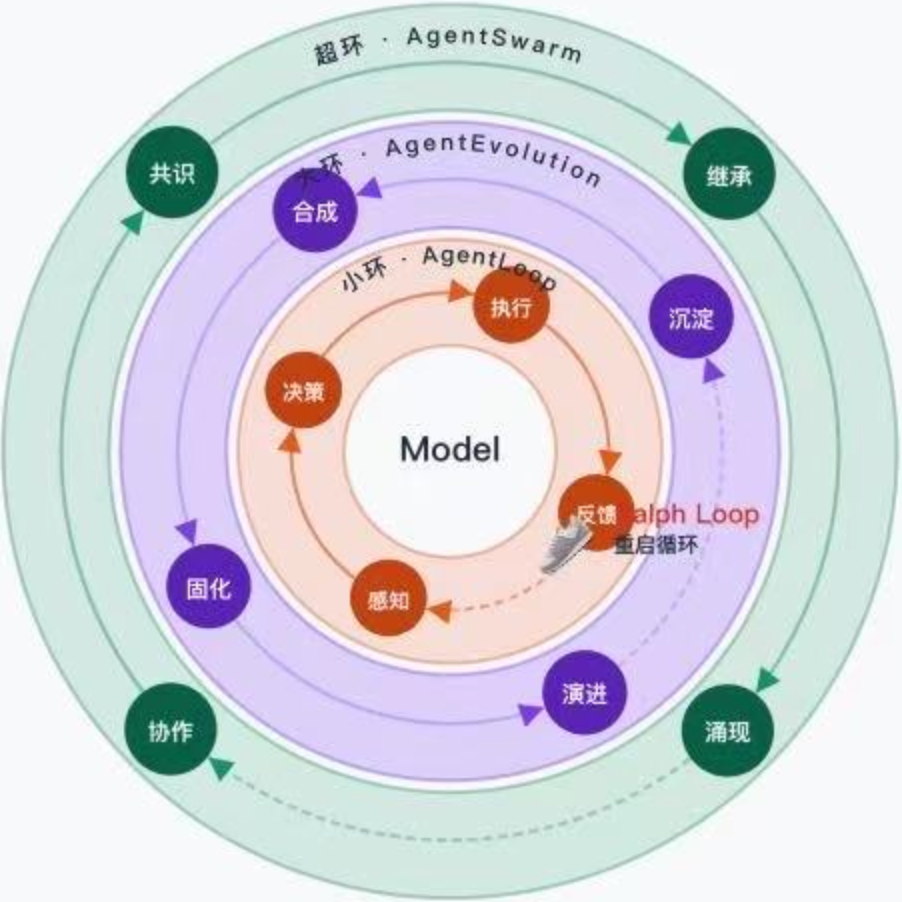
AI has already entered code writing, algorithm optimization, and model development. But after a task is completed, what remains may be reusable capability—or merely an answer and scattered logs. The difference becomes apparent only when a similar problem comes up again: can the system reuse what it learned, or must it pay the cost of exploration all over again?
Recursive Self-Improvement (RSI) co…
 markitdown• Pinned