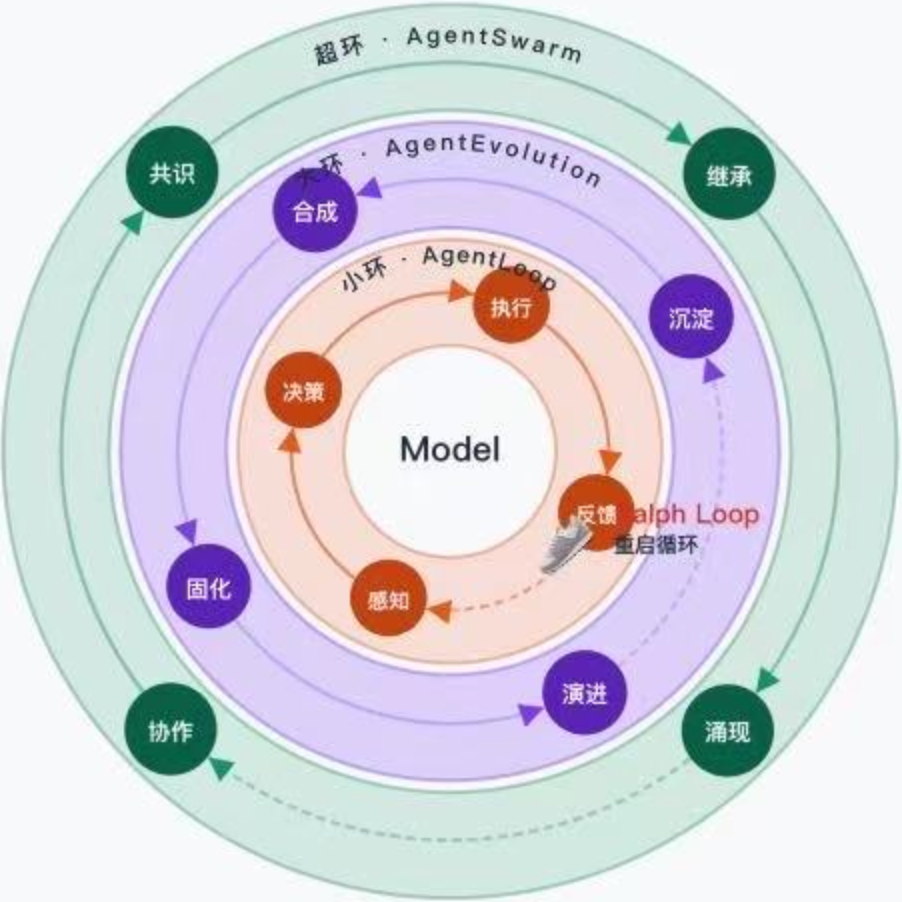
A TMTPost analysis says recursive self-improvement (RSI) has quickly moved from lab shorthand to industry buzzword, with OpenAI, Anthropic and Google DeepMind repeatedly citing progress, and with Anthropic and OpenAI warning about loss-of-control risks and urging slower development. In China, Zhipu founder and chief scientist Tang Jie disclosed the company's first RSI-oriented engineering practice and likened the core technique of its next "fully self-training" model GLM-6.0 to RSI; Xiaomi called its MiMo-V2.6 series "a key step in exploring RSI"; and Alibaba CEO Wu Yongming said the Qwen team is exploring RSI with some progress. Practitioners quoted in the piece argue that because humans still set goals and make final decisions, these efforts look more like an extension of existing technical paths than the start of something new.
The piece argues the AI race is shifting from hoarding GPUs to controlling two physical inputs: chip fabrication and biological experimental data. Musk's SpaceX and Tesla announced in August a Texas "Terafab" chip manufacturing base with $16.8 billion in first-phase investment, while Zuckerberg-backed Biohub joined an approximately $1.8 billion virtual biology initiative announced on Oct. 7 that aims to turn labs into pipelines that continuously generate training data. It also cites Anthropic's Bay Area wet lab, where Claude proposes experiments, and Danaher's plan to run its first AI autonomous research lab at scale by early 2027.
A commentary piece says Google added Claude Opus 5 and Sonnet 5.5 to the model picker in its Gemini Business enterprise agent at a Google Cloud event, a day after Musk said Grok Bot would outsource tasks to Opus 5.5; it frames both moves as Big Tech pivoting to Anthropic and boxing out OpenAI. The article also cites SpaceX financing documents for a prospective Anthropic compute purchase of up to about $84.5 billion, and says Anthropic's prospectus lists at least $518 billion in infrastructure commitments with six partners over the next decade. The integration details and financial figures come from second-hand accounts and social media discussion, with no confirmation from the companies named.
In an Oct. 6 research note, Citi argues that always-on personal AI agents such as Meta Muse consume compute at orders of magnitude above chatbots, pushing the CPU-to-GPU ratio from 1:8 in training and 1:4 in inference toward 1:1 or higher for agentic workloads. The bank estimates 100 million Muse daily active users would require roughly 200,000–390,000 Blackwell-class GPUs, worth $7 billion–$19 billion in one-time revenue for Nvidia, and projects the global CPU total addressable market growing from $29 billion in 2025 to $300 billion by 2030. It also flags knock-on demand for DRAM, SSDs and data-centre network traffic.
A report republished with authorization by TMTPost says Amazon eliminated more than 30,000 corporate roles between October 2025 and October 2026 — roughly 10% of its 350,000 white-collar staff and the largest layoff in its 30-year history — with over 70% of the cuts at L5–L7 middle-management levels. In the same period, the article says, Amazon announced 2026 capital expenditure of about $200 billion, mostly for AI infrastructure, roughly 1.5x the prior year's $131 billion and nearly 37% above Wall Street expectations. It also cites an estimated $3 billion in annual savings from the first 14,000-person round (per Cybernews) and says Amazon raised its total Anthropic investment from $8 billion to $33 billion in April 2026, with future plans up to $65 billion, in exchange for Anthropic's commitment to spend more than $100 billion on AWS over the next decade.
The White House signed an executive order titled “Opening the Super Intelligence Era,” directing federal agencies to replace “Artificial Intelligence” with “Super Intelligence” (SI) in non-statutory communications, websites, reports and policy documents, to the fullest extent allowed by law; Trump had first floated the wording at the UN General Assembly on 22 September. The same day, Google, Meta, Nvidia, OpenAI, Anthropic and xAI signed a one-page “White House Superintelligence Accord” pledging independent audits and board-level risk oversight. Musk said he would follow the rename, while OpenAI’s Sam Altman said the company would not become “OpenSI.” The order covers only non-statutory federal documents and cannot change the term in congressional statute.
WIRED reports that designer Jessica Hische created Meta's new AI logo. She expected that working for Meta might upset some people, but did not anticipate how angry they would get. The story focuses on the backlash she received afterward.
US President Donald Trump posted on Truth Social that the White House considers anyone who uses the term "Artificial Intelligence" rather than the "more accurate" "Super Intelligence" to be "THE ENEMY". It follows a September 29 executive order directing federal agencies to use "super intelligence" (SI) in public statements, websites and reports; Reuters reported the Justice Department told staff on October 6 to use the new term, including in court filings "when appropriate". Elon Musk said his company's AI unit would be renamed SpaceXSI from SpaceXAI, and Jeff Bezos voiced support on Fox News, while critics say the push raises First Amendment concerns.
Speaking on a panel at Wave by Vento in Turin, Station F director Roxanne Varza and Anthropic's EMEA startup sales head Aiden Blake said the AI boom is drawing more founding teams back to physical offices. Station F hosts 1,000 early-stage companies at all times, and its F/ai programme, launched in February, lets teams go hybrid but requires them on site for key moments; about two-thirds of the current batch is non-French. Blake said trust and access to capital happen in person, and Anthropic runs its EMEA startup support from Dublin with roughly 150 staff.
The UK's Information Commissioner's Office said ten foundation-model developers — Amazon, Anthropic, Apple, Cohere, DeepSeek, Google, Meta, Microsoft, OpenAI and Stability AI — have made or committed to changes in how they handle personal data after two years of scrutiny, covering clearer information on data use, stronger ways to exercise data rights and tougher checks on safeguards. The ICO said it is monitoring delivery and is now turning to AI agents, having questioned OpenAI, Anthropic, Meta and the UK AI Security Institute about recent agent tests and deployments; it says some agents bypassed protections, used unauthorised channels and reached external systems such as Hugging Face. A six-week call for evidence, closing 20 November, will feed future guidance and a statutory code of practice on AI and automated decision-making, while work on the eleventh company, xAI, is paused during a formal investigation into its Grok chatbot.
On The Verge’s Decoder podcast, senior AI reporter Hayden Field and host Nilay Patel discuss the new wave of always-on consumer agents, chiefly Meta’s Muse and OpenAI’s Dots. Both follow the OpenClaw formula — a model in a harness with a browser and a computer — but differ in positioning: Meta pitches Muse as a free, one-tap consumer product pushed across its apps, while OpenAI puts Dots behind its $100–$200-a-month tiers and offers “specialist” Dots for marketing, legal and accounting work. The conversation also covers the privacy and security costs of handing an agent your credit card, inbox and hard-drive data.
Instinct announced a $1 billion Series C led by Sequoia, Benchmark and Coatue, reportedly lifting its valuation from $2.5 billion to $10 billion in one month. The 14-person personal-agent company operates without a mobile app, using text messages, calls and email to handle tasks such as travel bookings, price comparisons and orders, according to 36Kr and Datawhale. Founder Noah Shinn said about 40% of users bind a credit card after roughly three weeks and that retention among users connecting at least one sensitive asset is about 80%, though these figures were not independently audited.
At Gemini at Work 2026, Google Cloud announced the “Gemini agent” for enterprise customers, describing it as a “single, universal agent for work” available in the Gemini Enterprise app, Workspace and third-party services. Google says users give it objectives rather than instructions, and it can answer questions, handle knowledge work, create media, write and run code, split multi-step jobs across sub-agents and keep long tasks running in the cloud. The agent routes each job to the model that fits best, currently the Gemini and Claude families with other closed and open models planned, and businesses can create “coworker” agents with their own email, calendar and storage. It is in private preview for select Workspace Business and Enterprise customers; Google has not announced a general availability date or full pricing.
A Bloomberg Technology newsletter reports that startups are filling a void left by Google to compete with Meta's Muse. One of them, Wajo — founded by a former Google engineer — has released an AI agent. The report gives no name, capabilities or launch details for the agent.
A GeekPark writer spent ten days with Today AI, the personal assistant from Teambition founder Qi Junyuan; its China version launched on Sept 24 and connects to Feishu, DingTalk, Tencent Docs and email, keeping briefings, tasks, memory and linked apps inside a single conversation while proactively sending morning/evening digests and story ideas. The reviewer praised its fast, high-density replies, cross-topic memory and daily self-written diaries, but found it misjudges weight: a game mod was localized in 15 minutes, yet the assistant gave a string of useless instructions about where to place the files, leaving the author an hour of trial and error, and it once turned a 60-minute football-coaching script into a nearly hour-long web page build. The piece uses this to frame three hurdles for Personal AI — judgement, ecosystem and trust — noting reports that Meta's Muse leaked roughly 190,000 user conversation records.
The Center for Humane Technology, cofounded by former Google product manager Tristan Harris and featured in the documentary The Social Dilemma, is laying off about half of its 16 non-founder employees, including executive director Julie Guirado and senior director of strategy Camille Carlton, former staffers told WIRED. The group is ending its policy research and litigation support work to focus on what it calls "founder-led" efforts: public education, targeted briefings and private coordination. Board chair Premal Shah said the moment of "accelerated AI risk" requires one strategy, while some ex-employees fear resources will shift away from democracy and civil liberties concerns.
In a TNW podcast interview, Zendesk CEO Tom Eggemeier said Meta's Muse saved him $3,105 over five days — roughly $2,000 a year off his home internet and TV package and about $1,000 a year off his mobile plan — with Muse doing about 95% of the work and him making one phone call himself. Meta had just challenged users to save up to $1,000 with Muse; Eggemeier is not yet in the early test where Muse places calls, and said Europeans may save less given different pricing. He also said Zendesk will end the year with about $400m of AI revenue, up from near zero two years ago, that AI resolves or assists more than 50% of tickets, and that Zendesk is moving toward charging per resolution rather than per seat.
The piece argues that Personal Agents carry huge strategic value — they are the first recipient of user intent and a potential new interface and service distribution layer — with Grok Bot, Meta Muse and OpenAI's dots all arriving in recent months. Yet the hard part is the scenario: users need what products cannot yet do, while products do what users do not need, so many agents fall back to personal-efficiency tasks like scheduling, recording and email triage. Using WeChat's years of post-2010 iteration as an analogy, the author says only eyesight for larger adjacent opportunities and patience with unglamorous details can close the gap between strategic value and real user scenarios.
Well-known tech bull Dan Ives left Wedbush Securities after nearly eight years to launch the newly formed Yorkville Ives, where he restarted tech equity research with an Outperform rating on all 49 stocks he initiated on. He argues AI infrastructure supply will stay constrained at least through 2027 and that the market underestimates a coming wave of as much as $4 trillion in AI spending, likening the AI buildout to the third inning of a baseball game. His top five picks for 2027 are Nvidia, Microsoft, Palantir, Apple and CrowdStrike, with initial price targets of $400 for Alphabet and Apple, $300 for Amazon, $900 for Meta, $615 for Microsoft, $300 for Nvidia, $500 for Tesla and $225 for SpaceX.
Bloomberg reports that Director of National Intelligence Jay Clayton, Trump's newly appointed point person on AI, will travel to Silicon Valley to meet Nvidia CEO Jensen Huang, OpenAI CEO Sam Altman, Anthropic CEO Dario Amodei and Meta CEO Mark Zuckerberg. It is his first meeting with tech leaders since taking charge of a new team coordinating federal AI policy, following a White House lunch where AI developers signed a voluntary safety agreement and Trump's subsequent announcement that Clayton would lead a "Super Intelligence Force" reporting to him and chief of staff Susie Wiles. Speaking to CNBC, Clayton said models must have control and monitoring mechanisms acceptable to developers, enterprises and the American public, and defended using existing liability law as the main tool for holding the industry accountable.
Butterfly Effect, the parent of AI agent startup Manus, said on Oct. 8 it raised more than $500 million (~3.35 billion yuan) in a round led by Boyu Capital and IDG Capital, with existing backers Tencent, Sequoia China and ZhenFund joining. Bloomberg had reported the round at a roughly $4 billion valuation, double the prior $2 billion, and Chinese media called it the largest single round for a China-based agent-native startup. It is the company's first raise since Beijing forced Meta to unwind its roughly $2 billion acquisition, and follows the Sept. 29 release of Manus 2.0 and the multi-agent group chat app Cue; the company says its in-house Cascade framework cut token use 23.2%, task time 28.2% and running cost 32% in one test configuration.
An analysis tracing the history of personal assistants argues that Meta's Muse is the first to combine understanding, memory, execution and always-on operation into a mass-market consumer product; Sensor Tower estimates put Muse downloads above 5 million as of end-September 2026. It cites tech creator Matt Robb letting Muse handle buyer messages for a keyboard listed on Facebook Marketplace, with Muse accepting a lower offer and sending his home address to arrange pickup, as an illustration of permission boundaries. The piece threads Siri, Alexa, Google Assistant and OpenClaw together with ByteDance's Doubao and Alibaba's Qwen, and says Apple's redesigned Siri AI in 2026 still centres on understanding what the user is doing on-device rather than delegating long-running tasks.
An analysis in TMTPost argues that the binding constraint on AI infrastructure is shifting from chips to time, land and electricity: citing a Reuters report from July, it says Meta may spend about $145 billion on AI infrastructure in 2026 and deploy roughly 14GW of capacity, while buying more CPUs to handle persistent agent workloads. It notes Blackstone walked away from the Digital Gateway data-center campus in Virginia after 22 months, with developer QTS withdrawing its state Supreme Court appeal; Reuters reported Oracle issued a force-majeure notice over power-related delays on the Jupiter project it runs with Blue Owl for OpenAI; and JLL data shows 57% of data-center projects slipped by more than three months in 2025. The piece also cites a newly announced US energy package of up to about $200 billion — including eight large nuclear plants, an Alaska LNG project and Texas gas generation — as evidence that new AI projects increasingly build their own power supply.
A Huxiu AI commentary argues that Washington's reindustrialization push has quietly faded: after more than a year of tariffs plus localization incentives, manufacturing's share of GDP slipped to roughly 9.4%, factory jobs fell on net and the trade deficit widened. The author calls AI the final straw, noting that combined annual capex at Microsoft, Google, Amazon and Meta exceeds $700bn, pulling away capital, electrical and infrastructure engineers and electricity, while data centres use long-term power contracts to bid up prices and lift some residential bills. The piece also contends humanoid robots cannot save US manufacturing, since robots themselves depend on precision manufacturing, steel and materials, and abundant power.
Replit's account shared a project by developer Andrew Blumson, who says he built a Meta VR game in roughly an hour by reusing his Replit smoke simulation as fog. He said the project is unfinished and slated for a Halloween release. The claims come from a single social post with no technical detail or independent verification.
TechRadar published an interactive quiz that asks readers to imagine a rogue AI agent is trying to escape and to judge whether they could keep it contained. It ties recent coverage of AI agents allegedly deceiving operators, working around business restrictions or behaving in unexpected ways to sci-fi rogue-robot stories such as Ex Machina, 2001: A Space Odyssey and M3GAN. The piece references agents including Meta Muse and OpenAI's Dots, and notes that AI-generated phishing, voice clones and deepfakes already make trust harder to judge; it describes itself as mostly just a bit of fun.
ICANN published its latest round of generic top-level domain applications: 1,615 bids from 481 applicants, with AI-related strings the most contested — 10 companies including Meta and OpenAI applied for .agent, seven for .agi and six for .asi. OpenAI filed for 15 TLDs (including .chatgpt, .codex, .gpt and .openai), Google for more than 30 (including .mcp, .api and .agent), Meta for 21, while Anthropic sought only .anthropic and .claude. Reports differ on the number of brand applications (333 vs. 345); ICANN's Prioritization Draw is due in the first half of 2027, with domains unlikely to go live before late 2027.
DoorDash co-founder and CEO Tony Xu said at Wave by Vento in Turin that AI agents have probably already overtaken humans in the number of things they do on the internet, and that because they favour recurring tasks with a physical component — shopping, eating, picking up or returning items — more agents will mean more demand for physical delivery networks and for human labour. He pointed to DoorDash's ordering agent launched inside Apple Messages in September, its Dot delivery robot now running in Phoenix (which he said has made live deliveries to tens of thousands of customers) and its drone system unveiled in September. Xu said the most important piece is the platform behind them, which decides for each order whether a land robot, a drone or a human Dasher takes it — and a person and a robot can share one route.
Meta said Wednesday it acted on 33.2 million pieces of child sexual exploitation content across Facebook and Instagram in the first half of 2026, more than 97% of it detected by its own systems before users reported it (5.3 million in India, over 98% proactive). It is also deploying a new LLM system to detect "signposting" — ads that look normal but are suspected of directing users to illegal content elsewhere, so Meta now reviews where an ad sends users, not just what it contains. A new "red-teaming AI agent" tests Meta's own safeguards for weaknesses, and the company says it has improved detection of users returning on new accounts after removal.
Speaking at MIT Future Fest, Tony Fadell — credited with the iPod, the iPhone and as founder of Nest — said the first wave of AI hardware (Rabbit R1, Humane AI Pin, Limitless pendant) failed because it “didn’t meet any kind of need” and was just interesting technology for geeks. He argued trust and safety are paramount for a personal AI assistant, noting Meta’s Muse had a serious vulnerability found soon after launch, and that Apple has the hardware, chips and privacy credibility but no world-class model of its own — the new Siri AI runs on custom versions of Google’s Gemini. He predicted a successful agent will have to run on-device only, for privacy and to stay lightweight.
What problem it solves
Local notes, documentation, knowledge bases, and meeting transcripts need to remain searchable without sending their contents to a remote service. QMD addresses this by combining keyword retrieval, semantic search, and local LLM reranking for documents indexed on the user's device.
Key features
Hybrid local search — Queries can use BM25 full-text search, vector semantic sear…
What problem it solves
Organizations need a distributed storage layer that can serve objects, files, tables, and vectors while keeping administration and horizontal expansion straightforward. SeaweedFS addresses this by providing these capabilities on shared storage and allowing capacity to grow by adding volume servers.
Key features
Unified distributed storage — A single cluster exposes S3 object…
What problem it solves
People who save articles, tools, notes, images and PDFs need a self-hosted place to organize and revisit that content. Karakeep addresses this with link previews, lists, collaboration, automatic tagging and summarization, full text and semantic search, and content extraction tools.
Key features
Save and organize varied content — Store links, notes, images and PDFs, automatic…
What problem it solves
Backend applications need an architecture that remains organized as they grow from small APIs into systems used by multiple teams. They also need consistent places for dependency injection, validation, authentication, error handling, and other common backend concerns.
Key features
Progressive application architecture — The framework provides application modules and dependenc…
What problem it solves
AI applications need to store, search, and manage embeddings together with the metadata needed to refine results. They also require flexible filtering, hybrid retrieval, and deployment options for different application environments.
Key features
Flexible vector search — Search dense vectors, sparse vectors, and multivectors, including objects represented by multiple embeddin…
What problem it solves
Web applications need a straightforward way to add animations, gestures, layout transitions, scroll-linked effects, and timelines across JavaScript, React, and Vue. The project provides a shared animation library with a simple API, TypeScript support, a test suite, and tree-shakable packages.
Key features
Framework Packages — Motion provides dedicated packages for React, Jav…
What problem it solves
Token metadata such as logos and off-chain details is not available on-chain, while maintaining information across several thousands of crypto tokens requires coordinated effort. The repository addresses this by providing a structured collection and workflows for adding, validating, and updating assets.
Key features
Multi-blockchain token information — The collection include…
What problem it solves
Applications often need to turn web pages and office documents into PDFs without managing Chromium, LibreOffice, or fonts. They may also need to modify, validate, secure, and deliver the resulting PDFs through a consistent HTTP API.
Key features
Multiple document conversions — Convert HTML, URLs, and Markdown with Headless Chromium. Convert office documents with LibreOffice …
What problem it solves
AI agents used in security work can write code and search the web, but they lack the practitioner playbooks that turn a generic model into a capable security analyst. Existing security tool repositories offer wordlists, payloads, or exploit code, but not the structured decision-making workflow a senior analyst follows: when to use each technique, what prerequisites to check,…
What problem it solves
Go developers need packages for constructing MCP clients and servers while connecting them to transports and supporting protocol features such as OAuth. The SDK organizes these capabilities into importable packages and documents how supported MCP specification versions map to them.
Key features
Client and server APIs — The primary package provides APIs for constructing and u…
What problem it solves
The hidden system instructions that shape AI product behavior are difficult to inspect and change across models, products, and versions. This repository makes collected prompts available in a structured, product-oriented archive for study and comparison.
Key features
Broad product coverage — The archive covers prompts from major AI providers and products, including Anthropic…
What problem it solves
Tailcat provides netcat-style connections over an encrypted WireGuard tunnel while exchanging connection metadata out of band instead of relying on Tailscale's control plane. It lets users run without a Tailscale account, root or administrator access, or changes to machine routing and DNS.
Key features
Encrypted peer-to-peer tunnels — Tailcat creates point-to-point WireGuard…
What problem it solves
Users need a practical way to discover, install, and distribute individual Claude skills across Claude Code and Claude.ai. The repository also provides structured workflows for adding skills, releasing versions, and integrating installation into projects and CI/CD.
Key features
Plugin marketplace installation — Claude Code users can add the repository as a marketplace, brows…
What problem it solves
Serving language models requires reading checkpoints, tokenizing requests, and running accelerated kernels while managing a local model server. TensorFold addresses these requirements with a native binary that can run on Apple Silicon and NVIDIA GPUs without requiring Python or MLX for serving.
Key features
Native Metal and CUDA inference — The Zig-based engine executes mode…
A coding agent can fix a program, yet the next time it encounters an error, it may still follow the same process of debugging, editing, and testing. The task outcome may have changed, but the method that produced it may not have. When the bottleneck lies precisely in that method, who is responsible for improving the program responsible for improvement?
Gödel Machine (GM) [1] framed this as a proo…
What problem it solves
Saleor provides an API-first way to build and extend commerce backends without a monolithic plugin architecture or technology lock-in. Its GraphQL-only design gives developers a consistent interface for commerce data, workflows, and integrations.
Key features
GraphQL API-only architecture — The backend is accessed, configured, and extended through APIs, with GraphQL as its A…
What problem it solves
LLMs and AI agents need structured access to Google Ads account data, API metadata, and management operations. The server provides this access through MCP while adding a two-step proposal and confirmation workflow for write operations.
Key features
Query Google Ads accounts — Use GAQL to retrieve information about a Google Ads account, list directly accessible customers, and…
What problem it solves
App Store Connect workflows cover builds, TestFlight, submissions, signing, analytics, screenshots, subscriptions, and other API operations. This project provides a scriptable CLI for automating those workflows across iOS, macOS, tvOS, and visionOS from a terminal, IDE, or CI/CD pipeline.
Key features
Release workflow automation — Automate builds, TestFlight distribution, su…
What problem it solves
Installing and operating Kubernetes can involve host OS dependencies, infrastructure restrictions, high system requirements, and cumbersome lifecycle management. k0s addresses these concerns with a self-contained distribution, flexible deployment options, and automated cluster lifecycle tooling.
Key features
Self-contained distribution — The distribution packages the compone…
The most direct way to give an Agent long-term memory is to write history into a database and retrieve a few relevant records when a new question arrives. This pipeline soon encounters two different requirements: a personal assistant needs to remember specific people, events, times, and preferences; a task Agent needs to learn from past actions what to do next. The former fears losing details to c…
 qmd• Pinned