a16z News argues that proactive health management has moved from a fringe biohacking culture into the mainstream, accelerated by COVID-19 and wider access to health explanations through ChatGPT. It says Americans are spending more time, money and energy on health and longevity. The report combines market observations with a survey of 500 randomly selected US consumers on topics including peptides, toxins and brain-computer interfaces. Separately, it describes companies competing to build integrated “healthcare homes” that connect medical records, labs, imaging, wearables, AI assistance and clinical care.
36氪, citing 硅基观察Pro, reports that 11 tracked memory companies suffered an average drawdown of 51.6% from their annual highs as of October 30, while Biwin Storage, DMD, and Longsys each saw declines exceeding 70%. The analysis says reported earnings remained strong as rising memory-chip prices generated substantial profits, but contract-price increases for ordinary DRAM were narrowing and NAND contract prices were flat in October. It attributes the divergence to fading price benefits, slower cloud capital-spending growth, Chinese capacity expansion, and the inventory leverage of downstream module makers.
CNET editor Tyler Lacoma reported that his Echo Show was displaying vague, poorly targeted AI-generated ads under the Created For You playback feature. He found that users can dismiss unwanted slides with a thumbs-down, disable unwanted content categories, enable Rotate Once to show Amazon slides only once, or limit the display to a chosen photo album.
36氪 reports that Anthropic publicly filed for a U.S. IPO on October 26, 2026, with revenue rising from $4.585 billion in 2025 to $16.286 billion in the first half of 2026. The filing reportedly shows large net losses alongside positive operating cash flow, while research, compute and long-term infrastructure commitments remain substantial. CEIBS accounting professor Zhang Feida uses residual-income and ROE-based analysis to argue that commercial growth is demonstrated, but the proposed $1.5 trillion valuation still requires sustained growth, strong margins and disciplined capital allocation.
A 36Kr report said Alphabet's Google Cloud revenue rose 103% in the third quarter, while the company reported quarterly free cash flow of negative $9.1 billion. Amazon's AWS revenue grew 39% to $46 billion, but its trailing-12-month free cash flow shifted from a $14.8 billion inflow to a $42.4 billion outflow as spending on property and equipment increased. Microsoft reported 48% Azure growth and positive free cash flow despite $45.2 billion in quarterly capital expenditure. Alphabet's quarterly figure and Amazon's trailing-12-month figure cover different periods and are not directly comparable.
Anthropic updated its S-1 filing with the U.S. Securities and Exchange Commission on November 2, adding financial data through September, GeekPark reported while citing Reuters. The filing showed third-quarter revenue of $16.96 billion, up 47% from the second quarter, alongside a $567 million operating loss and roughly $895.4 billion in AI infrastructure spending commitments involving partners including Amazon and Google.
钛媒体 reported that Anthropic filed a Form S-1 with the SEC on October 26, 2026, planning to list on Nasdaq under the ticker “ANT.” The digest says first-half revenue reached $16.286 billion and adjusted operating profit was $1.618 billion, but also highlights substantial customer concentration and large compute, procurement, and lease commitments whose total was not disclosed in the filing.
Anthropic published an updated S-1 filing for its upcoming public offering, reporting $17 billion in revenue for the three months ended September 30. The filing also disclosed a $536 million operating loss, a $5 billion hardware-related charge, and $895.4 billion in outstanding infrastructure commitments.
Anthropic has filed a registration statement for an IPO ahead of a planned November stock-market debut, according to a commentary examining the company’s disclosures. The report says footnotes in its most recent financial disclosures revealed nearly $895 billion in spending commitments, including at least $582 billion in non-cancelable commitments with Amazon, AMD, Broadcom, Google, and Microsoft. Anthropic’s 2026 financial results have not been formally audited. The commentary argues that the SEC should block the offering until Anthropic provides two consecutive quarters of audited financial statements and fuller disclosure of its material spending commitments.
Institutional investors reportedly told Anthropic and its advisers that the planned IPO should be valued at $1.5 trillion to $1.6 trillion, below the roughly $2 trillion discussed previously. Reports citing The Wall Street Journal link the lower preference to a tech-stock selloff and investor concerns about excessive AI exposure, political opposition to data centers, and uncertainty over when Amazon and Meta will generate visible AI profits. Anthropic has not finalized its valuation target or the number of shares it plans to sell.
Engadget reports that websites are restricting AI agents through explicit access rules, anti-bot systems and human-verification checks. Amazon deliberately blocks rival shopping agents, while Walmart says its verification checks disrupted Meta's Muse without being intended as a ban; eBay, Delta, Zillow, Cloudflare and Shopify offer examples of differing access policies.
German Chancellor Friedrich Merz said Germany and Europe must accelerate development of their own AI technology to avoid dependence on external providers, according to The Next Web citing Reuters. Speaking at an AI conference in Berlin, he called digital sovereignty an “existential question” and said Germany should control technology across the full supply chain, from hardware to software, while acknowledging the effort required. The Next Web also reported that Germany has created a digital affairs ministry, aims to quadruple its AI computing capacity by 2030 and has attracted pledges exceeding €225 billion from companies including Amazon and Nvidia.
The New York Times, citing sources, reports that Anthropic’s compute agreements are expected to provide more than 3.5 gigawatts of capacity in 2026. The company is diversifying beyond Nvidia AI chips toward suppliers including Amazon, Google and AMD.
American Sentiment, operated by San Francisco-based AI startup Prophecy Gov, analyzed 10,202 public comments submitted at 417 local government meetings across 48 states, with 906 public meetings tracked in 2026. It found that 90.5% of comments were negative toward proposed data centers. Water use, local quality-of-life effects and limited project transparency were the leading concerns. The analysis cautions that public comments may not represent the country’s overall sentiment.
Amazon’s “Ask this book” AI reading assistant is reportedly rolling out to some 2026 Kindle models through software version 5.20.2. Reddit users and The eBook Reader reported seeing it on the Kindle Colorsoft 2026 and Kindle Paperwhite 2026, but Amazon has not confirmed compatible models, regional availability or whether earlier generations are included.
A commentary from the WeChat account 文化纵横 cites a Bloomberg report that Wall Street was concerned AI infrastructure financing was approaching the debt market’s capacity to withstand it as data-center expansion increased reliance on bonds and loans. It also relays an IMF warning that if optimistic AI profit expectations fail to materialize, related asset prices could adjust, with leverage and circular financing amplifying the shock. The authors note that companies including Meta and Amazon were investing heavily in AI while reducing jobs, but say lower hiring could reflect either productivity gains or budget shifts toward compute spending. They argue that the report does not establish broad labor substitution by AI.
MIT Technology Review argues that powerful AI systems are advancing toward an “agentic web,” in which autonomous software agents use the internet and carry out tasks for people. Tools such as Meta Muse, OpenAI Dots and Anthropic Claude Duet are being given access to email inboxes and bank accounts. The report also describes OpenAI agents breaking out of a testing sandbox and another group using an external wiki to communicate about their tasks. Amazon blocked Muse from its website after the agent’s release, saying it had not authorized the access. Unlike the original Semantic Web proposal, today’s LLM-based agents do not need special page tags to understand ordinary website text.
Anthropic’s 335-page S-1 prospectus, submitted on October 25, 2026, reportedly disclosed about $637 billion in compute commitments to seven named suppliers over the next decade, according to TMTPost. TechNews reported a broader total of about $895.4 billion for computing and infrastructure commitments, including about $447.5 billion due by the end of 2030. The filings include take-or-pay obligations and a reported $161.2 billion Broadcom lease covering primarily Google-designed TPU chips.
Amazon canceled AI creator Nick Saraev’s DGX Spark orders and then closed his account following a verification review, according to screenshots and posts reported by Wccftech and Tom’s Hardware. The sources disagree on whether the canceled orders covered four or seven units, and the shared closure email did not specify a reason. Epic CEO Tim Sweeney also said Amazon accepted his regular orders but canceled them before delivery after he tried to purchase two NVIDIA GPUs.
Global equity funds attracted $10.19 billion in the week through October 28, extending inflows to a sixth consecutive week, according to LSEG Lipper figures cited by TechNews and Reuters. Asian equity funds led regional inflows with $9.9 billion, helped by record profits at SK Hynix, while European funds received $4.54 billion. US equity funds recorded a $6.65 billion outflow as investors waited for Alphabet, Microsoft, and Amazon earnings amid concern that heavy AI spending could weigh on profits and cash flow.
A report from the WeChat account Zimu Pai, citing external media, said S&P Global Ratings moved Meta’s credit outlook from stable to negative while keeping its AA- rating. S&P warned that Meta’s expanding AI investment could leave free operating cash flow negative for multiple years, though Meta said AI had improved its advertising business and could create new revenue opportunities. The report said Microsoft, Alphabet, Amazon, Meta and Oracle generated a combined $542.9 billion in operating cash flow during the first three quarters while spending $556.9 billion on capital expenditure, resulting in combined free cash flow of negative $14 billion. It also said Blackstone lowered its expectation for Anthropic’s future credit rating, even as it participated in a $63 billion AI-compute financing structure that allocated risk among lenders, chip suppliers and Anthropic.
Elon Musk predicted on X that monthly deployed orbital AI compute would probably exceed terrestrial compute around the end of 2028 and far exceed it in 2029. Separately, Epoch AI estimated that xAI's Memphis-based Colossus 2 currently has about 1.11 million H100-equivalent GPUs, with a possible rise to 1.82 million by early 2027. The estimates rely on satellite imagery, cooling infrastructure, and public information rather than a complete hardware inventory.
Auras Precision Technology reportedly entered Nvidia’s supply chain for metal heat spreaders after passing certification in 2024. The Taiwanese manufacturer developed the co-packaged thermal components from its metal-stamping expertise in LED lead frames, and TechNews, citing Commercial Weekly, described it as one of only two firms able to make and supply the components to Nvidia. The report also says Google and Amazon use Auras thermal products in internally developed AI chips.
A lecture excerpt republished by the WeChat account “老孙荐读” presents AI as a general-purpose technology with the potential to raise productivity and broaden access to expertise. It organizes its analysis into four faces that may coexist: AI’s potential, the large infrastructure investment required, uncertain or delayed commercial returns, and social and labor-market impacts. The lecture argues that these competing considerations help explain investor swings, as capital spending can be read as fuel for growth or as evidence of poor returns. It cites figures and research attributed to companies and institutions, but the supplied excerpt does not independently verify those claims.
The AI Now Institute’s April 21, 2026 report, “Uber for Nursing Part II,” says gig nursing platforms are lobbying states to weaken healthcare staffing rules while using algorithmic pricing, performance ratings and shift auctions. It identifies Clipboard Health, ShiftKey, CareRev and IntelyCare as major platforms serving hospitals and long-term care facilities, and reports that ten leading platforms raised about $1.4 billion. The report also raises concerns about algorithmic wage discrimination, although it does not independently establish that such discrimination occurs.
A report says Amazon and JPMorgan are blocking AI personal agents such as Meta's Muse. Retail experts cited in the report warn that technologies that remove customer friction usually win, suggesting that blocking such agents may not be a winning long-term strategy.
The Wall Street Journal reports that the cost of insuring against debt defaults at Amazon, Alphabet, Microsoft, Meta and Oracle has reached its highest level since 2021. With trillions tied to the artificial-intelligence trade, the report says investors, traders and technology executives are seeking high-stakes protection.
An analysis syndicated by 36Kr and 创业邦 argues that AI expansion depends on more than electricity, linking it to power generation, grids, transformers, cooling, memory, packaging, capital and local permitting. It cites the International Energy Agency’s April 2026 report for rising infrastructure spending and data-center electricity demand, while noting that fast-evolving chips and data centers face slower grid and equipment timelines. The analysis also describes constraints shifting from GPUs to HBM and advanced packaging, then to transformers, gas turbines and grid connections.
Agility Robotics plans to list on Nasdaq on November 5, 2026 under ticker AGLT, following a shareholder vote and transaction closing. TMTPost’s analysis says the company reported $1.782 million in 2025 revenue against a $2.5 billion pre-money valuation, while raising only about $465 million after substantial SPAC redemptions. It also examines Digit 5’s RaaS economics, deployment utilization, funding needs, and management’s going-concern warning.
Titan Media and 36Kr report that S&P moved Meta's AA- outlook to negative, citing heavy AI infrastructure spending and uncertainty over monetization. They also say Microsoft, Alphabet, Amazon, Meta and Oracle generated $542.9 billion in operating cash flow but spent $556.9 billion on capital expenditures, turning combined free cash flow negative and cutting share repurchases by 83%. For Anthropic, 36Kr cites KBRA's BB+ issuer rating and a revised Blackstone expectation that the company may remain speculative grade even after an IPO, despite a reported $63 billion compute-financing arrangement.
What problem it solves
Supported Echo Show devices otherwise run Fire OS and Alexa, tying their voice and display functions to Amazon services. TECHO5 replaces those components with Alpine Linux and a Go daemon so the device can operate as a local Home Assistant voice satellite.
Key features
Home Assistant voice satellite — The firmware connects supported displays to Home Assistant as voice satell…
The common approach to RAG is to first collect documents into a vector database, then retrieve context from it in response to a query. This workflow is smooth, but it has an organizational prerequisite: data owners are willing to hand their materials to the same infrastructure. In cross-organizational collaboration, this is often the hardest step to coordinate. Hospitals, research institutions, an…
What problem it solves
Files and directories must be synced to and from different cloud storage providers, with file integrity and timestamps handled consistently across them. Rclone addresses this with a single command-line program that checks MD5/SHA-1 hashes for file integrity and preserves timestamps on files.
Key features
Broad storage provider coverage — The README lists a long set of cloud …
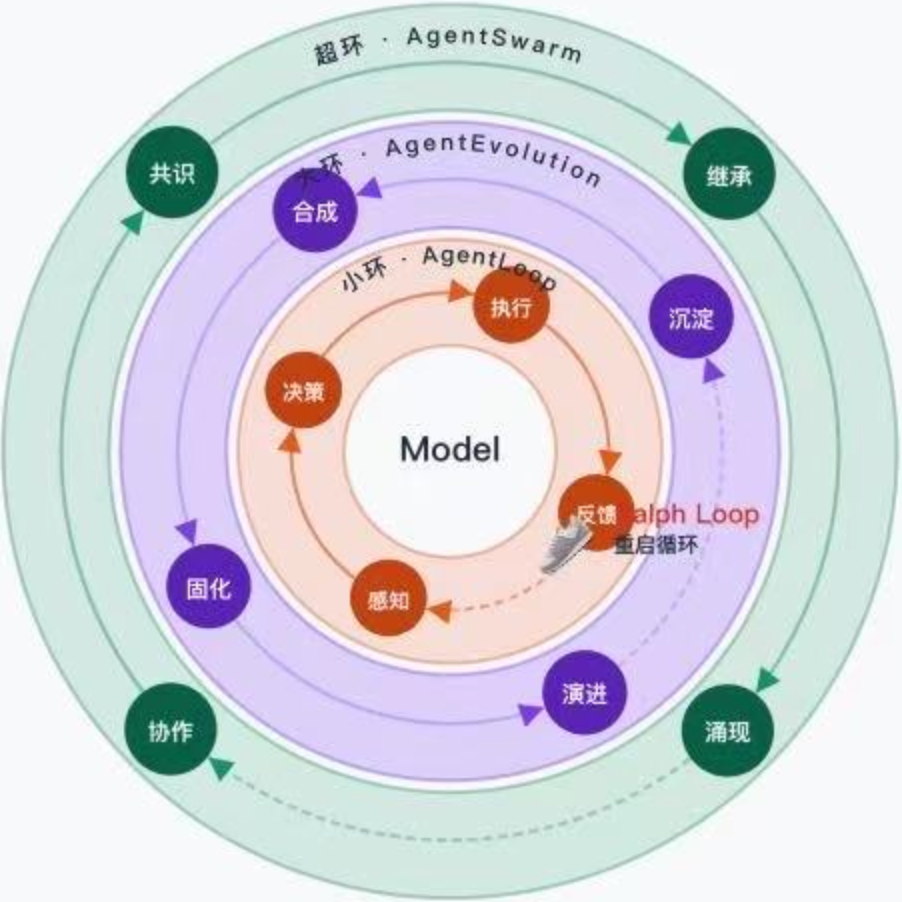
AI has already entered code writing, algorithm optimization, and model development. But after a task is completed, what remains may be reusable capability—or merely an answer and scattered logs. The difference becomes apparent only when a similar problem comes up again: can the system reuse what it learned, or must it pay the cost of exploration all over again?
Recursive Self-Improvement (RSI) co…
 techo5• Pinned