GPT-6 Astra Challenges the Case for Standalone Embodied-AI Brains
钛媒体 reports that OpenAI’s GPT-6 Astra was used without robot-specific training to control a robotic arm drawing the Golden Gate Bridge, while Unitree Technology and SenseTime reportedly tested related robotic capabilities. The article argues that general-purpose models can now handle tasks traditionally addressed by specialized VLA and WAM systems, putting pressure on startups whose valuations depend on an independent embodied-AI brain layer. It also notes limits such as cloud-inference latency and poor success rates for high-dynamic manipulation requiring force and tactile feedback.
If Astra’s reported capabilities hold up, embodied-AI companies may need differentiated robot hardware, proprietary deployment data, or vertical workflows rather than relying on a general-purpose model alone as their main technical moat.
(本文作者为 巨潮WAVE,钛媒体经授权发布)
文 | 巨潮WAVE,作者 | Maxx,编辑 | Rango
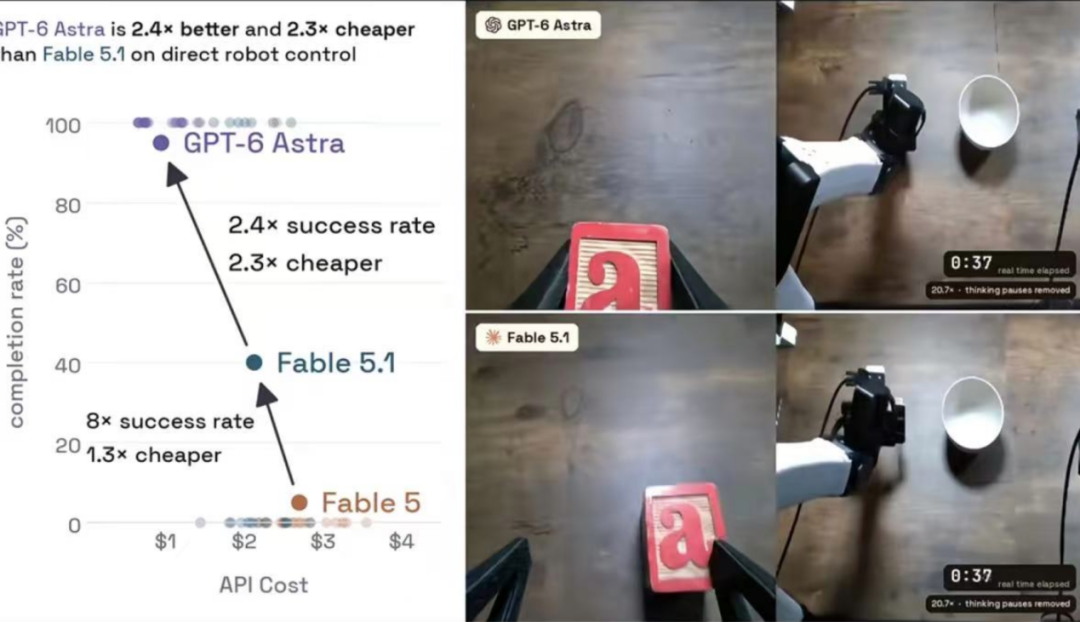
GPT-6 Astra的横空出世,让困扰了具身智能行业很久的“大脑”问题,以一种出乎意料的方式被撕开了一道口子,也带来了阵阵冲击。
在Astra的实测视频里,这个并非为机器人专门训练的通用大模型操纵着一只几百美元的机械臂夹着一支画笔,在白纸上画金门大桥。第一遍的时候线条还歪歪扭扭,但到了第四遍,金门大桥的轮廓和细节已经清晰可见。
当OpenAI机器人团队员工Thijs Simonian在X上发布了这段实测视频后,中美之间关于通用大模型是否能作为具身智能大脑的讨论就没有停止过,甚至有人断言“机器人领域的OpenAI将会是OpenAI自己,而不是Physical Intelligence或Skild。”
#OpenAI#GPT-6 Astra#Unitree Technology#SenseTime#Zhiyuan Robotics#Qianxun Intelligence#Galaxy General#Deep Robotics#Mech-Mind#Alibaba#Qwen-Robot#Force Robotics