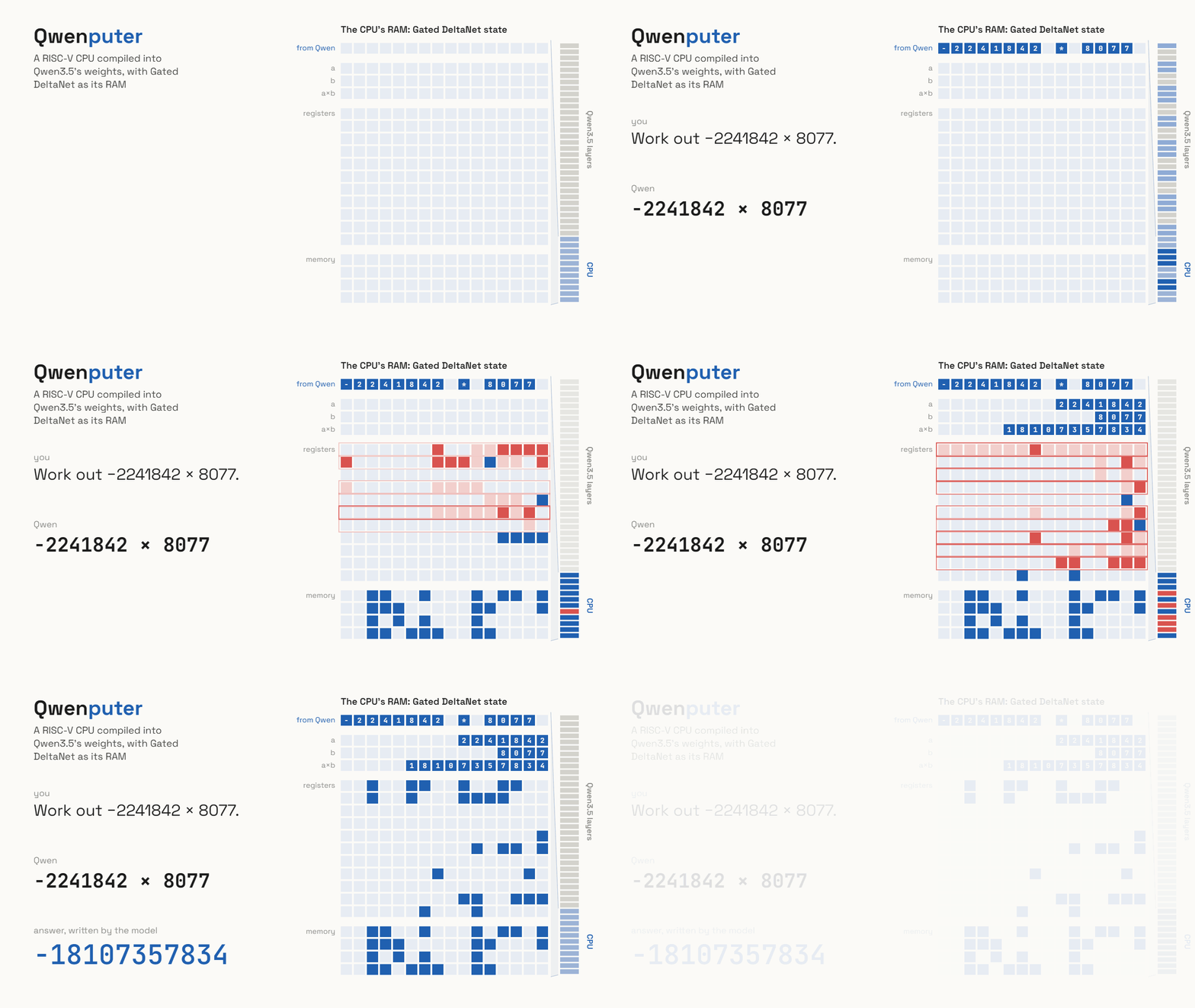
开发者在Qwen3.5-4B中加入模型内RISC-V处理器
开发者Divyansh Agrawal称,Qwenputer将确定性的RV32IM处理器编译进Qwen3.5-4B,利用Gated DeltaNet状态作为内存,在模型前向传播中执行算术运算以及C和MicroPython代码。开发者测试显示,Qwenputer的大整数乘法准确率为97.5%,基础模型为55%。IT之家报道称,该模型约为18.8GB,部分操作可能耗时数秒。模型权重和代码已在Hugging Face、ModelScope及GitHub提供。
I can't believe it's not silicon
Qwenputer is a pretty fun experimental model. It's a stock Qwen 3.5 4B with one addition: a RISC-V CPU embedded within the weights that uses the model's own Gated DeltaNet attention layers as RAM. (To learn how GDN works, here's a handy guide.) This 'CPU' runs completely within the forward passes of the model, and can run arithmetic operations, C and MicroPython code without any external runtime or tool usage whatsoever.
To be very clear, it is not a plugin, a tool or a sandbox. This blog will explain exactly how this model works, and how the model utilises GDN layers as RAM, and how I also slotted in an experimental in-model file storage.
I also wrote up two follow-ups built on top of Qwenputer: how hybrid models can learn to hide their reasoning in their RNN state and evade CoT monitoring, and how compiled weights like these can work as inbuilt monitoring tools that the model itself can't tamper with.