Scale-across networking targets multi-data-center AI clusters
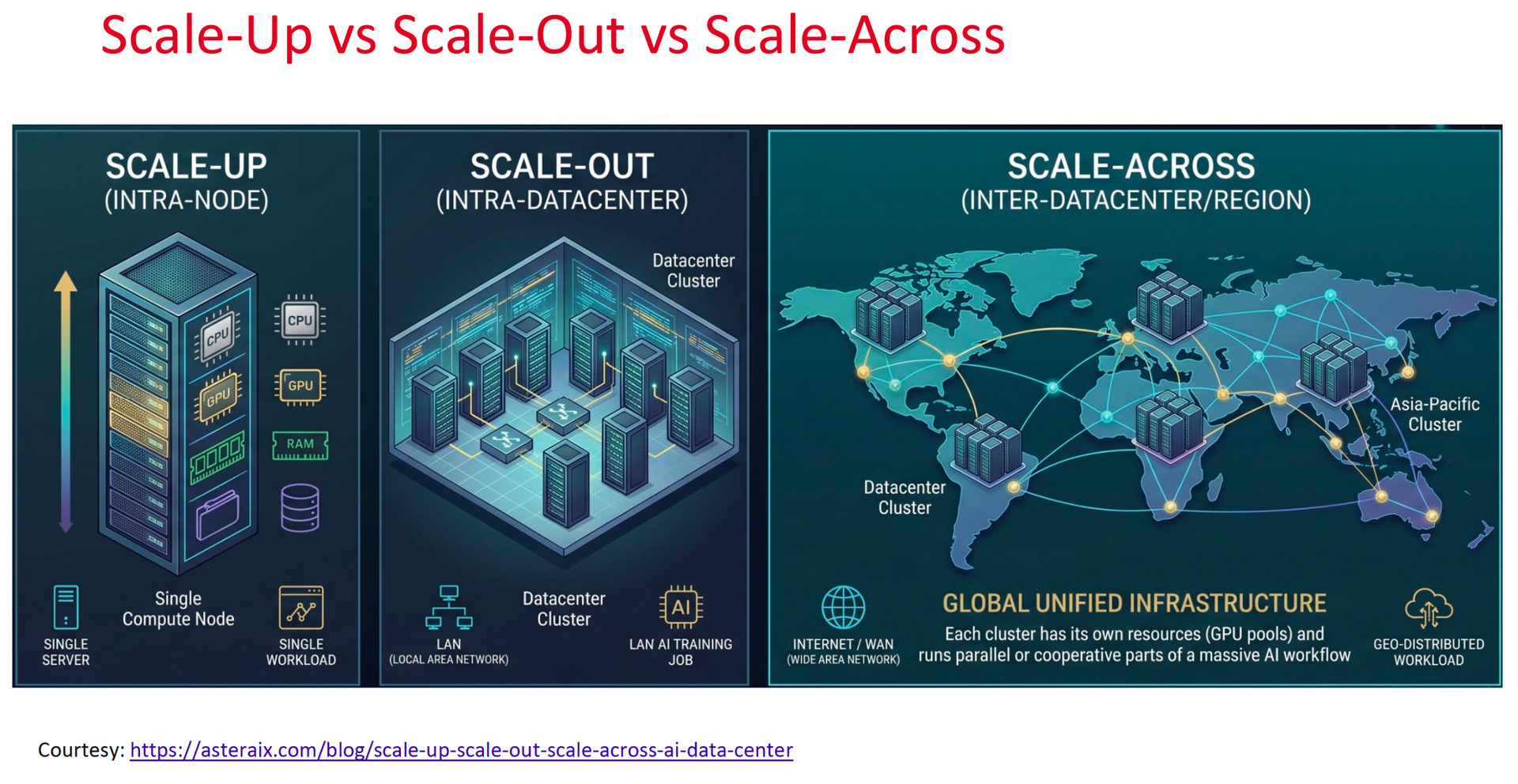
Researchers from The Ohio State University told SC26 attendees that AI clusters with more than 100,000 accelerators require networking that extends beyond individual data centers. Tom’s Hardware reported that power, cooling, and space constraints are driving interest in scale-across architectures, alongside developments from Google, Cisco, and Marvell. Long-distance latency, congestion, packet loss, synchronization, and software overhead remain significant challenges.
Modern AI clusters may outgrow the power and physical capacity of a single facility, making communication across data centers and regions increasingly relevant to large-scale AI infrastructure.
The rapid growth of AI clusters is pushing computing infrastructure beyond the physical and power limitations of individual data centers, which creates demand for new networking architectures capable of connecting compute resources across multiple facilities and even geographical regions. At Supercomputing 2026 (SC26), researchers from The Ohio State University discussed the evolution of high-performance networking technologies. At the conference, they explained how efficient distributed computing at such a scale requires considerably more than faster network connections, highlighting the importance of scale across domains to stretch workloads across different data centers in separate geographical regions.
Massive systems call for new interconnects
Modern AI clusters typically accommodate more than 100,000 AI accelerators and potentially millions of CPU endpoints, placing tremendous demands on network bandwidth, latency, and congestion management. Meanwhile, an accelerator's computational performance continues to increase faster than communication capabilities, which means that faster AI GPUs do not necessarily deliver proportional improvements in application performance. As a result, the efficiency of network infrastructure determines how effectively large-scale AI systems can use their computational resources.
#The Ohio State University#AMD Infinity Fabric#Intel UPI#Nvidia NVLink#UALink#HPE Slingshot#Ultra Ethernet#Google Virgo#Cisco#Marvell#NVIDIA SHARP#UCX