Open-Source npu-driver Renders Windows 11 Desktop on an Intel NPU
labscommunity has released npu-driver, an Apache 2.0-licensed research prototype that redirects Windows 11 desktop composition from the GPU to an Intel NPU without requiring application-specific changes. Tested on Intel Panther Lake systems, it can render the desktop and windows such as Notepad and Edge, but reports put actual refresh rates at roughly 2–3 FPS, with some readings as low as 0.6 FPS. The driver can fall back to GPU rendering on request or when a fault occurs, and developers describe it as a research prototype rather than a consumer product.
The project demonstrates that an AI-focused NPU can perform a traditional desktop-composition workload. However, its reported refresh rates remain far below the project’s 30 Hz target, and it requires specific Intel Panther Lake hardware and development tools, making it a technical proof of concept rather than a practical replacement for GPUs.
A developer group by the name of labscommunity has released a prototype driver for Windows 11 that renders the desktop using an NPU instead of the system’s (i)GPU. The new driver is called npu-driver, and the open-source (Apache 2.0) code is available on GitHub. It has been tested on Intel Panther Lake systems, and while it isn’t hitting its 30 Hz performance target yet, it is clever enough to fall back to GPU on request or on any fault.
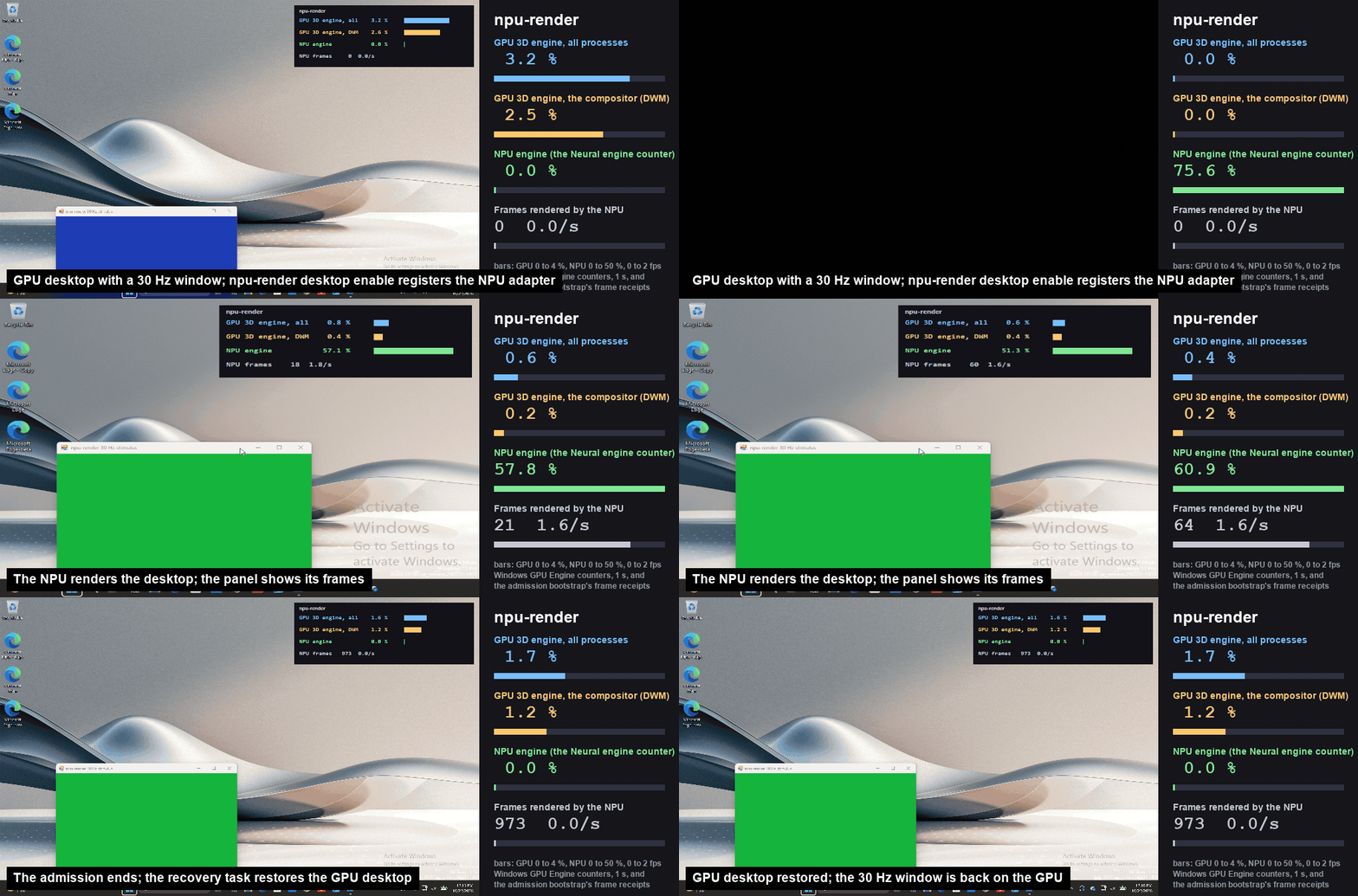
The reasoning behind the development of this driver may strike a chord with those observing the 2020s processor landscape. “Every new laptop ships an NPU that sits idle while the GPU composes the desktop, runs the browser and, increasingly, runs local models,” notes the npu-driver readme file. “The question this project asks is narrow and testable: can the NPU take over desktop composition, end-to-end, without the applications or the compositor knowing?”
#labscommunity#npu-driver#Windows 11#Intel Panther Lake#Intel NPU#OpenVINO#Microsoft Edge