ComfyUI adds NVIDIA RTX VFX nodes for upscaling, frame generation and SDR-to-HDR
Comfy's blog announced that Nvidia's RTX video effects now run inside ComfyUI as custom nodes, with the models shipping alongside the nodes and running locally on an Nvidia RTX GPU. The RTX Video Super Resolution node upscales images and video frames up to 4× or to target dimensions up to 8192 px, and can also denoise or deblur without changing resolution; RTX Video Frame Generation inserts new frames between adjacent pairs at 2× to 16× or at a specific timestep; RTX Video HDR converts SDR to BT.2020 HDR with HLG or PQ output, adjustable peak luminance from 400 to 2000 nits and debanding on by default. The post recommends chaining Super Resolution, then Frame Generation, then HDR, and the node pack includes starter workflows. The same release improves EXR handling: Save Image (Advanced) writes half-float 16-bit (now the default) and full-float 32-bit EXRs, Load Image preserves superwhites and negative values, color management adds sRGB, scene-linear Rec.709, HLG, PQ, ARRI LogC3 and ACEScct, and EXR outputs get JPEG previews for inspection and download. The speed and quality descriptions come from Comfy's announcement.
The release folds Nvidia's RTX video super resolution, frame generation and HDR conversion into ComfyUI's node graph, alongside EXR and color-management updates aimed at local VFX pipelines.
Nvidia’s RTX video effects now run inside ComfyUI as custom nodes. The models are fast, lightweight, ship with the nodes, and run locally on your Nvidia RTX GPU.
Nodes & Models Highlight
- The RTX Video Super Resolution node upscales images and video frames up to 4×, either by a multiplier or to target dimensions up to 8192 px. The same node can also denoise or deblur a source without changing its resolution.
- The RTX Video Frame Generation node creates new frames between adjacent pairs, for frame-rate conversion or slow motion. It works at 2× to 16× or at a specific timestep.
- The RTX Video HDR node converts SDR images to BT.2020 HDR data, with HLG or PQ output. Contrast, saturation, middle gray, and peak luminance from 400 to 2000 nits are all adjustable, and a debanding pass is on by default.
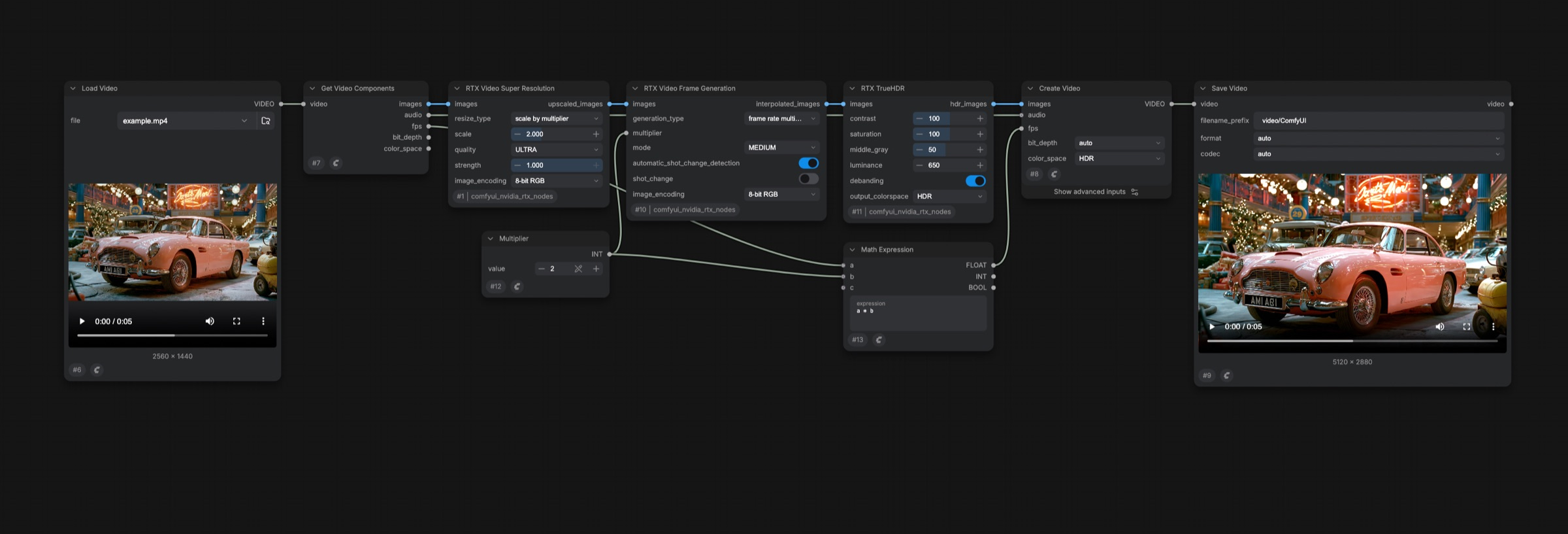
#NVIDIA#ComfyUI#RTX Video Super Resolution#RTX Video Frame Generation#RTX Video HDR#Comfy Cloud#Comfy Desktop