vLLM用编码智能体优化Kimi K3推理
vLLM团队称,使用智能体辅助开发为Kimi K3构建了统一的CuTe DSL解码路径,在NVIDIA GB300的8或16 GPU配置下覆盖注意力、MoE和通信优化。团队报告在16张GPU上使用DSpark时,批量大小1的速度超过840 tokens/s,多种测试配置的解码吞吐提升1.5至2倍,AgentX工作负载的P90交互性能最高提升1.8倍。SemiAnalysis另在GB300 NVL72上报告423 tok/s/user和1.68倍加速,但不同数字对应不同配置与测量方法。
这项工作展示了编码智能体参与复杂GPU内核开发的方式,同时vLLM提出的快速审查流程回应了自动化代码生成速度超过人工验证速度的问题。
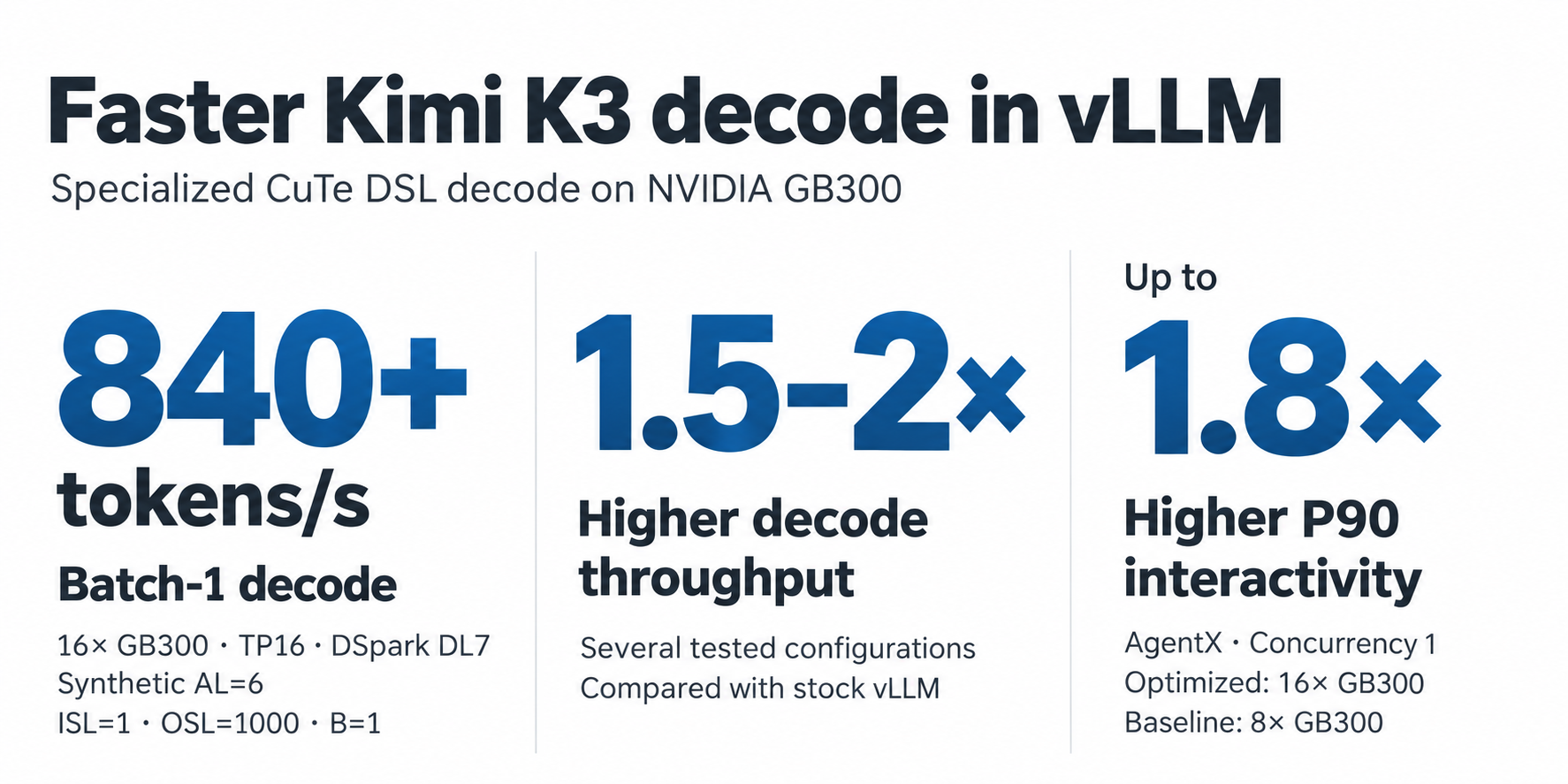
Coding agents can now help with some of the hardest parts of model optimization: writing complex GPU kernels, performing cross-operator fusions, overlapping computation with communication, and tuning execution across different batch sizes and GPU configurations. For Kimi K3, we used agent-assisted development to build a unified CuTe DSL decode path on the NVIDIA GB300, covering attention, MoE, and communication across 8 or 16 GPUs. The optimizations deliver over 840 tokens/s at batch 1 on 16 NVIDIA GB300 GPUs with DSpark (synthetic AL=6), 1.5–2× higher decode throughput in several tested configurations, and up to 1.8× higher P90 interactivity on the AgentX workload.
Agent-optimized inference code is outpacing our review and maintenance workflow. The manual review process of understanding every line of every kernel, mapping out potential issues, and testing every supported configuration, is very time-consuming work. On the other hand, if we omit this work then we risk shipping buggy software that could fail in production.