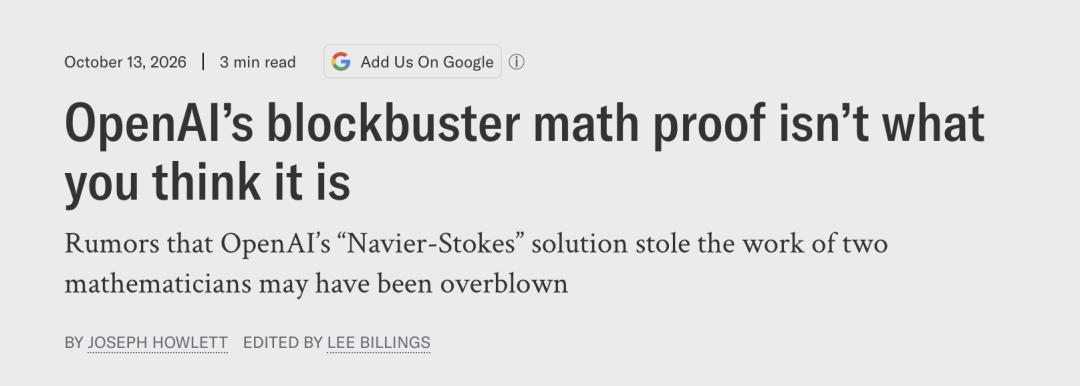
Mathematicians say OpenAI's Navier-Stokes proof took a different route than claimed
On September 8, 2026, OpenAI said its internal AI system produced a 166-page Navier-Stokes proof in about 88 hours using roughly 10,000 agents, published a Lean formalization, and attributed the approach to Spanish mathematicians Diego Córdoba and Luis Martínez-Zoroa. Several expert groups told Scientific American that the details instead show a different method, with EPFL mathematician Gonzalo Cao-Labora saying the similarities are only surface-level. OpenAI researcher Noam Brown estimates the multi-agent setup contributed under 10% of the success; NYU mathematician Tristan Buckmaster has accused OpenAI of building on work he did with Anthropic's Levent Alpöge, which OpenAI denies, and the Clay Mathematics Institute has been reviewing the proof.
The dispute exposes a verification gap: Lean can check whether each step follows, but it cannot explain why the method works, settle attribution, or measure what the large agent swarm actually contributed.
亏贼!OpenAI的纳维-斯托克斯方程连续剧,居然又又又反转了。。。
一个多月前,OpenAI刚宣布攻克这道悬赏100万美元的千禧年难题,就被数学家质疑研究成果的原创性。
当时,包括OpenAI自己在内,各方都认为,这份长达166页的证明沿用了两名西班牙数学家提出的研究路线。
然而现在,随着数学家们逐渐啃懂那份长达166页的证明,事情出现了意想不到的变化:
OpenAI最终采用的证明方法,根本不是此前大家以为的那条「西班牙路线」。
#OpenAI#Lean#Clay Mathematics Institute#Diego Córdoba#Luis Martínez-Zoroa#Tristan Buckmaster#Levent Alpöge#Noam Brown#Gonzalo Cao-Labora#Camillo De Lellis