Hobbyist uses GPT-6 Astra to prove 57-year-old circle-packing cases
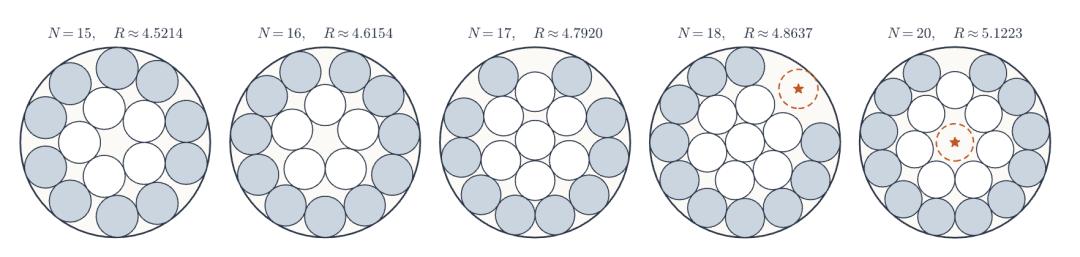
Math enthusiast nor used GPT-6 Astra to rigorously prove optimality for five remaining cases of the classic unit-disc-in-a-circle packing problem: N=15, 16, 17, 18 and 20. Previously only N≤14 and N=19 had been rigorously settled, even though the optimal arrangements were proposed in 1969 and their optimality went unproven for 57 years. According to the author's blog post, GPT-6 Astra reduced infinitely many packings to finitely many via geometric constraints, ruled them out by computer enumeration, and used rigidity arguments to upgrade 'very close' to exact; nor says he steered the model, verified the work by hand and rechecked everything with Claude Opus 5.5. The result currently appears only on a personal blog and on X, and has not been peer reviewed.
It is another example of an amateur researcher using a frontier model to push a long-open math problem forward, though the result still awaits peer review.
AI现在真是开启数学证明扫荡模式了。
刚刚,又有数学爱好者用GPT-6 Astra把一个57年数学难题推进了一大步。

问题听上去倒是不复杂:
给你N个半径为1的圆盘,怎么把它们塞进一个大圆里,才能让大圆的半径尽可能小?