Terence Tao's 'Math 2.0': AI pushes mathematics into proof abundance
In an October 9 talk at Caltech's Beckman Auditorium, Fields medalist Terence Tao retitled his lecture from "Machine-Assisted Proofs" to "Math 2.0," arguing that frontier AI has moved mathematics from an era of proof scarcity into one of proof abundance. The report relays claims that OpenAI coordinated roughly 10,000 AI agents to produce a Lean-verified finite-time singularity proof for the Navier-Stokes equations in 88 hours and published 700-plus AI-generated math manuscripts covering 372 results on GitHub, that Anthropic said Claude raised the lower bound for nontrivial zeros of the Riemann zeta function from 41.6% to 67.2%, and that Google DeepMind's AlphaProof has reached IMO gold-medal level. Tao warned via a thought experiment about an AI-designed "perfect cancer drug" that correct but incomprehensible output is a dangerous misalignment, and proposed Math 2.0: human-AI collaboration that feeds back into human understanding, such as tackling "open explanation problems," merging papers into an evolving knowledge network and building large formalized math knowledge bases.
If proofs become cheap yet incomprehensible, mathematics and science shift from human understanding toward black boxes; Tao's framing offers an understanding-centered direction for AI-assisted research.
今年10月9日,加州理工学院,贝克曼礼堂,是一场迟到了一年的演讲。
站在台上的,是菲尔兹奖得主陶哲轩。
最初的题目叫《机器辅助证明》。但在AI狂飙突进的这几个月里,世界已经天翻地覆。
于是,他改写了整个演讲,将最新的题目定为——《数学2.0》(Math 2.0)。
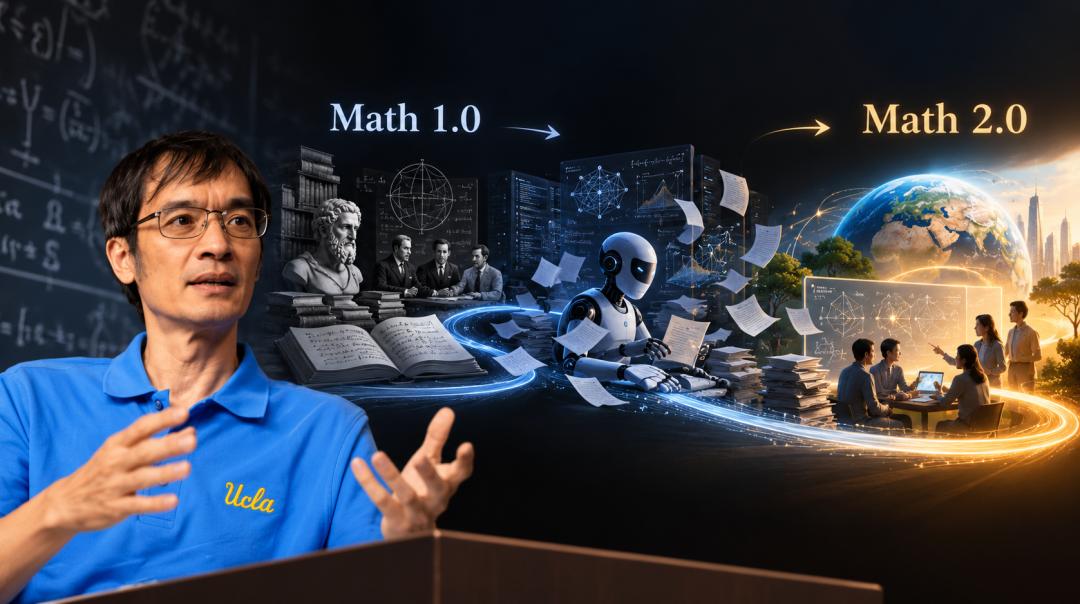
前沿AI,已经把数学界从「证明稀缺」的旧时代,一脚踹进了「证明过剩」的新纪元。但如果我们沉迷于让AI疯狂刷题,人类最终将被自己造出的神明反噬。
#Terence Tao#OpenAI#Anthropic#Claude#Google DeepMind#AlphaProof#Lean#Scott Aaronson#Caltech