Fine-Tuned Inception v3 Outperforms Two LLMs in Dermatological Test
In a test designed by Dr Magnus Lynch, a fine-tuned Inception v3 correctly diagnosed 125 of 200 biopsy-proven skin lesions, compared with 84 for GPT-6 Astra and 85 for Claude Fable 5.1. The CNN selected melanoma as its first diagnosis for 13 of 30 melanomas, versus 8 and 11 for the two LLMs. All 200 lesions were biopsied, making the cases unusually difficult. Lynch cautioned that the sample was small, each LLM case was run only once, possible dataset contamination could not be ruled out for the LLMs, and Inception v3 was deliberately a non-state-of-the-art baseline.
On this dermatology evaluation, a task-specific image model outperformed the two general-purpose multimodal LLMs. However, the small sample, single-run design, possible contamination and author-designed test do not support a definitive ranking of the models.
This is a melanoma.
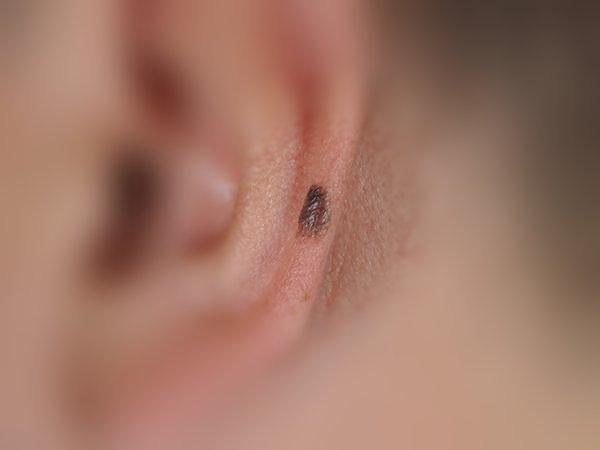
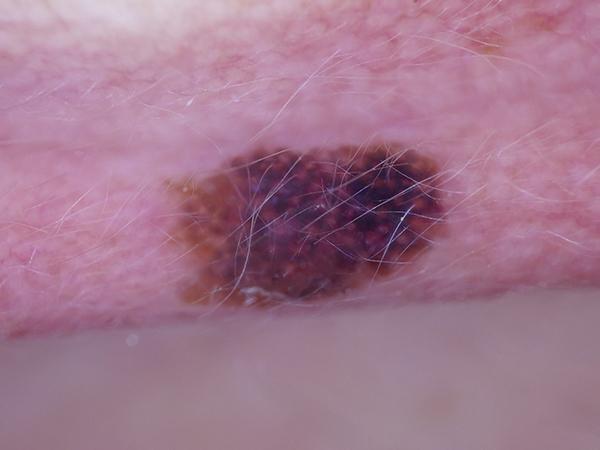
Figure 1. Invasive melanoma on the ear, under 0.8 mm thick. Both LLMs called it a seborrhoeic keratosis and said it could be discharged. The CNN called it a melanoma. Clinical photograph on the left, dermoscopic image on the right. Images: MILK10k, MILK study team, CC BY-NC.
I showed these two images - a clinical photograph and a dermoscopic (skin microscope) image - to GPT-6 Astra and Claude Fable 5.1, two of the most capable AI models available in October 2026. Both said it was a seborrhoeic keratosis, a harmless warty growth, and that the patient could be discharged. I then showed them to fine-tuned version of Inception v3, a convolutional neural network (CNN) first published by Google in 2015 and fine-tuned here on public dermatology images. The CNN got the right answer based on the dermoscopy view.
#Inception v3#GPT-6 Astra#Claude Fable 5.1#MILK10k#ISIC Archive#International Skin Imaging Collaboration#Claude Code#Anthropic