According to 新智元, Claude Fable 5.2 ranked first in RoboColiseum’s new season with an overall score of 18.30, leading the fine-manipulation and cross-embodiment tracks. The updated benchmark adds 50 tasks across dexterous-hand operation, whole-body coordination, fine manipulation and embodiment transfer, while agents scored particularly poorly on dexterous-hand tasks. The report also says the platform added hidden and dynamic test sets, human review, separate agent and policy rankings, and execution-efficiency scoring.
A coding agent can fix a program, yet the next time it encounters an error, it may still follow the same process of debugging, editing, and testing. The task outcome may have changed, but the method that produced it may not have. When the bottleneck lies precisely in that method, who is responsible for improving the program responsible for improvement?
Gödel Machine (GM) [1] framed this as a proo…
The most direct way to give an Agent long-term memory is to write history into a database and retrieve a few relevant records when a new question arrives. This pipeline soon encounters two different requirements: a personal assistant needs to remember specific people, events, times, and preferences; a task Agent needs to learn from past actions what to do next. The former fears losing details to c…
Performance optimization usually starts with a clear goal: completing the same work faster. What really takes time is identifying bottlenecks, designing experiments, comparing candidates, and then determining whether the differences come from the code or from measurement noise. After handing this process to an Agent, there is another kind of cost: repeatedly organizing logs, waiting for long-runni…
Optimizing a GPU kernel or completing a set of formal proofs often requires repeated trial and error: try a different implementation, run an evaluation, and keep iterating in whichever direction proves effective. When giving a model more test-time compute, the most direct approach is to let more agents try simultaneously; if the task only needs one best result, the value of the other attempts lies…
Handing a problem to four Agents most easily produces four attempts. Increasing the number to eight may raise the success rate further. But if every Agent searches along similar lines, a significant portion of the additional computational power brought by a larger team will be spent on duplicate work. If we instead require them to communicate continuously, messages will consume context and reasoni…
What problem it solves
Research context is often fragmented across PDF libraries, note applications, and separate model conversations, forcing researchers to move or copy information manually between tools. PDFs can also be difficult for models to interpret reliably, while common AI reading, translation, synchronization, and batch-import workflows require multiple plugins or repetitive manual acti…
An Agent can complete a task once by relying on the context and reasoning available at that moment. To avoid relearning lessons on the next task, it needs to turn past experience into reusable knowledge. The challenge is that experience is never an isolated action: it also includes the original goal, environment, and why the action worked. Remembering only “how we did it last time” may save redund…
The common approach to RAG is to first collect documents into a vector database, then retrieve context from it in response to a query. This workflow is smooth, but it has an organizational prerequisite: data owners are willing to hand their materials to the same infrastructure. In cross-organizational collaboration, this is often the hardest step to coordinate. Hospitals, research institutions, an…
When asking AI to solve a problem, we usually prepare the question, rules, and evaluation criteria for it in advance. Scientific research often starts from an earlier point: how should a phenomenon be described, which premise in an existing theory deserves scrutiny, and what kind of new explanation could connect several things that were previously separate. After reasoning capabilities continue to…
The difficulty in getting an agent to complete a long task often lies midway through. It may have already written the code but missed the actual delivery steps; it may also have simply encountered an ordinary error and be looking for an alternative on its own. At this point, we want it to correct its course promptly, but we also don't want to interrupt it every time something happens.
Meta² studi…
When an intelligent agent handles enterprise tasks, it often spends considerable effort on preparatory work: finding APIs, browsing directories, parsing spreadsheets, and determining which script generated a particular table. Change the question, and all that preparation gets repeated. Models can certainly keep getting stronger, but if many tasks take place in the same workspace, we can ask anothe…
After an Agent completes a task, what it leaves behind is often more than an answer. There is also an expensive exploration path: which files it read, which tools it tried, where it failed, and what checks it used to confirm the result. The problem is that the next execution may not be able to use those experiences. The model parameters have not changed, and a new session will not naturally inheri…
AI has already entered code writing, algorithm optimization, and model development. But after a task is completed, what remains may be reusable capability—or merely an answer and scattered logs. The difference becomes apparent only when a similar problem comes up again: can the system reuse what it learned, or must it pay the cost of exploration all over again?
Recursive Self-Improvement (RSI) co…
The Research system Anthropic unveiled in June 2025[1] organizes a research problem into a process of analysis, parallel search, and synthesis of results. Beyond model capabilities, how work is allocated and how results from different directions are connected have also become design questions that AI engineering needs to answer separately.
Along this line, I want to ask a deeper question: if even …
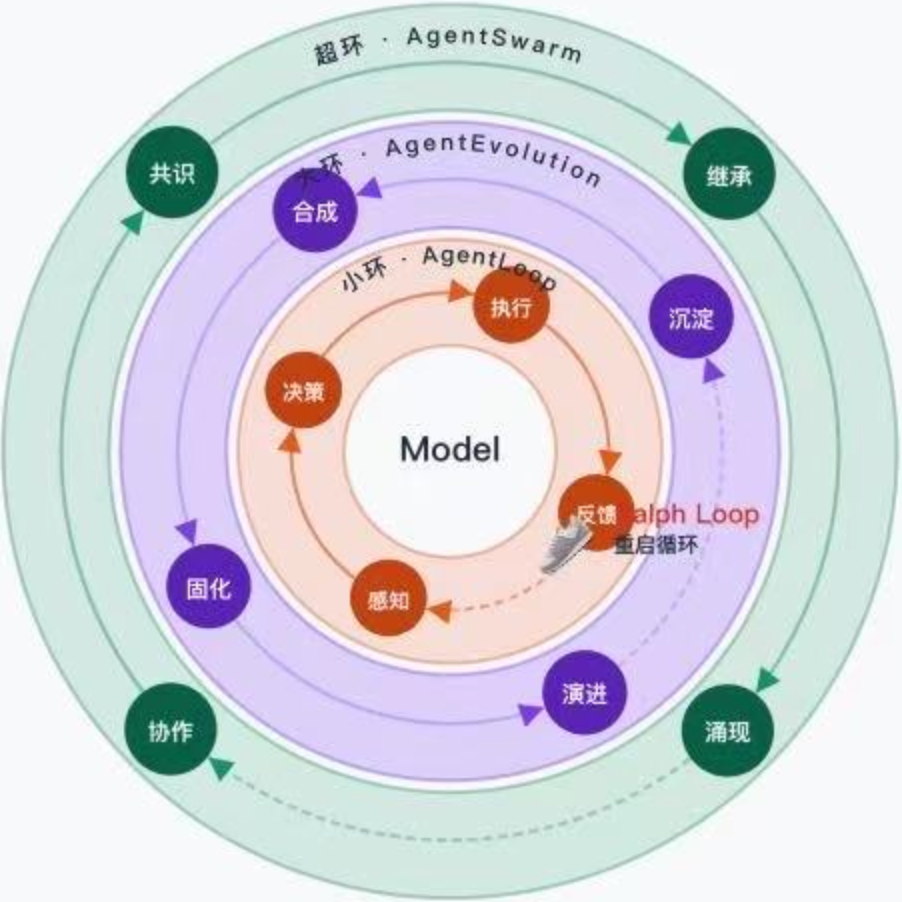 Recursive Evolution•Florian•Opinion